Nine Words: How Politico Ended Frank Rose's Career

Second of six parts.
Part 1 Guilty Until Proven Gone: He Ran America's Nuclear Arsenal
This is Part 2
On April 5, 2024, Politico published an article headlined "Sexual harassment allegations made against top Biden nuclear official"
"The No. 2 at the Department of Energy's nuclear security agency is leaving his post amid complaints about his behavior."
The story begins:
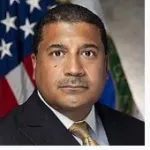 Frank Rose
"When the Department of Energy announced last week that the No. 2 official of its nuclear security agency, Frank Rose, was leaving, his boss issued an internal memo calling him an 'empathetic, candid, and action-oriented leader who always thought of the whole team.'
"Left unsaid were the complaints about Rose's behavior that had led to an internal investigation into allegations of sexual harassment and a hostile work environment, according to eight current and former government officials familiar with the matter, all of whom were granted anonymity to discuss personnel matters."
The takeaway is meant to be obvious: Frank Rose didn't retire with the dignity, grace and praise his boss said he deserved.
He was pushed out over how he treated women.
The story, Politico acknowledges, is based on "eight current and former government officials … all of whom were granted anonymity to discuss personnel matters."
Only one accusation, however, amounted to what the headline promised: sexual harassment.
That accusation came from a woman, identified through a defamation lawsuit later filed by Rose, as Kathryn "Kate" Hewitt.
She had worked under Rose at the Brookings Institution before he became the number 2 official at the NNSA. She also worked at the NNSA when Rose was there.
WHAT'S IN THE POLITICO STORY
Aside from the sole headline-supporting sexual harassment allegation, the Politico story consists of three other things Rose allegedly did.
"According to three current and former NNSA officials, Rose made some women in the office feel uncomfortable."
What and when did he do to which women that made them uncomfortable?
Politico does not say.
Second: "At least one employee warned female colleagues 'to be cautious' about potential harassment when working with Rose's office."
Warned them about what?
Based on what?
Cautious of whom?
Note the tense. Potential harassment. Not harassment that occurred. Not harassment anyone saw.
The sentence says Rose's office — not Rose.
The reader is told a caution existed, with no explanation of why.
The article never explains the conduct that produced the feeling and prompted the warning.
THE JOKE
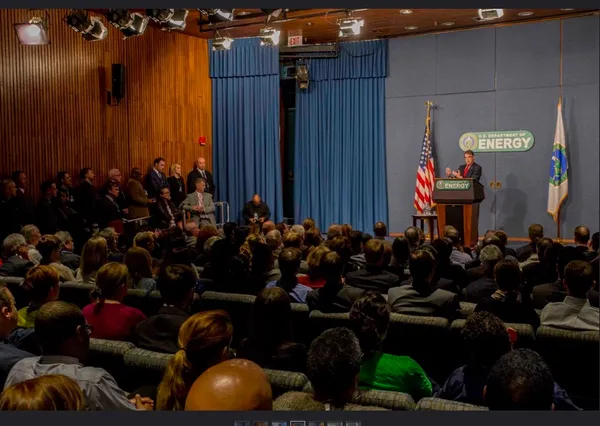 DOE auditorium.
Politico reported: "One incident involving Rose was recounted by three of the current or former NNSA employees. At an agencywide meeting in December with hundreds of NNSA employees in a DOE auditorium or watching virtually, Rose recounted how a female foreign government counterpart had complimented NNSA's work to him. He responded by telling her: 'I love you, will you marry me?' Some employees laughed at the remark, but it did not go over well with others who thought it was inappropriate."
Rose told a story at a large staff meeting about a foreign counterpart who had praised the agency's work.
Who was the woman?
A foreign government official.
Was she present?
No. She was not at the meeting. She is a character in an anecdote Rose is telling about a past conversation.
Did she complain?
Not said. Not to her own government, not through diplomatic channels, not to the State Department, not to anyone the article identifies.
Who was uncomfortable, then?
Employees who heard him tell the story.
How many?
The article says some laughed and others thought it inappropriate.
Where did it happen?
In a DOE auditorium, at an NNSA agencywide meeting, with a virtual feed running. Not a closed door. Not a private conversation.
It is not an act directed at anyone present. It is a report of a remark, recounted by three anonymous people who may or may not have been in the room, about a woman who was not there and who is not said to have objected.
Maybe it was a lousy joke.
EIGHT SOURCES, OR THREE?
Politico said it had eight sources. That's a lot of people who had something bad to say about Rose, the number 2 guy at an agency with 60,000 employees and contractors that he had supervised.
The foremost anonymous source was Hewitt, the sole source for sexual harassment.
Then there are "three current and former colleagues of hers, all of whom were part of the eight (anonymous sources) interviewed."
Subtracting Hewitt and her colleagues leaves four anonymous sources.
Two are covered here:
"The investigation into Rose, the principal deputy administrator of the National Nuclear Security Administration, was launched earlier this year by DOE's Office of Hearings and Appeals, according to two of the officials, one a current and the other a former NNSA employee."
And two said somebody complained to the Inspector General.
"Complaints from women about Rose's behavior have also been sent to the Department of Energy's inspector general, according to two of the eight current and former government officials."
THE ARITHMETIC
Two of the eight said that complaints went to the IG. Two said that OHA launched an investigation.
Three said that Rose made some women uncomfortable
One said she gave a warning to colleagues
Three recounted a joke.
The three who described the joke may be the same three who said women felt uncomfortable. The two sources who knew about the OHA may be the same two who said somebody complained to the Inspector General.
One may be the employee who gave the warning.
Politico gives the reader no way to know.
WHAT POLITICO NEVER SAYS
It never says "two other officials." Never "a third official." Never "separately."
Politico's eight sources do not describe eight accounts. They describe one set of claims, attributed in overlapping groups of three, two, and one, with no language distinguishing the groups.
When a reporter has genuinely distinct sources, that's how it's signaled, because source count is the whole currency of an anonymous story.
"Eight sources" suggests eight independent voices arriving separately at the same conclusion.
The article's method of describing sources permits a narrower reality: one accuser, three people connected to her, and substantial overlap among the remaining attributions.
WHAT DID HEWITT’S COLLEAGUES KNOW?
 Kate Hewitt
Politico calls them Hewitt's "current and former colleagues."
It does not say they worked at Brookings when the alleged harassment complaint was made. It does not say any of them witnessed Rose commit misconduct.
They corroborate that Hewitt told people her story. That is not the same as corroborating the story.
Was there a sexual harassment complaint?
WHAT POLITICO SAID HE DID TO HER
Politico reported that Rose had delayed the intergovernmental detail of an NNSA employee (Hewitt) whom it described as someone "who had lodged a sexual harassment complaint against him" when both worked at Brookings.
Read nine critical words.
Hewitt was someone "who had lodged a sexual harassment complaint against him."
THE VERB
The error lies in the verb. "Had lodged" is past perfect indicative. It states that the complaint was filed.
Not that someone said it was filed.
The complaint does not appear as a claim. It appears in a relative clause, as the identifying detail of the employee whose DOD detail Rose delayed — background the reader must accept simply to follow the sentence.
Logicians call this plurium interrogationum, the fallacy of many questions. The familiar example is "When did you stop beating your wife?" The beating is never alleged. It is assumed. The assumption rides in on a sentence that appears to be about something else.
The sexual harassment is based on a complaint that Politico never confirmed. It is also the only specific assertion in the article with no source attached.
Hewitt said she had complained about Rose at Brookings.
Politico had not independently established that she had lodged or filed the complaint its sentence described.
WHAT BROOKINGS SAID
Politico wrote:
"A Brookings spokesperson said that it doesn't comment on personnel matters but added in a statement: 'Brookings takes allegations of misconduct very seriously. Harassment, including sexual harassment, is clearly prohibited by Brookings' policies.'"
Its spokesperson said the institution does not comment on personnel matters. The spokesperson also said that harassment violates Brookings policy.
Every institution opposes harassment when a reporter calls.
It proves nothing about Frank Rose.
THE PROMOTION
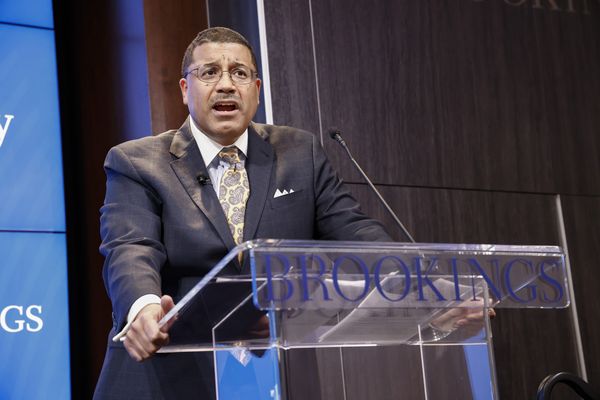 Frank Rose
After Hewitt left Brookings in April 2019, Brookings promoted Rose to Co-Director of the Center for Security, Strategy, and Technology.
Later, when he went to NNSA, Brookings invited him back for presentations and discussed his potential return after his tenure at NNSA.
Politico didn't report the promotion or the invitations.
WHAT ROSE SAID
Mark Zaid, a lawyer for Rose, said in a statement that Rose "denies he ever acted in a way that intentionally sought to make colleagues feel uncomfortable or harassed in any way and does not believe his actions would objectively be construed in such a manner."
Politico also reported that Zaid said Rose was never made aware of complaints filed against him at Brookings.
Conversely, Rose does not dispute delaying Hewitt’s intragovernmental detail extension.
In his lawsuit filed against the Department of Energy, he says her department, Public Affairs, was operating with five people when it needed ten. NNSA was paying Hewitt. She was working on a detail assignment at the Department of Defense.
That assignment was expiring. She was expected to return to the NNSA. She wanted to stay at the DOD, while being paid by the NNSA.
Politico did not fabricate the dispute over her detail.
Its mistake was reporting Hewitt's explanation for Rose's motive. In doing so, Politico presented the necessary premise of that explanation — the prior complaint — as established fact.
FOUR WORDS
The accurate version was simple.
"She says she filed."
Four words would have preserved the essential distinction between allegation and established fact.
They would have told the reader precisely what Politico knew: Hewitt said she filed a complaint.
It also would have disclosed what Politico did not know: whether such a complaint could be independently confirmed.
Politico chose the stronger, less honest sentence.
The sentence suggests Rose, at NNSA, punished Hewitt for a complaint she filed at Brookings years earlier.
If no such complaint was lodged, the factual premise disappears.
Rose could have denied the extension for the reason he stated in his lawsuit.
WHAT HER OWN LAWYER WROTE
 Attorney Kuntz
After Rose sued Hewitt for defamation, her own lawyer put the matter in writing.
In a Renewed Plea in Bar filed January 23, 2026, Hewitt's attorney, Mary E. Kuntz of Kalijarvi, Chuzi, Newman & Fitch, wrote that "Ms. Hewitt did not file a complaint of discrimination against Mr. Rose."
Under federal law, sexual harassment is a form of sex discrimination, as Kuntz's filing acknowledges.
WHAT PEOPLE REMEMBER
Politico (as much as Hewitt and the DOE) ended Rose's career. It did it with its headline: "Sexual harassment allegations made against top Biden nuclear official."
Since leaving NNSA, Rose says in his lawsuit that he applied for more than 20 positions in his field. Some rejected him. Most never answered.
Careers can end before the truth catches up.
"Sexual harassment allegations made against top Biden nuclear official."
That's what people remember.
Not the overlapping anonymous sources. Not the verb tense.
Not Brookings refusing to confirm.
Nine words.
"Who had lodged a sexual harassment complaint against him."
Politico wrote them as fact.
It had not established them as fact.
Next: Hewitt, the accuser — two years of requests for Rose's help, followed by messages that she made disappear.


