Nuke No. 2 Axed in 17 Days Over Complaint No One Can Find

Third of six parts.
Part 1: Guilty Until Proven Gone: He Ran America's Nuclear Arsenal
Part 2 Nine Words: How Politico Ended Frank Rose's Career
PART THREE: THE ACCUSER
Kathryn "Kate" Hewitt was Frank Rose's research assistant at Brookings. He wrote the references that got her into the National Nuclear Security Administration. For two years afterward, she asked him for help.
Then Rose became the presidentially nominated and Senate-confirmed No. 2 official at the NNSA.
For eight months they were in the same building. Then Hewitt left on a detail to the Department of Defense and never came back.
Rose oversaw an agency of some 60,000 employees and contractors. Hewitt was in the ten-person public affairs office. She liked the Pentagon. She wanted to stay.
She wanted another extension. Her NNSA public affairs department was understaffed. Rose insisted she return to her NNSA job, which paid her.
Then came the accusation that ended his career.
THE BROOKINGS PERIOD AND THE ALLEGED REPORT
 Kathryn Kate Hewitt
Now to the question of what, if anything, she actually reported at Brookings in 2018 or 2019, to whom, and whether Frank Rose ever knew of it.
She was there from 2018 to 2019.
Others worked beside her in an open bullpen.
People could see and hear one another. Rose, a senior fellow, had an office near the bullpen. Another senior fellow had the office next to Rose.
Whenever Hewitt met with Rose, according to Rose's filings, his office door stayed open.
No one working within sight of that office ever raised a concern about how he treated her. No bullpen colleague appears among the witnesses Hewitt's counsel intends to call.
But there were two well-documented incidents, neither of them sexual in nature.
THE CHAIN OF COMMAND
 Brookings Institution
The first was over a report. A supervisor would not put Hewitt's name on the cover because of Brookings policy. Research assistants do not get their names on the cover. They get an acknowledgment inside the report.
Hewitt thought this was unfair. She went over her supervisor's head. Reportedly, she got her name on the cover, credited as a research assistant.
A second incident followed. Hewitt wanted to attend a conference during work hours, and her supervisor told her she could go but had to take personal leave. She wanted to be paid to attend.
Again, she bypassed the person who had denied the request. This time, reportedly, her request was denied.
Rose spoke to her about leaping over the administrator to the vice president.
Follow the chain of command, he told her. These are the rules.
She responded that she "didn't need the administrative staff to tell her what to do."
THE RULES WERE NOT MADE FOR US

Her state of mind may be illuminated by something she said much later.
On July 24, 2024 — sixteen weeks after the Politico story that ended Frank Rose's career- Kate Hewitt sat on a panel called "The Broken Rung: Barriers Holding Women Back at Work."
She introduced herself as deputy director of nuclear forensics at the Department of Defense's Office of Nuclear Matters.
It was the Pentagon career she had wanted all along. By her lawyer's account, she accepted a permanent competitive-service position at DOD in December 2023 and resigned from NNSA to take it — four months before Rose was gone.
Asked how organizations could mitigate bias in hiring and promotion, she said the national security and intelligence system was not built by women or with women in mind. Then she said this, and the recording preserves it.
"As you think about mitigating bias, I think you have to be really blunt with the fact that this system, the National Security and the intelligence system, was not built by women with women in mind. So the rules that we have to operate by were not made for us and so I don't feel like we should be held to them to be totally frank with you."
Later, urging women to accept help from senior men, she came back to it.
"The system is not built for you, and you don't have to play by these rules."
WHAT SHE HAD ALREADY DONE
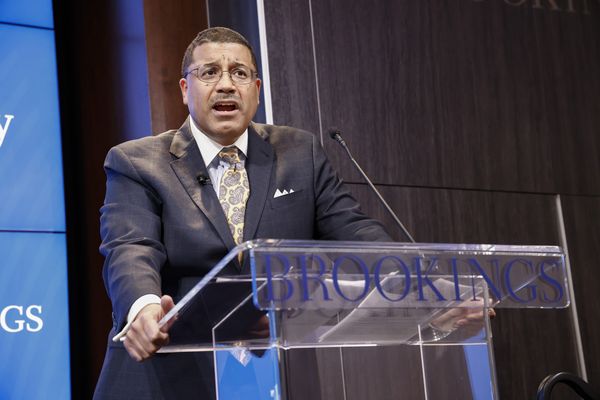 Frank Rose
But that came later, after her allegations had helped end Rose's career.
In the meantime, after the conduct she says occurred at Brookings and after the period in which she says she reported it, she continued to seek Rose's professional help.
When she left Brookings as a research assistant, Rose helped her get a job at double her Brookings pay.
She asked Rose for a reference to get into NNSA. He gave it. She got the job.
She also needed a reference for her security clearance. She asked Rose. He gave that too.
Her lawyer offers a different view of the same fact. Kuntz's filing says Hewitt resolved to leave Brookings because of Rose's conduct and sought the necessary recommendation from Rose in order to get out.
That explains one reference. It does not explain the security clearance reference that followed, or the two years of messages that came after.
Ultimately, Biden nominated Rose as Principal Deputy Administrator of the NNSA, and the Senate confirmed him. He was sworn in on August 2, 2021.
They were now in the same agency again — but not, as at Brookings, a few feet apart.
Hewitt had been at NNSA since April 2019, first as a contractor, then as a federal employee from March 2020 — a Public Affairs Specialist in one of eight offices under Rose. She did not report directly to him but to the head of her department. Her department head reported to Rose.
THE EXTENSION FIGHT
They had no direct contact. In April 2022, eight months after Rose arrived, Hewitt began a temporary assignment at the Department of Defense. She was not in the building again. NNSA kept paying her salary.
By the spring of 2023, she had been at the Pentagon a year on NNSA's payroll, and she wanted more time.
The NNSA Public Affairs office was understaffed, with five people doing work meant for ten. Rose denied the extension.
Hewitt was paid to work at NNSA, not the DOD. He wanted his Public Affairs department better staffed. If she did not want to come back, he would fill the position with someone willing to work in the department for which she was paid.
Kuntz disputes that account, and it is only fair to say how. Her filing claims Hewitt's own NNSA supervisor, Shayela Hassan, told Hewitt the office did not need her to return.
Note what that argument requires. It requires the head of a five-person office doing the work of ten to have told a departing employee the office did not need her.
And it requires Rose's insistence that a person on his payroll work in his department to be evidence of something other than what it appears to be.
Hewitt went around Rose. She asked senior DOD official Vipin Narang to speak to Rose on her behalf. He did.
 Vipin Narang went to bat for Kate Hewitt, much like Rose did earlier in her career.
Rose changed his decision. He gave her six more months, he said, as a courtesy to help her find a permanent job at DOD.
After that, there would be no more extensions.
Hewitt was not sure six months was enough to get a permanent DOD job. She did not want to return to NNSA. She wanted NNSA to keep paying her while she worked at DOD until she obtained a permanent Pentagon position.
NNSA paycheck.
Pentagon job.
She got the permanent DOD job in December 2023 and resigned. The extension fight was over. Rose was still in his office.
WHAT SHE TOLD THE AGENCY
Hewitt did more than go around Rose.
She alleged that his refusal to let her stay at DOD was retaliation by Rose.
Hewitt made a confidential and official HR complaint alleging retaliation.
Her lawyer's account of how that came about differs from the one implied here. Kuntz says that in February 2024 Hewitt's second-level supervisor at DOD, Casey Deering, contacted Hewitt to ask whether she had experienced harassment by Frank Rose — and that Hewitt then told her. Not the reverse. Somebody was already looking. Who set Deering in motion, and on what, is a question for the next part of this series.
Here was Hewitt’s allegation: Back when they were at Brookings, Rose had sexually harassed her. She made a complaint at Brookings.
Hewitt did not accuse Rose of sexually harassing her at NNSA. She accused him of retaliation.
What did she say he did at Brookings?
Hewitt alleged Rose had a habit of standing too close, reading over her shoulder on work he helped her edit. Sometimes he commented on her appearance and showed excessive interest in her personal life. At other times, he looked at her legs or chest.
On occasion, she said he touched her knee, leg, or shoulder.
She did not allege groping. She did not accuse him of assault. She did not say he demanded sexual favors for employment or advancement.
One further allegation entered this case much later, and it is dealt with below.
But she said she did make a harassment complaint against Rose at Brookings in 2019.
She alleged this was why he denied her a job-detail extension. She said it was to punish her for complaining about his earlier conduct at Brookings.
Neither DOE nor its subsidiary agency, the NNSA, told Rose that Hewitt had made a complaint against him. He would learn of the accusation from a damaging news story published in Politico.
At the DOE, they just told Rose to resign or get fired.
He chose to resign. When he chose to resign, he did not know Hewitt had accused him.
He only knew that the DOE Chief of Staff Christopher Davis had made up his mind.
He could go quietly or be fired publicly through a removal process that undoes what a Senate confirmation put in place.
THE MESSAGES THAT WENT AWAY
 LinkedIn via Shutterstock
After Politico published its rather one-sided, all-anonymous-sourced story, featuring Hewitt's accusations, without naming Hewitt, she deleted her LinkedIn account.
The LinkedIn account went, and with it, the message history.
Two years of exchanges in which she had asked Rose for advice, for references, for continued professional contact, even for virtual coffee - chronologically dated after she says the harassment occurred, and after the period in which she now says she reported it.
Rose had saved copies before the account came down. He put them in the court record.
His defamation lawsuit against Hewitt argues the deletion was an attempt to erase evidence that she had relied on him and had kept relying on him. And that the exchanges showed the opposite conduct of a woman who had complained against him.
In fact, they were messages of gratitude and thankfulness, with the onus almost always on what he could do for her and without a whisper of either past bad conduct or any resentment on his part.
The point is she initiated the contact. Rose obliged her willingly. Read alongside what she later said he had done to her at Brookings, the messages are difficult to reconcile with the account she gave the agency.
The deletion is worth considering on its own.
Had Rose not kept his own copies, that two-year message history might no longer have been available for examination.
THE COMPLAINT NOBODY CAN PRODUCE
 Attorney Kuntz
After Rose’s lawsuit, Hewitt's lawyer put something in writing.
Hewitt "did not file a formal complaint of discrimination" at Brookings.
It appears in a Renewed Plea in Bar filed January 23, 2026 by Hewitt's counsel, Mary E. Kuntz.
Kuntz does not stop at the concession. She says what Hewitt did instead: that Hewitt reported Rose informally to two Brookings managers — Leah Dreyfuss, associate director of the Center for Security, Strategy and Technology, and Bruce Jones, vice president and director of the Foreign Policy Program — in March 2019.
Both are on Hewitt's witness list.
So even taking her at her word, assume both conversations happened exactly as her lawyer describes them.
Neither one produced a document. Neither triggered a process. Neither was a complaint Rose was told about. Nothing in the record suggests Dreyfuss, Jones, or anyone else at Brookings ever told Rose.
Kuntz's own filing concedes the point about Jones: Hewitt, she writes, had no indication from him what action, if any, he took.
No one has produced a complaint. Not Hewitt. Not Brookings, which would not confirm one to Politico. Not by the Department of Energy, which acted on it.
That is not a minor clerical inconvenience for the retaliation theory. It goes to the logic of retaliation itself.
Rose was forced out of the NNSA over retaliation based on Hewitt's allegation that he was retaliating because she made a complaint against him at Brookings.
Retaliation requires knowing about the act you are supposedly punishing. You cannot retaliate against something you do not know happened.
Rose says he never knew of any complaint. Two and a half years on, nobody has produced one for him to have known about — and the two informal conversations Hewitt had with Brookings employees her lawyer describes would not have reached him.
THE QUESTION HER OWN LAWYER WOULD NOT ANSWER
The same filing does something else, and it is the most remarkable thing in this case.
One of Kuntz's defenses under Virginia's anti-SLAPP statute was that several of Hewitt's characterizations were matters of perception or opinion rather than objectively verifiable statements of fact. The distinction is not academic. A false statement of fact can be defamation. An opinion cannot.
Kuntz argued opinion.
Whether Rose stood uncomfortably close, she wrote, is personal to Hewitt and may not be shared by others. His comments on Hewitt's dress, her legs, her comparative attractiveness, his interest in her love life, are alarming to Hewitt — and, Kuntz wrote, others may not judge them so.
Then Kuntz asked the questions herself.
Were Rose's expressions of interest in Hewitt's love life sexual harassment, or courtesy? Was Rose really staring at Hewitt's legs, or her chest?
Her own lawyer poses it. Her own lawyer declines to answer it. The filing says the answer depends largely on Hewitt's point of view.
Rose denies all of it — the staring, the comparisons, the interest in her personal life.
Frank Rose was nominated by a president and confirmed by the Senate. He was removed in 17 days, without notice of the accusation, without an interview, without a hearing, without being told who had accused him or of what.
Two and a half years later, his accuser's counsel tells a Virginia court that the conduct at issue cannot be judged true or false by anybody, because it exists in the perception of the person describing it.
Both things cannot be right.
If the question is unanswerable in a courtroom, with witnesses under oath and two years of discovery, then the Department of Energy did not answer it in 17 days without asking the accused a single question.
WHAT SHE DOES NOT CALL AN OPINION
 Kate Hewitt
There is one allegation the opinion argument does not cover.
In the fact section of the same filing, Kuntz alleges Rose told Hewitt privately that he had inappropriate thoughts about her all the time.
Rose denies it, vehemently and completely.
It is worth being precise about where that sentence came from and when.
It is not in the Politico story of April 5, 2024. It does not appear to be among the things the Department of Energy was weighing in February, March, or April of that year.
It appears in a declaration Hewitt signed on May 9, 2025 — 13 months after Rose was forced out — attached to the plea asking a Virginia court to hold her immune from his lawsuit.
The most serious thing anyone has ever said about Frank Rose appears to have surfaced for the first time in a document written to defend against the lawsuit he brought.
Note also where it does not appear.
Kuntz's opinion argument runs through the proximity, the reading over the shoulder, the dress, the legs, the attractiveness, the love life, the staring. It does not reach the remark about inappropriate thoughts.
It cannot.
Either Rose said those words, or he did not. Perception has nothing to do with it, and a court could try to find out.
So the filing splits in two. The one allegation capable of being tested: Rose denies it, and no one has tried to prove it. Everything else, her lawyer says, cannot be tested by anybody.
On both halves the record is the same. Rose was never asked. Not by the Department of Energy's Office of Hearings and Appeals, which never interviewed him. Not by the NNSA administrator who called him in Hanoi and did not say what he was accused of. Not by the DOE chief of staff who told him to resign or be fired.
THE SEQUENCE
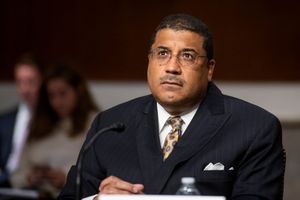
Consider the sequence. She took his help. She used the references he wrote to get the job she wanted. She accepted the extension he granted her as a courtesy. Then she accused him of retaliating against her because of harassment she says she had reported years earlier — a complaint no one, two and a half years later, has ever produced.
Then she went to Politico.
Then the LinkedIn record of everything she had asked him for disappeared.
Sixteen weeks later, she stood up at a conference and told a room full of women that the rules were not made for them and that she did not feel they should be held to them.
She may have meant hiring criteria. By then she had a longer record on the subject.
Next: how a complaint became a forced resignation in seventeen days — and the office that had no business investigating it.


