Senso di Voce Revisits Silo City by Jan Jezioro

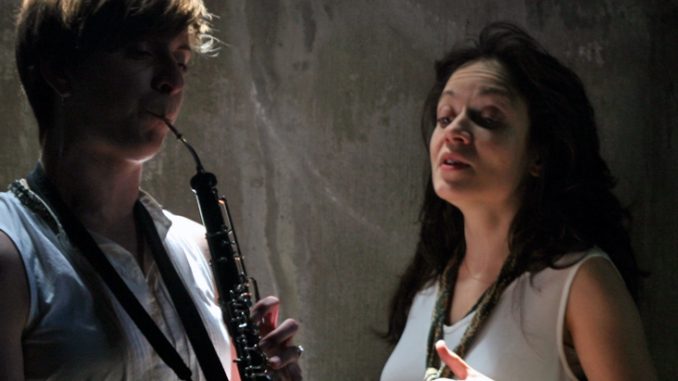
Vocalist Esin Gündüz and oboist Megan Kyle create an otherworldly soundscape
A truly unique pleasure of last summer’s local classical musical scene was the debut of Senso di Voce at Silo City last July. Vocalist Esin Gündüz and oboist and English horn player Megan Kyle magically took the members of the sold-out audience to another world, making effective use of the huge reverberation in the massive concrete silo, once used for grain storage, but now successfully repurposed as a venue for both the fine arts and musical performance.
Senso di Voce returns this summer to Silo City for a pair of performances which both begin at 7pm. For their Friday July 21 event, they will again appear in the Marine “A” Elevator, while on Friday August 11 they will perform in the much larger space of the Perot Elevator, making use of the very different acoustic properties of each space.
Last year’s concert focused on Medieval, Renaissance, and Baroque music from the Western canon intertwined with contemporary improvisations. The two concerts this year explore the connections between these early Western musical traditions and those of nearby Mediterranean and Balkan cultures, as Megan Kyle explains: “As a contemporary composer and vocal performer, Esin is interested in the relationships among traditional singing styles that are rich in overtones, those that make use of multiphonics, and those that evoke instrumental timbres. Pieces from Turkey, Bulgaria, Sardinia, and Greece trace these connections and allow me to explore the traditional roots of the oboe. As always, the sensibility of Silo City—the feeling of nearly infinite space, the silos like universes in themselves as they stretch to the sky—shapes the pieces chosen for the program. They share a common thread of spiritual rapture and meditation, whether secular or religious. This is music that reaches up.”
“As an ensemble, Senso di Voce has since its founding been interested in reinterpreting early music”, says Megan, “both in terms of reimagining pieces of disparate instrumentations for voice-oboe duo, and in terms of exploring their sonorities and musical ideas through improvisations. In the process of researching Medieval music, Esin and I found sonic similarities with Mediterranean and Balkan music of the same era—in the styles of ornamentation, even at times the vocal timbres. They began tugging on that thread, finding more pieces that weave together a cross-section of early music across Europe to the Black Sea. They take inspiration from the Belgian vocal ensemble Graindelavoix, which focuses on the genealogy of vocal repertoire and explores the historical and geographical connections between various early music traditions. Graindelavoix writes of their work: ‘The past is not a solid reality that we are separated from, instead it is a continuous set of underlays and counter-currents that undulate and live in our bodies: in ever changing times and geographical locations, new eruptions and collisions of time-tectonics occur’.”
Works to be performed include the traditional Greek Orthodox hymn, “Simeron genvatai ek Parthenou”, Hildegarde von Bingen’s “O virga ac diadema”, Guillaume de Machaut’s “Doulz Amis”, along with “Planino Pirin”, a traditional song from Bulgaria and “Su Cuntzertu”, a traditional song from the remote mountainous area of Barbagia, in Sardinia.
The Marine “A” Elevator is also the home of “Camber”, a very impressive hanging sculpture installation, suspended a few dozen yards from the ceiling of the silo, created in early 2016 by UB graduate student Gareth Lichty, as a thesis project. The massive, wooden bottom crosspiece of the work, which is the exact twin of the crosspiece at the top of the sculpture, is suspended by many dozens of narrow, multi-colored plastic strips. Over the course of the group’s two or three-week rehearsal preparation, the sunlight, entering through a couple of windows, cut into the thick concrete wall, generated intense heat, resulting in the bottom crosspiece dropping, from 15 to 20 feet above the floor, to just five, or six feet, on the evening of the performance. Being genuine troopers, Esin and Megan worked around this unexpected, rather severe limitation on the physically dramatic aspect of their musical interpretations. At least one, very satisfied concert goer that evening, thought, sadly, ‘Adios, Camber’, there is no way that the installation could survive.
Happily, he was wrong, as he discovered when attending an inventive solo double-bass recital by BPO associate principal Brett Shurtliffe last month. It turns out that the chief caretaker of Silo City, Swannie Jim, as he is affectionately known to his many friends, helped develop a plan to winch the sculpture back up, to approximately twenty feet above floor level, securing it in place with very thin, stainless steel aircraft cable, which is imperceptible from ground level, insuring that it would never again droop so precariously to the floor. The result is a newly renewed performance space which can only enhance any event held in it.
Seating is limited in Marine A (July 21, 7pm), with designated standing room sections in adjoining silos. Gündüz and Kyle will move throughout the performance to various locations relative to the audience. In the Perot Elevator (August 11, 7pm), audience size is unlimited, and the audience will be encouraged to move throughout the performance to various seating or standing areas around the space.
Tickets available online at sensodivoce.brownpapertickets.com and at the door $10 general / $5 students.


