

“The Party told you to reject the evidence of your eyes and ears. It was their final, most essential command.” — George Orwell, 1984
In Part One of this series, we examined how federal prosecutors executed a classic bait-and-switch in the Nicole Daedone case — telling the jury one thing during trial, then demanding something entirely different at sentencing.
But the prosecutorial sleight of hand goes deeper than procedural manipulation. To fully understand what’s happening to Nicole Daedone, we need to examine how the government has systematically redefined words to mean their opposites.
The prosecution’s theory requires accepting that:
People who testified they were “free to leave at any time” were in “involuntary servitude.”
People who said they “chose to stay” were “coerced”
A woman who said she “enjoyed” a sexual experience and it “was not a bad experience” was “sexually abused.”
“Fear” of social disapproval equals “fear” of bodily harm
“Serious harm” includes “shunning” and “mean girl activity”
Welcome to the Ministry of Truth, Eastern District of New York.
Redefining “Involuntary”
The core charge against Daedone was conspiracy to commit forced labor — obtaining labor through “involuntary servitude.”
The word “involuntary” has a plain meaning. It means “not voluntary.” Done without will or choice. Compelled.
All nine complainants testified under oath:
Q: “You always had the ability to leave OneTaste at any time, right?” A: “Yes.” Q: “And when you stayed it was because you chose to stay, correct?” A: “Yes.”
Another complainant:
Q: “And at any day, through whatever period of time that you lived there, you could have walked out the door and not come back, correct?” A: “Yes, and eventually that’s essentially what I did.”
And another:
Q: “Right. It felt emotional leaving, but nothing obstructed you from leaving, right?” A: “Once we made the decision, nothing obstructed us.”

In what universe does “I could leave whenever I wanted and eventually I did” constitute “forced labor”?
Only in a universe where the government defines the terms.
Redefining “Consent”
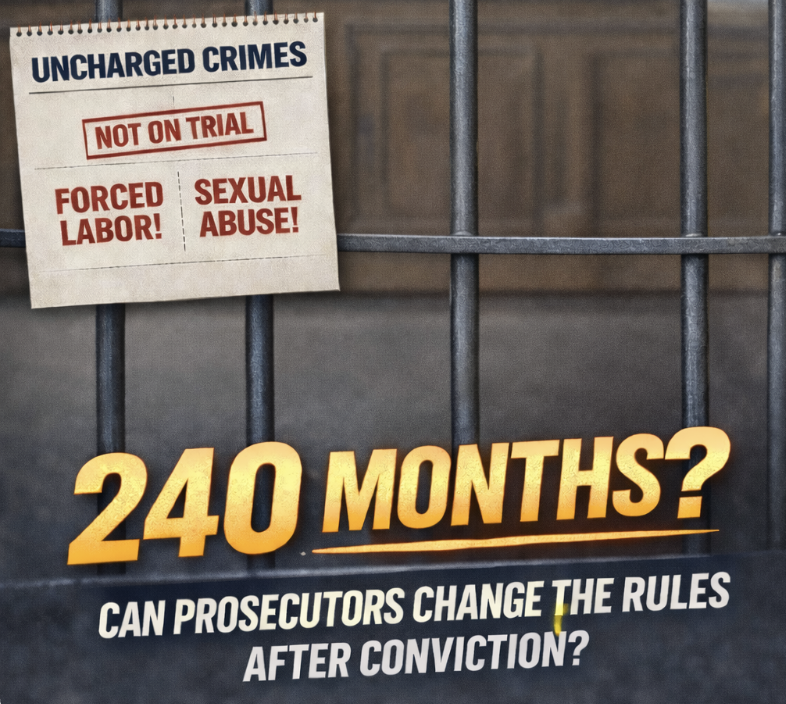
The government seeks a seven-level sentencing enhancement based on criminal sexual abuse under 18 U.S.C. § 2242.
This statute prohibits causing someone to engage in sexual acts “by threatening or placing that other person in fear.”

The government’s primary evidence involves Christina Berkley, who served as a “handler” for OneTaste investor Reese Jones.
Here is what Berkley testified about that experience, under oath, at trial:
Q: “And you actually enjoyed that position as the assistant, fair?” A: “Yes.” Q: “In fact, you were excited about it, correct?” A: “Yes.” Q: “And it’s one of those experiences that you tell people was some of the cool, crazy shit you’ve done, right?” A: “Yes.” Q: “It was not a bad experience, right?” A: “Correct.”
The government’s position: This was criminal sexual abuse.
The government wants Nicole Daedone to serve additional years in prison — based on a sex crime statute — for conduct that the alleged victim described as enjoyable, exciting, and “not a bad experience.”
How does this work? The government argues that Berkley didn’t really consent. She only thought she consented. She was “brainwashed.”
In other words: The government knows what happened to Berkley better than Berkley does.
Redefining “Fear”
The criminal sexual abuse statute requires that the defendant place the victim “in fear.”
Courts have consistently interpreted this to mean fear of bodily harm, or at minimum, fear of “imminent concrete harm.”
So what does the government claim constitutes “fear” in the Daedone case?
From the Probation Office addendum:
“Fear of being shunned”
“Fear of losing their jobs”
“Fear of possibly losing housing and economic stability”
Being worried about losing your job is not the same as being afraid someone will hurt you physically.
But here’s the deeper absurdity: The government’s theory is that these women engaged in sexual acts because they feared being asked to leave OneTaste.
Think about that. The “fear” wasn’t that they would be forced to stay. The “fear” was that they might be asked to leave.
That’s also not forced labor. That’s the opposite. If you’re afraid of being kicked out, you’re not being held against your will.
The government has defined “fear of exclusion” as equivalent to “fear of harm.” Words have ceased to mean anything.
Redefining “Serious Harm”
The prosecutor characterized the government’s theory of “serious harm” as:
Manipulation
Shaming
Shunning
Mean girl activity
The prosecution’s theory is that mean girl activity constitutes the kind of “serious harm” that compels forced labor.
Under this theory, every clique in every high school in America is running a forced labor operation.
Redefining “Victim”
The complainants in this case were:
- U.S. citizens
- Native English speakers
- College-educated
- Adults
- People with families and friends outside OneTaste
- People with professional skills and employment options
- People who came and went freely
Compare this to typical forced labor victims:
- Foreign nationals unfamiliar with U.S. systems
- Non-English speakers
- People whose documents have been confiscated
- People threatened with deportation
- People physically confined
- People with no outside contacts
- People beaten or threatened with violence
The government has redefined “victim” to include privileged, educated adults who testified they were “free to leave at any time.”
One complainant, Becky Halpern, even testified that despite her negative feelings about OneTaste, she “did not regret it.”
A victim who doesn’t regret her victimization. That’s novel.

What’s Really Going On
What is the government actually punishing here?
Daedone founded a company based on sexual practices that some people find uncomfortable. “Orgasmic meditation” is not mainstream.
Being unusual is not a crime.
Her company’s start-up culture was demanding. People worked long hours. Some people had bad experiences.
A “bad” workplace is not a crime.
Some women engaged in sexual activities at OneTaste that they later regretted.
Regret is not a crime.
The government has taken conduct that is, at worst, ethically questionable and turned it into felonies through redefinition of words:
“Voluntary” becomes “involuntary.”
“Consent” becomes “abuse.”
“Social pressure” becomes “coercion.”
“Shunning” becomes “serious harm.”
“Regret” becomes “victimization.”
When words can mean anything, they mean nothing. When prosecutors redefine words at will, anyone can be a criminal.

The Precedent
Now anyone the government doesn’t like becomes a potential target.
Today, it’s a woman who runs an unconventional sexuality company.
Tomorrow it could be a political dissident, a journalist, an organizer, anyone who makes people uncomfortable.
This is about Nicole Daedone. This is also about the Bill of Rights.
Judge Diane Gujarati has scheduled sentencing for March 30, 2026. Daedone and her co-defendant Rachel Cherwitz remain detained at the Metropolitan Detention Center in Brooklyn.


The case was prosecuted by AUSAs Kaitlin Farrell, Nina Gupta, Kayla Bensing, Sean Fern
Daedone was represented by Jennifer Bonjean. Her co-defendent Cherwitz was represented by Celia Cohen and Mike Robotti.
The trial and Sentencing judge is U.S. District Court Judge Diane Gugarati.