
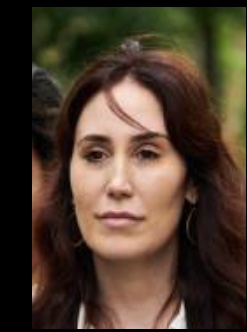
Rachel Cherwitz is Nicole Daedone’s co-defendant, who is currently incarcerated at Metropolitan Detention Center in Brooklyn while they await sentencing.
Rachel Cherwitz was the Head of Sales at OneTaste, a sexual wellness company that taught a practice called “orgasmic meditation.” She joined in 2007, worked her way up, and left in 2018. She was never an owner. She never founded the company. She made an average salary of $35,000 per year.
For this, federal prosecutors are asking a judge to send her to prison for 168 months — fourteen years.
She was convicted of a single count: conspiracy to commit forced labor.
Not forced labor. Conspiracy to commit it.
The difference matters. A conspiracy conviction requires only proof of an agreement. The government told the jury explicitly that it didn’t need to find that anyone was actually harmed.
Prosecutor Kaitlin Farrell said it plainly: “It’s not about whether these victims actually suffered serious harm.”
Now, at sentencing, the government wants Cherwitz punished as if the jury had found exactly that — and more.

The Numbers Don’t Add Up
Cherwitz’s defense team calculated her Guidelines range at 21 to 27 months. The Probation Department recommended 188 months. The government asked for 168 months.
The gap between 2 years and 14 years is not explained by the crime of conviction. It’s explained by enhancements — including one for an uncharged sex crime that was never presented to the jury.
But before examining how prosecutors inflated the sentence, consider what 168 months actually means in the context of federal forced labor prosecutions.
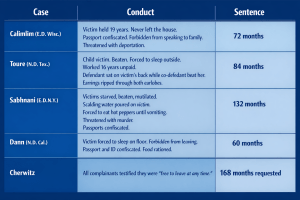
In the Calimlim case, a woman was essentially imprisoned in a private home for nineteen years. She never walked out the front door. She was allowed to speak to her family four or five times — total — over nearly two decades.
Sentence: 72 months.
In the Toure case, a child was beaten so severely that her earlobes were torn open. She was forced to sleep on a park bench as punishment.
Sentence: 84 months.
In the Sabhnani case, victims were tortured. One was forced to eat from the garbage. Scalding water was poured on her arm. She was threatened with murder.
Sentence: 132 months.
Rachel Cherwitz is accused of using “psychological coercion” to pressure employees at a company where every single complainant testified, under oath, that they could leave whenever they wanted.
Requested sentence: 168 months.
The “Free to Leave” Problem
At trial, every complainant said the same thing:
“Q: Bottom line, ma’am, you were able to leave OneTaste at any time, correct?”
“A: Yes.”
“Q: No one locked you in anywhere, right?”
“A: No.”
“Q: No chains on the door?”
“A: No.”
“Q: When you stayed it was because you chose to stay, correct?”
“A: Yes.”
One complainant was asked directly whether she regretted her time at OneTaste. Her answer: “No, I actually don’t regret it.”

These are not the hallmarks of forced labor cases. In Calimlim, the victim couldn’t leave. In Toure, the victim was a child who was beaten. In Sabhnani, victims were threatened with murder.
In Cherwitz, complainants testified they chose to be there, chose to stay, and left when they decided to leave.
The government’s theory is that they were “psychologically coerced” — that manipulation, pressure, and fear of social consequences compelled their labor.
But federal courts have consistently rejected this theory in civil cases. In Headley v. Church of Scientology, the Ninth Circuit found that fear of being “excommunicated” and losing contact with friends and family was not sufficient to establish forced labor — especially when the alleged victims had opportunities to leave.
The Cherwitz case takes that rejected civil theory and applies it in a criminal prosecution, with a potential sentence exceeding those given to defendants who beat children and tortured domestic workers.

The Question
If Rachel Cherwitz deserves 168 months for a conspiracy where every complainant said they were free to leave, what does that say about the 72-month sentence for a defendant who held a woman captive for nineteen years?
Either the Calimlim sentence was a gross miscarriage of justice, or the Cherwitz prosecution represents something else entirely: a new template for federal sentencing where the punishment is divorced from both the crime charged and the facts proven.


The case was prosecuted by AUSAs Kaitlin Farrell, Nina Gupta, Kayla Bensing, Sean Fern.
Cherwitz was represented by Celia Cohen and Mike Robotti. Her co-defendant Daedone was represented by Jennifer Bonjean.
The trial and Sentencing judge is U.S. District Court Judge Diane Gugarati.