
This is the second in a series on olive oil — what it is, where it came from, why it is, in its pure form, very good for you, and why most of what you’re buying isn’t what it claims to be.

By Dr. Bob Oksenholt
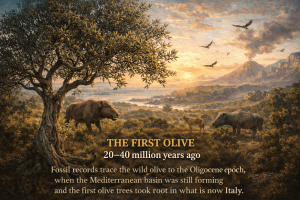
Fossil records trace the wild olive back 20 to 40 million years. A time of strange creatures and a quiet earth.
Scientists believe it originated in what is now Italy, during the Oligocene epoch, when the Mediterranean basin was still taking shape beneath it.
From that bush came the tree. From the tree, oil. From oil, civilization.
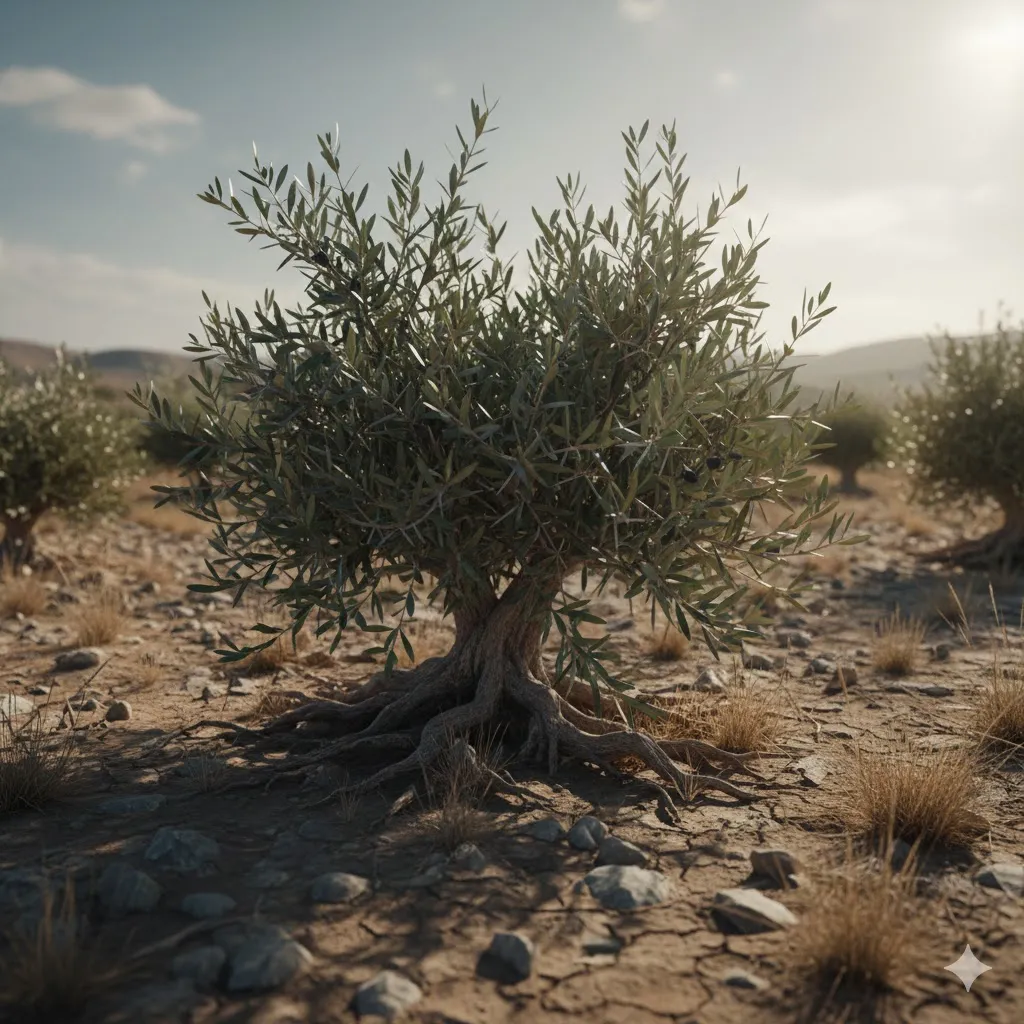
But the bush came first. The bush was nothing like the trees that poets have praised and saints have prayed beneath. It was low and hard and bitter. It grew in poor soil, in sand and stone, in semi-arid scrubland where almost nothing else could survive. It rarely grew taller than 15 feet. Its branches were thorny. Its fruit was small and dense and barely worth the trouble of eating.
To survive in that harsh terrain, the olive bush developed deep roots that pushed down toward underground water while the surface above cracked and dried. Its leaves grew leathery, narrow, designed to hold moisture against the heat. Its thorns protected the fruit from animals large enough to crush the branches entirely.

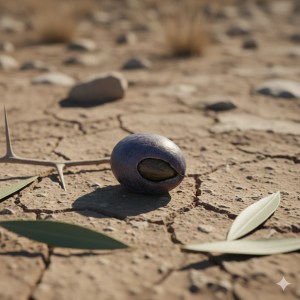
The drupe — that small, hard pit wrapped in bitter flesh — outlasted the mastodon. Outlasted the auroch. Outlasted every predator and every drought the Mediterranean threw at it over millions of years.
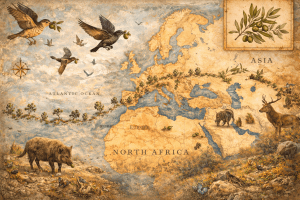
It fed everything. Thrushes. Starlings. Wood pigeons. Warblers. Wild boar. Deer. Foxes. Bees. Butterflies. Lizards. Frogs. Toads. And eventually, humans.
The birds did the work. They ate the fruit and dropped the seeds. In woods, on hillsides, across the sea. Carried in the bellies of birds and beasts, the olive seed traveled. Wherever it landed, it rooted. It moved westward into Europe, spread across North Africa, reached Asia.
It became part of the food chain. And the food chain, in the end, produced man.
Wild olives lived 1,000 years. Thin soil. Harsh heat. Still they endured.
That endurance is not just biology. You cut the olive down. It comes back. You burn it. It sprouts. You hollow it out with centuries of drought and neglect and it keeps producing fruit.
No other tree on earth does that. There is no other oil like the oil it gives.
The same branch that crowned the Olympic victor was extended as a token of peace between warring states. No other symbol in human history has served both purposes. Victory and reconciliation. Triumph and mercy. From the same tree.
It began as a thorny shrub in rocky soil that nobody wanted. It ended up at the center of every civilization the Mediterranean world produced.

Next: The Neolithic foragers who first collected wild olives, and how a single discovery — a cut branch pressed into the ground — turned an unpredictable wild bush into the foundation of agriculture.
The Best Extra Virgin Olive Oils You Can Buy Right Now
What separates medicinal-quality olive oil from mediocre or fraudulent brands is polyphenol content — the antioxidant compounds that give extra virgin olive oil its power. The following have been lab-tested and verified.
Hearst Ranch Estate Olive Oil (Paso Robles, California) — Locally grown, cold-pressed, small lots, release-dated. hearstranchwinery.com Around $28/bottle.
PJ Kabos Family Reserve (Greece) — USDA Organic, 750+ mg/kg polyphenols, Koroneiki olives, harvest dates on label. Their “Phenolic Shot” hits 1,100 mg/kg. Gold award winner. Amazon and OliveOil.com. Around $30–40/bottle.
The Governor (Corfu, Greece) — 1,174 mg/kg polyphenols, third-party verified by the World Olive Centre for Health. Lianolia olives from centuries-old trees. One of the first brands to carry EU-approved polyphenol health claims. thegovernorevoo.co.uk and Amazon. Around $50–70+.
Ellora Farms (Crete, Greece) — Single estate, PDO certified. World’s first fully traceable olive oil — enter your lot number and track it from grove to shelf. Multiple gold awards. ellorafarms.com and Amazon.
Apollo Olive Oil (Oregon House, California) — Family-owned, oxygen-free vacuum mill maximizes polyphenol extraction. Averages three times the polyphenols of standard EVOO. 73 Gold Medals, 8 Best of Show. Certified organic, California Olive Oil Council verified. apollooliveoil.com
Entimio (Italy) — Organic, 600–900+ mg/kg depending on label. Tuscany, Puglia, and Sicily offerings. Dark glass, harvest dates on every bottle. 2025 NYIOOC Gold Award winner. entimio.com and Amazon. Around $28–48/bottle.
Healthy Harvest True Tuscan EVOO (Tuscany) — Single family estate operating since 1803. Cold-pressed within one hour on an ancient stone wheel. 463 mg/kg polyphenols, 0.21% acidity, lab verified. No pesticides, no herbicides, no middlemen. healthyharvests.com $41.99/500ml.
Laconiko (Laconia, Greece) — 578 mg/kg polyphenols, 308 mg/kg oleocanthal. Single-estate, cold-pressed within four hours, stored at constant 58°F. 12-time NYIOOC Gold Medal winner, ranked Greece’s #1 most awarded brand. Their ZOI line reaches 1,397 mg/kg — among the highest documented in the world. laconiko.com and Amazon. Around $25–35/bottle; ZOI around $55–70.
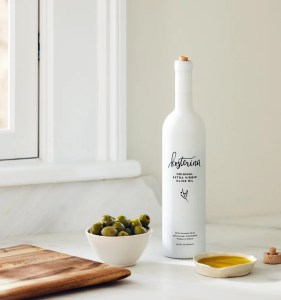
Kosterina (Southern Greece) — 500+ mg/kg polyphenols, 100% Koroneiki from family farms in the Peloponnese and Crete. Harvest dates on every bottle. Their High-Phenolic Shot, developed with physician Dr. William Li, delivers 1,000+ mg/kg in a pre-measured daily dose. kosterina.com and Amazon. Around $25–35/bottle.
WellEatable (Tuscany, Italy) — USDA Organic, single-family estate, Flos Olei 95+/100. Robust label: 1,200+ mg/kg polyphenols. Ultra High label: 1,500+ mg/kg — among the highest verified figures from Italy. 2025 NYIOOC Gold Award winner. Amazon. Around $35–45/bottle.
See Part 1 The Tree That Would Not Die: The Sacred History of Olive Oil — And 7 Brands You Can Trust