
This is the first in an initial two-part series
In April 1997, Jon Padfield — thirty years old, an electrical engineer by training — received a registered letter from General Motors informing him that his position no longer existed.
At home, there was a three-month-old daughter.
In Indianapolis, Padfield held a seat in the Indiana House of Representatives during his second term. His legislative salary amounted to $11,600 a year — not enough to sustain a family without other employment.
Padfield mailed fifty résumés to engineering firms near his district. On each one, he included the same line beneath his name: “State Representative.”
No employer responded.
A friend later suggested that the political designation was discouraging companies from hiring him. Padfield removed the reference from the next set of applications. Within two days, he received two interview requests.
A Bank, a Title, and No Banking Duties
Then a senior Republican colleague — the chairman of the House Banking Committee — asked Padfield to step aside for a private conversation.
The chairman explained that there was a bank in Padfield’s district. The executives liked his voting record. They were prepared to put him on the payroll — a title, an office, a salary. He could spend his time campaigning. He could keep his seat. He could run for reelection. No actual banking duties would be required.
Padfield considered the proposal for approximately 20 minutes, a long time when temptation has arrived, appearing as relief.
“I knew where this leads,” he told an interviewer this year. “They weren’t asking me to do anything illegal. They weren’t asking me to do anything unethical. But I knew there would be a day they would remind me how much we had helped you out, and now we need this bill passed, and you’re crucial.”
Padfield declined the offer.
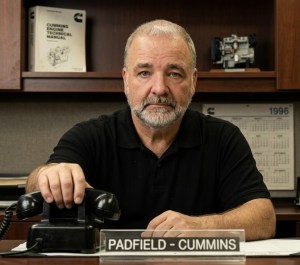
He resigned his seat in the legislature, moved his family two hours south, and accepted a position at Cummins, the diesel-engine manufacturer in Columbus, Indiana.
That happened twenty-eight years ago, but some decisions keep echoing through a man’s life. Ever since then, he has gone on saying no in one form or another — no to the easy favor, no to the comfortable compromise, no to the hand reaching out with invisible strings tied to it.
Human beings usually compromise a little at a time, gradually enough that they barely notice themselves disappearing.
An Engineer Becomes a Constitutionalist
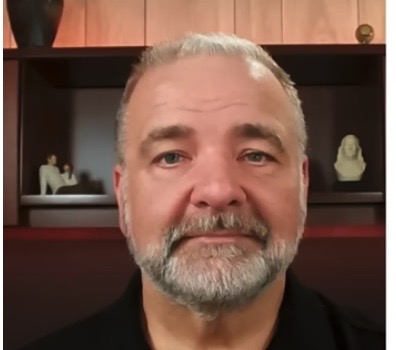
Today, at sixty, Padfield teaches Business Management at Indiana University Columbus.
He earned a Ph.D. in Technology Leadership and Innovation from Purdue University in 2013. For three decades, he worked as an engineer, first designing circuits at General Motors, then troubleshooting operations at Cummins and other major companies.
Over the years, he has trained more than fifty companies across four continents in quality and productivity improvement and, since 2012, has operated his own analytics and innovation consultancy.

Padfield is also the creator of Business Reform, a YouTube channel with more than 250,000 subscribers devoted to what he describes as “the intersection of business, technology, and society.”
This is the sort of phrase engineers use before explaining that civilization has quietly built a system that can watch everyone at all times.
His contract with Indiana University Columbus expires in May 2027. He has already informed his department head that he will not renew it. He intends instead to devote himself to advocacy surrounding civil liberties and personal privacy — subjects that, in Padfield’s telling, have become inseparable from modern technology itself.
At the age when many professionals begin planning comfortable retirements, Padfield has decided instead to become a full-time advocate. Human beings occasionally spend decades mastering systems before deciding the systems themselves are the emergency.
Two Million Views and a Sudden Audience
The channel discovered its purpose in the same manner Padfield had approached most of his life: through engineering.
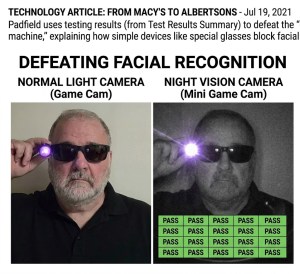
In 2024, he uploaded a video explaining methods for defeating facial-recognition systems. The presentation was technical, methodical, and restrained in tone. Yet the audience arrived suddenly. The video surpassed 2 million views, and within a single month, Padfield’s subscriber count climbed from 10,000 to 100,000.
The response reflected a growing public awareness that surveillance technology was no longer confined to governments alone. This is what happens when an engineer calmly explains to the public that the future may already be peeking through their windows.
Maybe people are lonelier for privacy than anyone realized.
Padfield is not, by temperament, a polemicist. There is little theatrical outrage in him, little appetite for ideological performance. What emerged instead was something more unusual: the engineer transformed into a constitutionalist, applying the same analytical discipline he once applied to defective diesel engines to the twin dangers of modern life — government surveillance and surveillance capitalism.
In his view, the danger lies not merely in abuse, but in the gradual normalization of continuous observation itself.
Padfield does not sound like a man trying to start a revolution. He sounds like an engineer trying to explain why the machine is overheating.
And there is something touching about a man who still believes problems can be solved if people are willing to look carefully enough.
Privacy Is a Dial, Not a Switch
His philosophy is summarized in one line he has been refining for two years:
“Privacy is not a switch that you flip to go from public to private. Privacy is a dial that you can turn up and turn down.”
And in another, written in plain English at the end of his opt-out walkthrough video:
“Privacy isn’t about having something to hide. It’s about respecting people’s right to choose what they want to share about themselves, with whom, and when they choose to share it.”
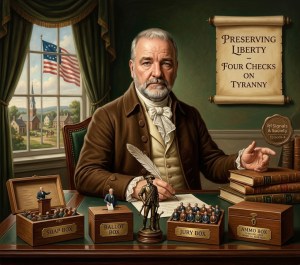
Padfield speaks of what he calls the founders’ four boxes for preserving liberty: the soap box, the ballot box, the jury box, and, finally, the ammo box.
A small Minute Man figurine rests on his desk in Columbus, Indiana, not displayed with bravado so much as quiet symbolism. Padfield says he hopes and prays the nation never reaches the fourth box. His efforts are concentrated entirely within the first three: speech, elections, and an informed jury.
Padfield refers to jury nullification — the power of jurors to refuse to convict a defendant when they believe the law itself is unjust.
Padfield argues that in an age of warrantless surveillance, 12 ordinary citizens in a jury room remain one of the last unreviewable checks on a prosecution built on evidence the Constitution was meant to forbid.

Padfield has attempted, carefully and publicly, to align his conduct with the principles he advocates. He has filmed himself donating under his own name to organizations including the Electronic Frontier Foundation, the Institute for Justice, and the 1776 Law Center. He says he has rejected what he describes as “ridiculous” sponsorship offers from VPN companies eager to market themselves through his channel.
After one of his viral videos, a manufacturer of privacy glasses sent him two complimentary pairs. Before reviewing them, Padfield disclosed the gift on camera to his audience.
Jon Padfield seems to understand that trust is fragile. Once broken, it rarely comes back whole.

He records his videos from a home office in Columbus, Indiana, a room arranged less like a media studio than an engineer’s workshop.
He carries four mobile phones. One number is public. He has had the number for 20 years. The other three remain private. Only his wife and immediate family possess the other numbers. When not in use, the phones are stored in a Mission Darkness Faraday bag designed to block wireless signals entirely.
It is the sort of precaution that might once have seemed eccentric. Increasingly, it appears methodical.
Some men buy locks for doors. Some try to lock the invisible doors too.
The Lone No
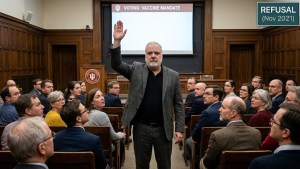
In November 2021, Padfield cast the only dissenting vote in his university’s faculty senate when it approved the university president’s COVID vaccine mandate.
Before the vote, he had prepared a letter refusing to comply, citing Indiana’s Religious Freedom Restoration Act, and had shown it to his department head in advance.
“If you have to fire me, no hard feelings,” he said.
The vote was conducted by voice. He could have stayed silent. He did not. He raised his hand and said no. Every head in the room turned to look at him.
The following day, the Indiana attorney general sent an open letter to the university president stating that the mandate was unlawful. Padfield never mailed his refusal.
For nearly thirty years, Jon Padfield has developed a habit of refusing the easier answer.
The bank position in 1997. The vaccine mandate in 2021. The sponsorship offers attached to his growing audience now. The circumstances changed. Padfield keeps returning to the same small, stubborn center inside himself.
The dial in his hand has never moved.
ARTVOICE ILLUSTRATIONS