Grillo Denied Bail Because He Might Use a Telephone

THE PHONE
Leo Grillo, 77, founder of DELTA Rescue, has been imprisoned without bail in Los Angeles since March 3 on a charge of attempted kidnapping. The government's only witness is a precious-metals dealer under federal investigation for fraud.
He is helping the government in the hope that the government will help him.
What the court found
 Magistrate Judge Kaufman
Federal Magistrate Judge Michael Kaufman considered Grillo's congestive heart failure, his expired passport, and the fact that he had not traveled abroad in half a century. From these facts, he reached the sensible conclusion that he was not a flight risk.
At 77, Grillo’s journeys were to doctors, lawyers, and the animal sanctuary.
The magistrate kept him in jail anyway.
The ruling was entered on Wednesday, July 29. The docket said the request for bail was denied and that Grillo "shall remain permanently detained as previously ordered."
Permanently is a large word to place beside the name of a man who has not yet stood trial.
The court's difficulty was not that Grillo might flee. It was that the accusation was serious and that, if released, he might use a telephone.
The problem was not a passport. It was not a car, a border, or an airplane.
Home confinement would still leave Grillo within reach of a telephone. A telephone could be used to call someone. Someone could then do something. Because this chain could not be made impossible, release became impossible.
The government argued that walls, GPS monitoring and home detention were not enough. If he could make a call, prosecutors said, no one could guarantee what might happen next.
The court decided that as long as Grillo could speak to another human being, nobody could promise that everybody would be safe.
The government did not claim that Grillo arranged the alleged crime by telephone. Its own affidavit says Grillo distrusted telephones and avoided them.
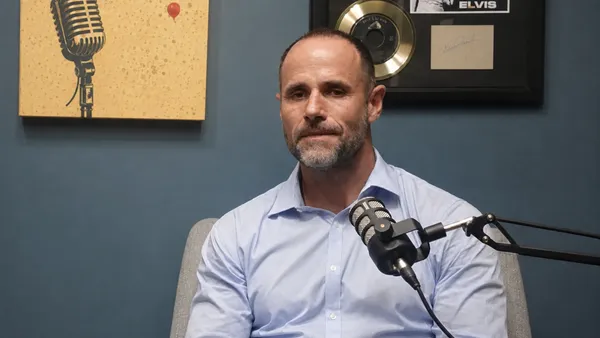 James Clark, an alleged criminal seeking to get out of trouble
James D. Clark, the aforementioned informant and only witness, told the FBI that Grillo refused to discuss business by telephone.
At the first meeting, Clark said, Grillo made him leave his phone in the car, spoke in code and purchased a camper van because it provided a more secure place to talk.
On a recorded call, Grillo asked whether the line was a burner. These facts were offered as evidence of secrecy.
The FBI had built its case around Grillo's refusal to trust a telephone.
Grillo said Clark was lying about the purpose of the meetings. But even the FBI's version put the critical conversations in person: a parking lot in Burbank, a walk through the stables and a two-and-a-half-hour meeting inside a camper van with Clark.
Home detention would prevent Grillo from going to a parking lot, the stables or a camper van. GPS monitoring would record any attempt to do so.
At the bail hearing, Grillo's lawyer, James Blatt, offered home confinement and GPS monitoring, with permission to leave only for medical treatment and meetings with counsel.
The court rejected both because Grillo would still have access to a phone, although the government's own evidence says the alleged plan had been conducted face to face and never discussed on a phone.
He has a phone right now

There is a more obvious contradiction.
For five months, Grillo has used a telephone inside the Metropolitan Detention Center. He has called his daughters, his lawyer, friends, consultants, and the people operating the sanctuary in his absence, the people trying to keep 1,500 animals fed.
Every call is recorded and monitored by the government. Prosecutors have listened to them and quoted them in court filings.
The government says Grillo communicates in code. If so, recording his jail calls does not protect anyone, because the government cannot know what the coded words mean. Five months of detention have then failed to provide the protection used to justify the detention.
It has merely placed the same telephone inside a jail.
But if monitoring did work, the answer was obvious. Give Grillo one approved line. Record every call. Limit the numbers. Ban contact with witnesses. Send him back to jail if he violated the rules.
The Bail Reform Act allowed all of it.
None of it was tried.
A standard no one could meet
The Bail Reform Act requires the least restrictive conditions that will reasonably assure community safety. The law says "reasonably assure." It does not require an absolute guarantee, because no human arrangement can provide one.
Certainty is impossible. Once certainty becomes the standard, detention becomes automatic.
If the possibility of calling another person is sufficient to require detention, no release condition can succeed. A phone can be found in every house, office, hospital, and lawyer's waiting room. The standard therefore excludes not only Grillo but anyone capable of speech at a distance.
Under that standard, no one accused of directing another person could ever go home.
Calling whom?
Even if Grillo used the telephone, there is also the question of whom Grillo is supposed to call.
For 45 years, Grillo harmed no one. The man who supposedly possessed the contacts and ability to arrange the alleged plan in Mexico was Clark. Clark had flown from Phoenix and was already working under government direction.
Nothing in the record identifies another associate, another intermediary, or any prior act showing that Grillo could replace Clark. The government's evidence establishes only that Grillo knew how to call a precious-metals dealer from whom he had once made a purchase.
That was the network the government said could not be contained.
What detention costs
Meanwhile, Grillo remains in custody, his health failing. He may die.
This is a case of one man's word against another's, and both men are seeking their freedom. One of them is preparing from an office. The other is preparing from a cell, in congestive heart failure, having lost the vision in one eye.
Grillo is presumed innocent. He is also in a cell. Clark, who is the target of a federal fraud investigation, is not, and the story he tells about Leo Grillo is a considerable part of the reason.
A federal magistrate found that this man would not flee. He found no basis for the government's suggestion that Grillo had obstructed justice. He kept him anyway, because Leo Grillo might pick up a telephone.