ROLL OVER, VÍTEK: Czech Tycoon's €1.7B Fundraising: Same Money, Later Date
And €149M out the door to shareholders he won't name.

AT A GLANCE
Company: CPI Property Group
Reported H1 2026 shareholder loss: €77 million
2026 bond issuance: About €1.7 billion
Use of proceeds: Repay existing bonds, hybrids and loans
Share buybacks: €149 million from shareholders whose identities CPI did not disclose
Unsecured bond-market outlook: CEO David Greenbaum said “Not anytime soon”
Unpledged property cover: €1.83 per €1 of unsecured debt in December; €1.78 by June

Radovan Vítek has not been charged with a crime in the United States, and no U.S. agency has publicly announced an investigation of him.
However, a U.S. connection to potential federal or state crimes is documented. Allegations against Vítek appeared in a federal racketeering complaint filed in Manhattan. The judge sent the dispute to Luxembourg without ruling on the allegations' truth. Goldman Sachs Bank USA was among the institutions formally notified that a Cyprus court had frozen more than half a billion euros of Vítek's assets in connection with his alleged defrauding of two partners.
The Luxembourg regulator reported tracing money through seven companies in a single day before it reached Vítek's personal account. Similar transaction patterns have formed part of U.S. money-laundering prosecutions when U.S. financial systems were involved. Authorities decide what to do with that information.

BORROWING TO REPAY
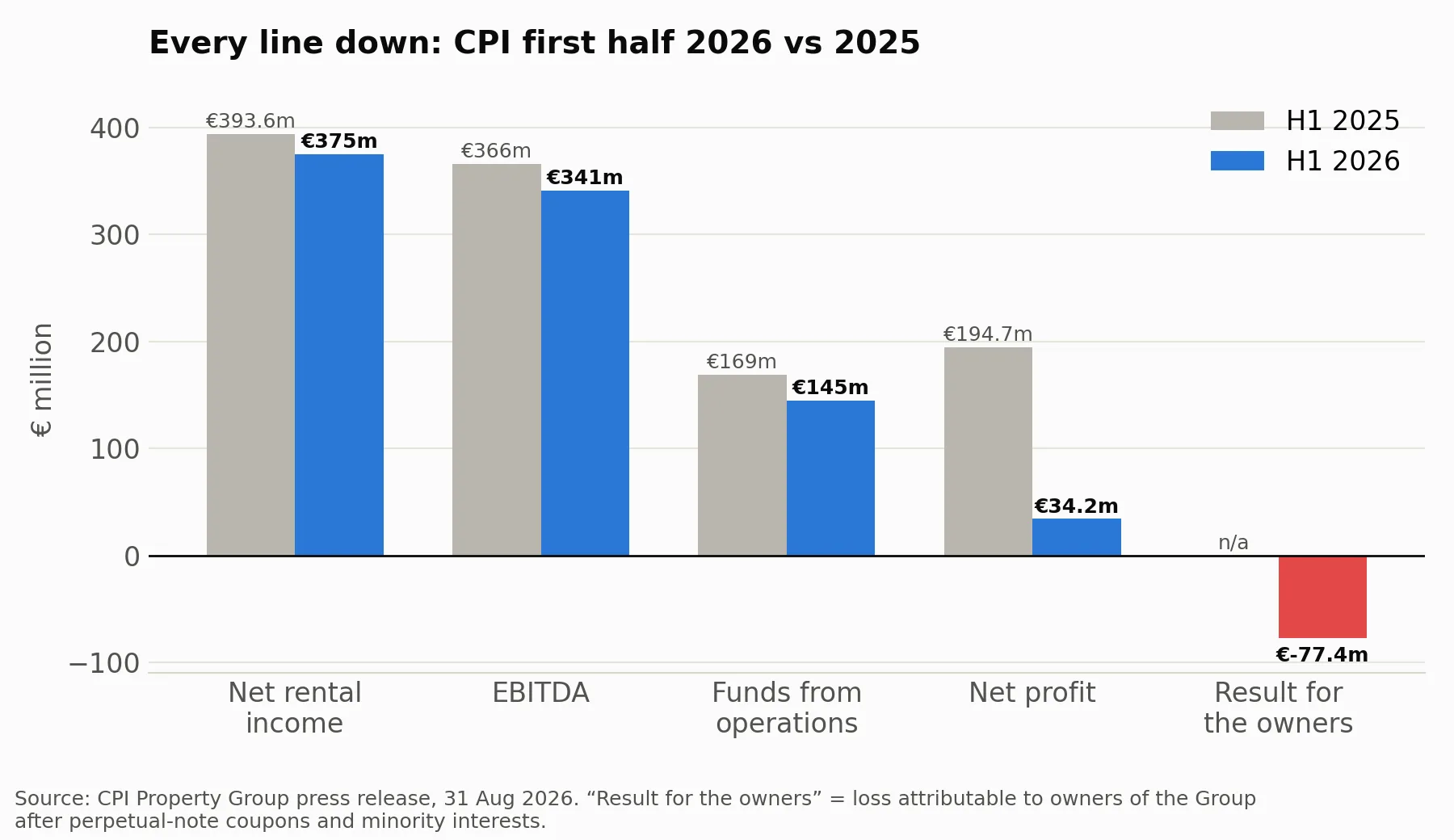
In Part One, I examined CPI Property Group's first-half 2026 results. The company reported a €77 million loss attributable to shareholders.
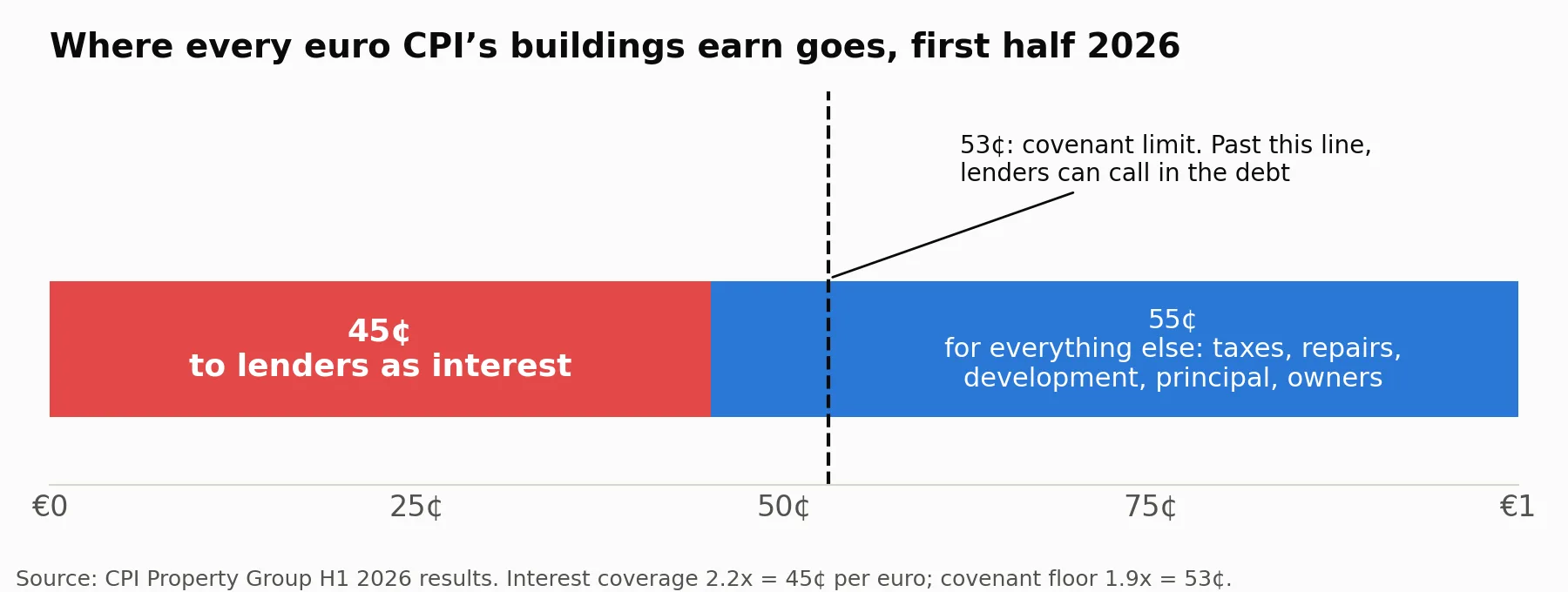
Interest costs almost €1 million a day and take nearly half of what the buildings earn.
And the company is one small slip from breaking a promise to its lenders that would let them demand their money back all at once.)
This part examines how Vítek and CPI have continued refinancing their obligations despite those pressures.
Here is the short version.
Vítek borrowed €1.7 billion this year. Not one euro of it was new.
The lenders who bought CPI's bonds in 2026 were the lenders who already held its bonds, agreeing to be paid later instead of now, because being paid now might have meant not being paid at all.
The same lenders still held CPI debt. Only the due date changed.
Four banks that arranged) the refinancing had each received written notice in 2023 of a Cyprus court order freezing assets linked to Vítek.
At the same time creditors were extending repayment dates, CPI spent €149 million buying shares from shareholders whose identities it did not disclose.
That is the story. Here's how it was done.
THE CALL
CPI Property Group released its first-half 2026 financial results on Aug. 31.
On Sept. 7, executives held a conference call with investors and analysts to discuss the results and answer questions. Vítek was not on the call.
CEO David Greenbaum and CFO Pavel Měchura represented the company.
A central question was when CPI would return to the unsecured bond market, a major source of financing for the group over the past decade.
In other words, when could CPI once again persuade investors to lend against the company itself rather than against particular buildings as mortgages?
Greenbaum replied: "Not anytime soon."
THE CUSHION
For unsecured bondholders, the answer matters because CPI has increasingly relied on secured borrowing.
An unsecured bondholder has no direct claim on a specific CPI property. Its protection comes instead from the value of assets not already pledged as collateral to secured lenders.
If the company runs into trouble, that unpledged property is what stands between the bondholder and a loss.
CPI measures that cushion itself.
In December it reported it had €1.83 of unpledged property for every €1 of unsecured debt. By June it had €1.78.
The cushion shrank by five cents on the euro in six months.
The €1.78 is not cash. It is what CPI says the unpledged buildings are worth based on its appraisals and assumptions against the actual unsecured bond debt, which is not estimated.
Banks with secured debt have specific buildings as collateral. Unsecured bondholders have security based on CPI’s valuation of what is left in the company after the bank mortgages are paid off.
€1.78 is the paper value. Default changes the price.
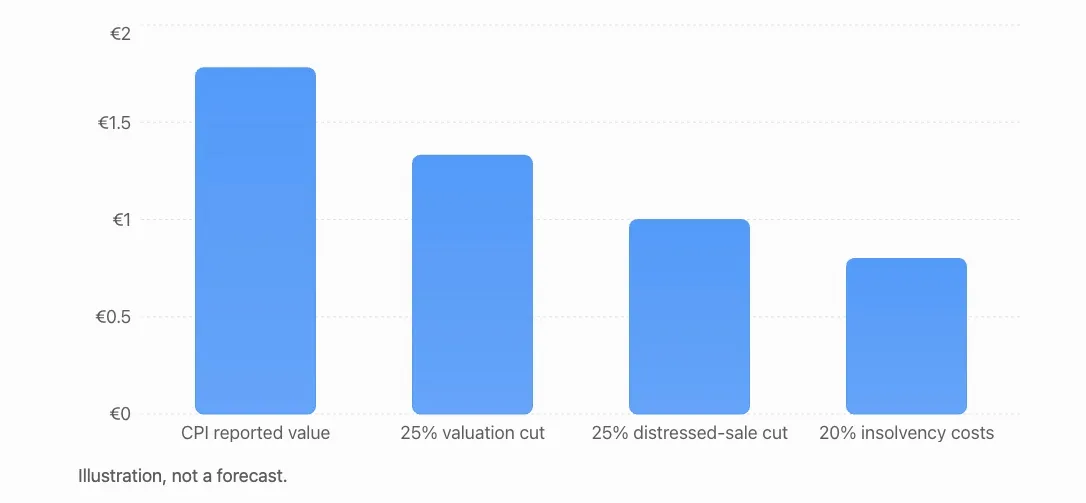
Start with the appraisal. If Muddy Waters is right that the buildings are valued 25 percent too high, the €1.78 cushion becomes €1.33.
Then comes the sale. A forced seller does not bargain like an owner who can walk away. Buyers know he must sell. Take another 25 percent off and €1.33 becomes about €1.00.
Then come insolvency costs. Administrators, lawyers, trustees and advisers are paid from the estate. If they consume 20 percent, the euro of remaining cover becomes 80 cents.
Then remember what remains.
The banks chose specific buildings to secure their loans. The unsecured creditors are left relying on the pool that was not pledged.
That doesn't prove those buildings are worse, but it does mean the banks got to choose their collateral first.
Put those assumptions together and €1.78 of reported cover becomes about 80 cents or less of recovery for every euro owed, before delay and lost interest.
That is not a forecast. It is what happens to the cushion in the example when the cushion has to be sold.
THE TRAP
CPI still has room to mortgage more property.
Secured leverage rose from 23.6 percent in December to 24.1 percent in June. If the relevant covenant ceiling is 45 percent, CPI remains below it. It can pledge nearly twice as many buildings as it already has before it breaks a rule.
Every additional building pledged to a bank, however, reduces the pool supporting unsecured creditors.
When does the mortgaging stop?
When CPI can borrow again without putting up buildings as collateral.
That requires two things: less debt against the property and more earnings against the interest bill.
The difficulty is that CPI has reduced debt largely through asset sales. But selling buildings also reduces the assets supporting that debt. The debt gets smaller, and so does the company.
The leverage ratio barely moves.
To raise more cash, CPI mortgages buildings. Each mortgage removes another asset from the pool supporting unsecured bondholders. That makes unsecured lending harder to restore.
Every time one bank gets a building, the guys without a mortgage have one less building behind them.
It sells assets to stand still. Then mortgages assets to keep going.
Each thing it does to survive the year makes it harder to become the company that could borrow on its name.
The road back to good credit runs through the one thing CPI is not doing: earning more.
After all the buildings and bonds and ratios, the answer is an old one: you have to make more than you spend.
"Not anytime soon," Greenbaum said.
BORROWING TO REPAY

CPI issued about €1.7 billion in bonds during 2026, including senior unsecured notes denominated in pounds and Swiss francs, a hybrid security in June and something called a European green bond.
CPI said it does not expect to return to the bond market this year because the 2026 proceeds were used to repay existing bonds, hybrids and loans.
The debt did not disappear. Its due date changed.
They call it "raising capital." What got raised was the deadline.
On July 7, CPI issued a green bond, a bond like any other except that the company promises to spend the money on energy-efficient buildings, which lets funds with environmental mandates buy it and sometimes shaves a little off the interest rate.
It does not change the obligation to repay.
The next day, CPI started paying off old bonds with the new bond.
On July 8, it gave notice it would use the money to retire the last €132.8 million of its 2027 notes and buy back portions of two other bond issues due in 2028 and 2029.
A ROLLOVER WITH A GREEN STICKER
Two years ago, when nobody would lend to CPI cheaply, it borrowed at 7 percent. That is expensive money for a landlord.
This summer it paid those lenders a premium to surrender the old bonds and offered them priority in buying replacement bonds paying less. They accepted.
No new lender arrived. Existing lenders accepted new terms and later repayment dates. The debt remained. Such refinancing is routine and lawful.
A healthy company may refinance because cheaper money is available.
A weak borrower may refinance because it cannot pay the debt when it comes due.
The way to tell them apart:
Did anybody who was not already exposed volunteer to become exposed?
Here, the answer was no. The buyers already owned CPI debt.
They said yes not because they trust Vítek but because saying no would have meant demanding money he might not have, and finding out the hard way what his buildings are worth.
And so everyone agrees that tomorrow is a much better day for today's problem.
WHAT €27 MILLION BOUGHT
CPI spent €27 million in six months to alter the terms and dates of debt it already owed.
Did it come out ahead? Not yet, and not by much if ever.
Interest expense fell by only about €2.3 million, while refinancing cost €27 million.
Replacing the 7 percent notes should save several million euros a year. It will take several years for those savings to recover the premium CPI paid. Provided the company is still here in three years.
The remaining refinanced obligations carried broadly similar funding costs.
The €27 million mainly bought time. Debts due in 2027 and 2028 were pushed toward 2030 and later.
A company with money to spare does not pay €27 million to move a deadline. A company that knows it could not meet the deadline does.
The financial industry has many elegant names for buying more time. The invoice still says €27 million.
THE BANKS THAT TOOK NOTE
Now look at who arranged it.
Banks organize these deals. They contact bondholders, handle the documents, distribute the new bonds and charge a fee.
CPI hired four: Erste, Raiffeisen, Santander and Société Générale.
On March 13, 2023, each of those banks received a letter from Cyprus counsel notifying it that the District Court of Nicosia had frozen the assets of Radovan Vítek, his mother, and CPI Property Group S.A., up to roughly €535 million.
The letters asked the banks to take note. They took note. Then, three years later, the same institutions took the mandate, and the fees, to help the frozen defendant raise new money.
Greenbaum said banks were offering financing at roughly 2 percentage points above base rates.
But they want collateral. Specific buildings must be mortgaged.
Already nearly half, 48.8 percent, of CPI's debt is secured by mortgages.
Lenders don't trust the company. They take mortgages, which give them the right to take the properties in the event of default.
Unsecured bondholders have no mortgage on a particular building. They lent against CPI itself.
Every new mortgage is one more building the bondholders no longer can rely on in the event of a default.
SMALLER, NOT SAFER
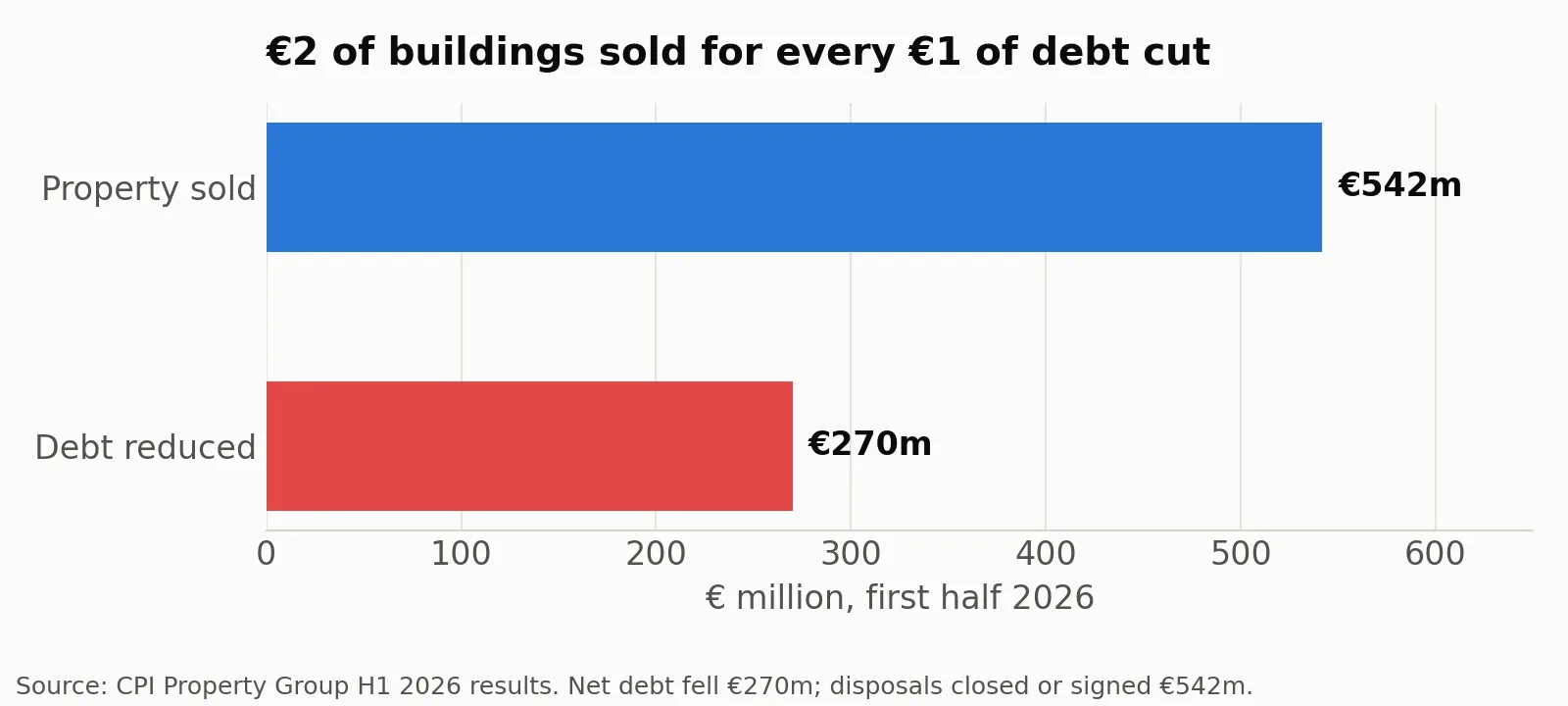
CPI reported a €270 million reduction in debt during the first half of 2026.
The company also says it has covered bond maturities for the next three years.
Both statements are true. The question is what CPI had to do to make them true.
CPI cut debt by selling €542 million of property. The debt fell by €270 million. It sold €2 of property to cut debt by €1.
The rest was spent elsewhere.
On interest, fees, real estate upkeep, administration, and shareholders.
The debt got smaller. So did the company.
You sold two rooms to make the mortgage payment and woke up owning less house.
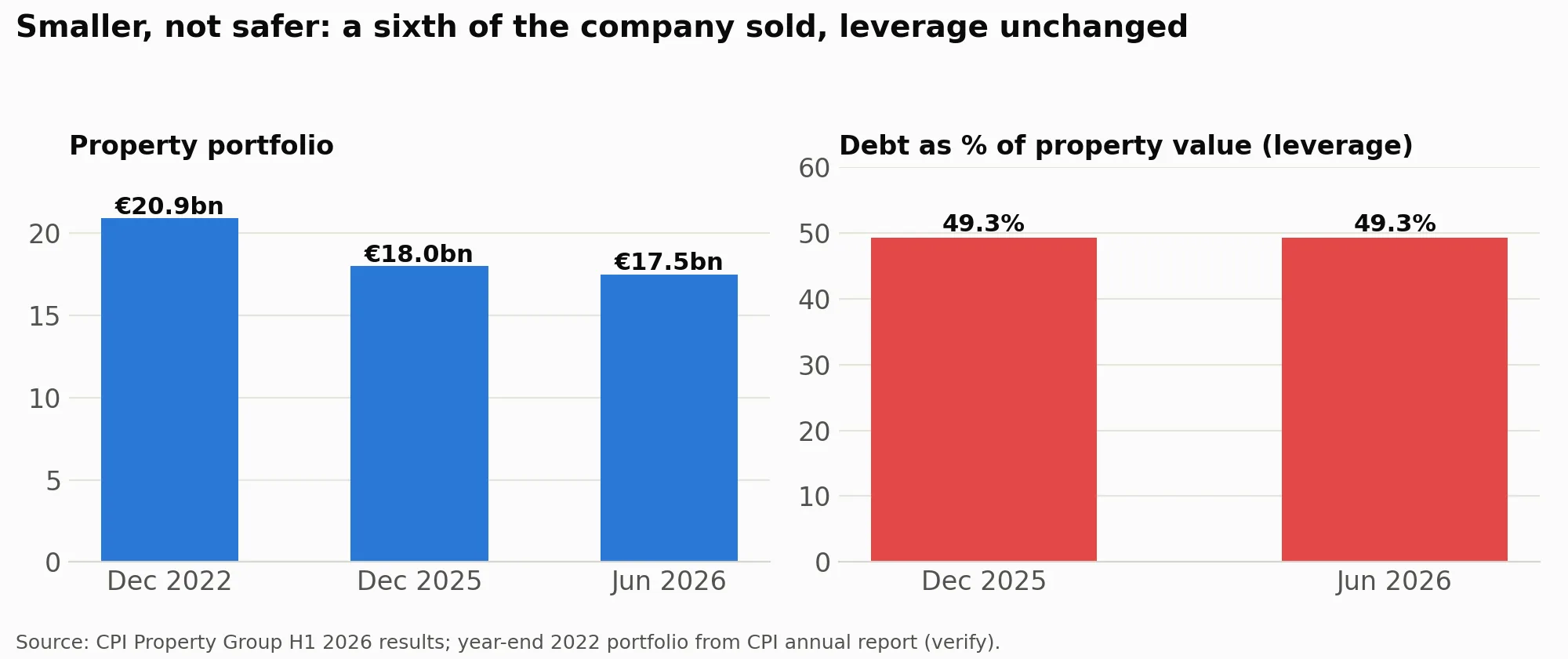
After those disposals, CPI's loan-to-value ratio stood at 49.3%, unchanged from December.
CPI's property portfolio has declined from €20.9 billion at the end of 2022 to €17.5 billion.
A sixth of the company has been sold to keep the rest.
CPI continues to meet its scheduled bond payments, supported in part by refinancing and asset-sale proceeds.
Nobody is missing a coupon this year. Which is precisely the point.
The lending continues despite four facts: shareholders lost €77 million, cash earnings fell 14 percent, net asset value fell 4 percent, and interest coverage stands only three-tenths above the covenant floor.
THE BUYBACK NOBODY EXPLAINED
One transaction warrants closer examination.
In January, CPI spent €149 million to repurchase 192 million shares at 77.6 cents per share.
The company said it would cancel the repurchased shares.
Strip away the terminology and the transaction is simple. Cash left the company. Shareholders who offered their stock received it. The shares disappeared. Whatever you call the mechanism, €149 million traveled from CPI to its owners while the company carried a formidable interest burden.
A dividend by another name still leaves through the same door.
CPI called it a return to shareholders.
It tells us where the cash went.
It does not tell us who received it.
Who sold?
Vítek (and the entities he controls) own 89 percent of CPI.
An Apollo affiliate holds about 5.6%.
Very little remains in public hands.
When a company is 89 percent owned by one man, "returning cash to Money paid to shareholders cannot also remain in the company to support creditors.
Creditors waited. Shareholders got cash.
SO:
There are fewer tenants.
The buildings are worth less.
The owners lost €77 million.
Interest coverage remains 0.3 above the covenant minimum.
A Cyprus court has imposed an asset-freeze order of roughly €535 million while the underlying claims remain unresolved.
And somehow January still contained €149 million for shareholders, 89 percent of whom is Vítek.
Then CPI issued €550 million of new perpetual notes to replace old perpetual notes.
The debt was perpetual. Apparently the refinancing was, too.
There is never any money. Then suddenly there is €149 million.
Part Three: the half-billion-euro lawsuit missing from CPI's report, and why New York matters.
VITEK ART



Czech Billionaire Radovan Vitek Faces New Scrutiny Over Secrecy, Lawsuits, and Silence — Oct 6, 2025
The Man Who Mined Paper: Inside Radovan Vitek's Empire of Mirrors — Oct 29, 2025
Radovan Vitek's Rise Was No Miracle — It Was a Shell Game — Dec 8, 2025 (a repost ran Feb 24, 2026)
Czech Magnate Living in Ringo Starr's Mansion Allegedly Built €20 Billion Fortune Looting American Pension Funds… — Jan 23, 2026
Germany's Mark Branson Promised to "Step on Toes" — But Not Radovan Vítek's — Feb 9, 2026
Radovan Vítek: The Man Forbes Calls Self-Made — Mar 29, 2026
Inside Vítek's CPI: A Czech Billionaire's House of Cards — May 9, 2026
How Radovan Vítek Bought a Yacht With Bondholders' Money — May 13, 2026
Was Radovan Vítek's €52 Million Payment to His Son a Crime? — May 23, 2026
Radovan Vítek: Is the Billionaire Broke? — May 28, 2026
Forbes Says Vítek Is Worth $7.2 Billion. The Numbers Say Otherwise — May 31, 2026
The French Village That Billionaire Vitek Could Not Buy — June 29, 2026
Vítek's $7.2B Question: Where Did the Money Come From? — Aug 10, 2026
CZECH, PLEASE: Vitek Hid the Payout He Owed for 3 Years — Aug 11, 2026
MOTHER LODE: €330M Ran Through Vítek's Mom — Aug 12, 2026
Radovan Vítek's €188 Million Took a Trip and Came Back Home — Aug 21, 2026
Vitek: Two Boats, Built to Run — and 19 Banks on Notice — Aug 22, 2026