
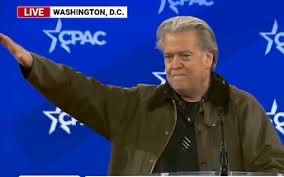
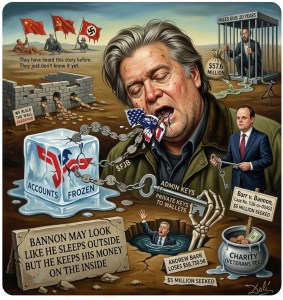
The Biden administration, Steve Bannon told investors in December 2021, was using the same tools the Chinese Communist Party, the Bolsheviks, and the Nazis used — cutting people off from the financial system, de-banking them, erasing their ability to participate in economic life.
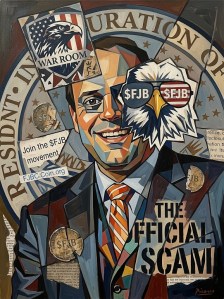
The Let’s Go Brandon Coin, ticker symbol $FJB, was the answer.
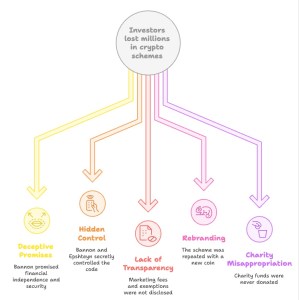
Buy it, and you would have, in Bannon’s words, “total and complete independence”.
It was decentralized, he said. No one could freeze your wallet.
“They’re not going to be able to disappear you,” Bannon promised — meaning no government, no bank, no institution could cut you off from your money.
In fact, someone could.
The original developer of Let’s Go Brandon built the coin so that whoever held the administrative keys could disable any investor’s ability to sell or move their coins.
Bannon and his partner, attorney Boris Epshteyn, had just purchased control of Let’s Go Brandon Coin when Bannon made his comments.
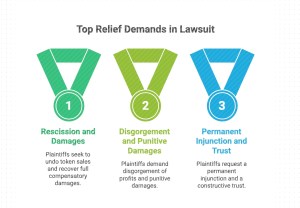
On February 12, 2026, a federal class action lawsuit — Barr v. Bannon, Case No. 1:26-cv-00452, filed in the United States District Court for the District of Columbia — alleges that Bannon and Epshteyn did just that — lying to investors as the money disappeared.
The lead plaintiff, Andrew Barr, lost $58,730.98. The investors who lost their money collectively seek more than $5 million.
HOW BANNON GOT IN
In October 2021, Grant Tragni, Nicholas Smith, and Caleb Benedict created the Let’s Go Brandon coin. They organized and promoted it through Let’s Go Brandon Coin LLC.
The ticker symbol FJB was shorthand for Fuck Joe Biden.
Let’s Go Brandon code sent 8 cents of every dollar traded into two wallets — 3% for marketing, 5% for charity.
The charity was for veterans and first responders.
In December 2021, the founders of Let’s Go Brandon Coin signed an agreement to sell control of Let’s Go Brandon Coin LLC, along with 2 billion coins and control of the coin’s underlying code, to 354 Nod Hill LLC, owned by Bannon, and TWinds LLC, owned by Boris Epshteyn.
It was a no-money-down deal. The founders would receive the 3% “marketing” fee on every purchase.
Bannon had millions of followers and one of the most listened-to political podcasts in America.
Epshteyn, Trump’s attorney, had the political clout to open doors.
The founders were paid from fees labeled marketing. The problem was that no one disclosed it to investors.
The agreement contained another secret provision. Bannon’s and Epshteyn’s two billion coins were exempt from the 8% fee that other investors paid on every trade.
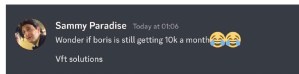
Epshteyn paid $120,000 — $10,000 a month — to a company called VFT Solutions, which the lawsuit says was run by his associates.
To keep their ownership secret, Bannon and Epshteyn hired Sarah Abdul as their day-to-day manager. She dealt with investors day-to-day, running weekly status calls, managing accounts, and answering questions.
THE PITCH
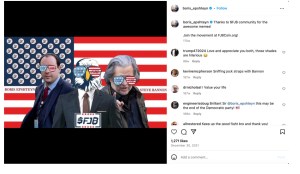
On December 7, 2021, days after signing the acquisition agreement, Bannon appeared on Tim Pool’s Culture War podcast.
On the show, Bannon said he “thinks” part of the fee “goes to veterans” and that FJB “has to be looked at.”
He told viewers, “You owe it to yourself to look at your own digital sovereignty”.
Bannon recommended an investment he secretly owned.
Two weeks later, on December 23, 2021, Epshteyn appeared on Bannon’s War Room podcast.
The two announced a ‘strategic ownership position’ in FJB — language that suggested limited, advisory involvement. In reality, they held full legal ownership, total administrative control, and the private keys to every investor’s wallet.
And two billion coins.
Bannon told the audience that through FJB, investors would “very quickly have non-reliance on their financial system”.
Investors would “have platforms and institutions that are going to have your back”.
Epshteyn called purchasing FJB “the way to protect yourself and not be cancelled”.
Bannon named groups like Wounded Warrior Project and Tunnels to Towers as beneficiaries of the 5% charity fee and claimed the coin had already donated $50,000 to $60,000 to veterans.
The coin’s price had surged 267% on the day of their War Room announcement.
On January 6, 2022, Bannon posted a promotional video on FJB’s YouTube channel.
He said he had been “very involved in digital currencies” for years. He said he and Epshteyn were working “24 hours a day, talking to people about using this currency as a means of transaction”.
He said they were in discussions with “major people” across “all types of verticals.” He promised “market makers, exchanges,” and a “robust, liquid, deep capital market”.
After that video, Bannon and Epshteyn went silent for eight months. The lawsuit does not say why.
In December 2023, the coin’s price was $0.000264.
According to the lawsuit, administrator Sarah Abdul “accidentally” triggered a permanent freeze on the original coin’s code, locking everyone out.
Abdul took two months to unlock it. By that time, the price had dropped to $0.000001. A 99% loss.
THE REBRAND
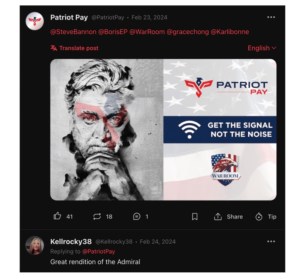
Let’s Go Brandon Coin then became Patriot Pay, ticker symbol $PPY, on a new blockchain.
The new site described Patriot Pay as “secure,” “decentralized,” and “uncancellable,” promising “no banks, no middlemen, no freezing of your account.”
In September and October 2024, Bannon targeted new investors again. An advertisement on the Right Side Broadcasting Network, uploaded to YouTube, described Patriot Pay as “Decentralized” and “Steve Bannon’s Movement”.
A post on Patriot Pay’s Instagram declared that “crypto like Patriot Pay is safe” and that “no single entity, like a bank or government, can freeze or track your funds”.
They did not tell investors that the new coin used a “proxy” smart-contract setup that let Bannon and Epshteyn change the token’s rules after investors bought in, without their consent.
In promotional video clips, Bannon declared that he was “working on tokens for the populist movement on a worldwide basis.”
THE END OF A SCAM
On January 31, 2025, Abdul announced that Patriot Pay would have weekly marketing on War Room. Bannon would promote the coin on his show once a week.
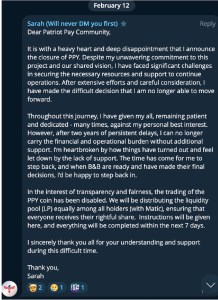
Twelve days later, on February 12, 2025, Abdul announced the closure of Patriot Pay. All accounts were frozen. She said that the remaining funds would be distributed equally among all investors within seven days.
They did not distribute the funds. Everyone lost everything.
The money is gone.
THE CHARITY SHORTFALL
The charity money never arrived.
From December 2021, when Bannon and Epshteyn took control, until the closure, the total amount donated to charity was $15,000, compared with millions of dollars collected into the charity account.
Abdul produced a donation confirmation email. It was a doctored donation record.
The uncropped version showed the donation was only $100, made before Bannon and Epshteyn took control.
MISSING MILLIONS
In October 2022, the project’s internal administrators informed one another that the marketing and charity wallets had gone “missing”.
Abdul privately told the project’s developer that an internal audit found the situation “worse than I ever imagined,” and that the $120,000 Epshteyn paid to VFT Solutions were “drops in the bucket” compared to the total malfeasance.
By August 2023, Abdul was telling insiders that “time is running out” to recover approximately $2.7 million in “missing” transaction fees.
Bannon and Epshteyn targeted a politically loyal audience that trusted them. The complaint seeks damages on behalf of thousands of investors nationwide.
A LEGAL NOTE
The allegations in Barr v. Bannon are civil. Prosecutors have not filed criminal charges in connection with Let’s Go Brandon Coin or Patriot Pay.
The complaint describes conduct that fits the federal wire fraud statute — 18 U.S.C. § 1343.
The specific, verifiable false statement that the coin was decentralized and that wallets could not be frozen — transmitted over podcasts and social media — while Bannon and Epshteyn knew the freeze mechanism existed and held the keys to use it — is the paradigm case the statute covers.
THE PATTERN
In 2018, Bannon and associates launched We Build the Wall — a crowdfunding campaign that raised $25 million from Americans who wanted to fund border wall construction.
Bannon and his partners did not spend the money on the wall. Bannon took one million, and Trump pardoned him on his final day in office in January 2021. In February 2025, Bannon cut a plea deal in New York state court, pleading guilty to scheming to defraud donors — a felony. He received a conditional discharge. No prison. His three partners in We Build the Wall all went to prison.
Beginning in 2017, Bannon partnered with Chinese dissident Miles Guo, and it turned out to be a billion-dollar fraud on Chinese immigrant investors. $57.6 million flowed from entities controlled by Guo’s money man to Bannon-linked operations.
A jury convicted Guo in 2024. He will spend the next two decades in prison. Guo’s chief of staff, Yvette Wang, was sentenced to 10 years. The feds did not charge Bannon.
Steve Bannon broadcasts for four hours a day. His audience is still out there, still loyal, still listening. They have heard this story before. They just don’t know it yet.
See also:
The Miles Guo and Steve Bannon Money Trail;
Two Frauds, One Playbook: How Steve Bannon Walked Away Twice;