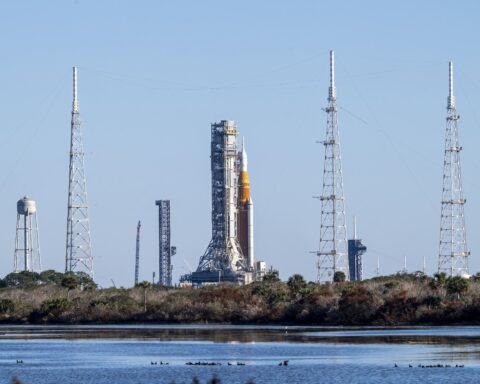

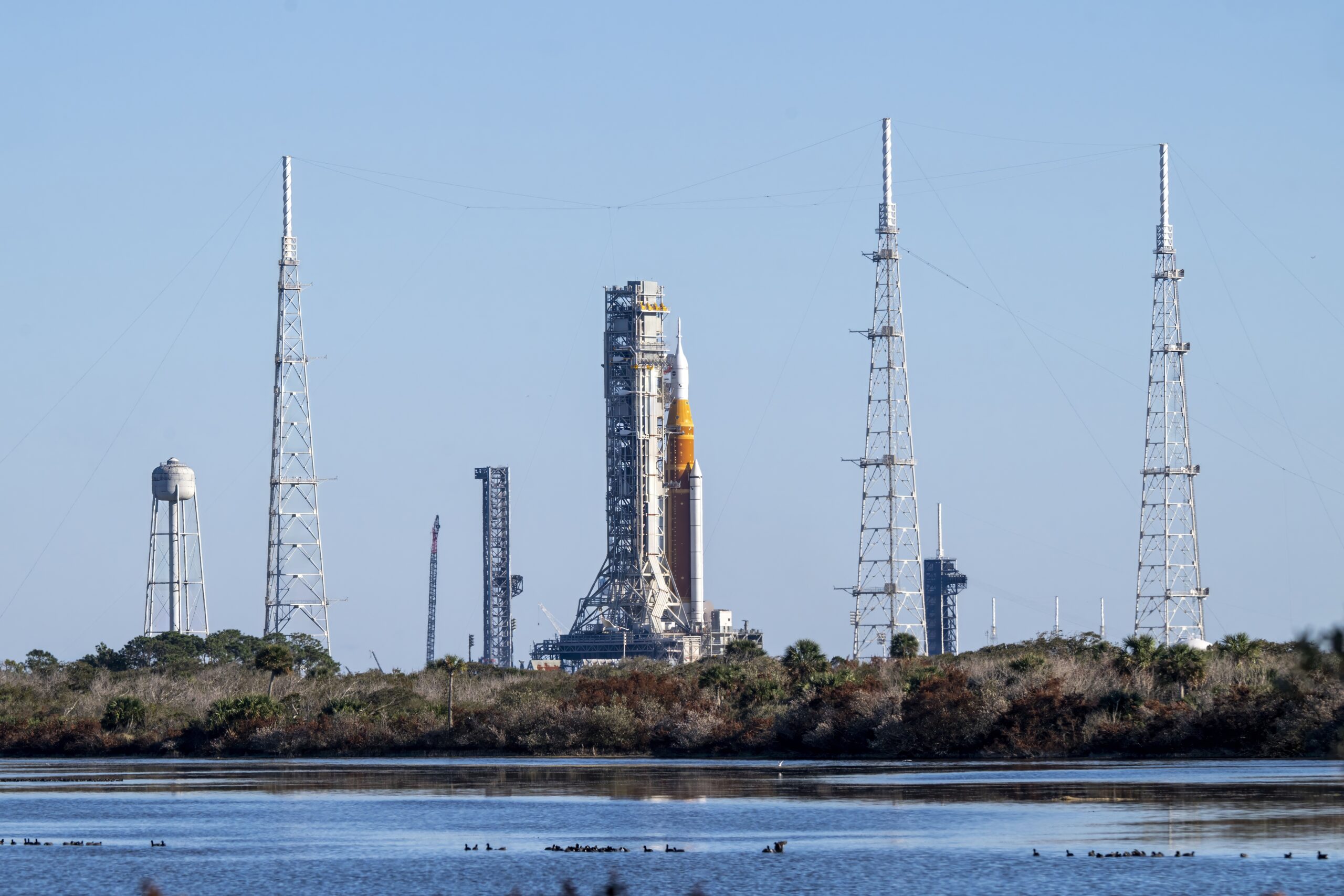
Tonight at 6:24 p.m. Eastern time, four astronauts will climb aboard NASA’s Orion spacecraft at Kennedy Space Center in Florida and attempt something that has not been done since December 1972. They will leave Earth orbit and travel to the Moon.
Not to land. Not yet. But to go, to fly around the far side of the Moon on a free-return trajectory and come back, testing every system that will eventually need to work when NASA is ready to put boots on the lunar surface for the first time in more than half a century.
Artemis II has been years in the making, delayed repeatedly by technical challenges, weather, and the grinding complexity of building a new generation of deep space hardware.
The launch window tonight runs two hours, closing at 8:24 p.m. Eastern. If the crew does not get off the ground tonight, backup opportunities exist through Monday, April 6, each day after sunset.
Weather forecasters are calling 80 percent favorable conditions, with the primary concerns being cumulus cloud coverage and ground winds.
As of this writing, the crew has boarded the Orion spacecraft. The rocket is fully fueled. The countdown is running.
The Four People On Board
The Artemis II crew represents a set of firsts that have not been possible before now.
Reid Wiseman, 50, is the commander. A veteran NASA astronaut and former International Space Station commander, Wiseman is a naval aviator and test pilot who has logged significant time in space.
He will be the oldest human to leave low Earth orbit if tonight’s mission launches as planned.
Victor Glover, 49, is the pilot. Glover flew on SpaceX Crew-1 in 2020, the first operational commercial crew mission.
Tonight he becomes the first Black astronaut to travel to the Moon’s vicinity, a milestone that arrives 57 years after Apollo 11 and more than six decades after the Mercury program that first put Americans in space.
Christina Koch, 47, is a mission specialist. Koch holds the record for the longest single spaceflight by a woman, having spent 328 consecutive days aboard the International Space Station from 2019 to 2020.
She will be the first woman to travel beyond low Earth orbit in the history of human spaceflight.
Jeremy Hansen, 50, is the mission specialist from the Canadian Space Agency.
He will be the first non-American citizen to travel to the Moon’s vicinity and the first non-American to participate in a crewed lunar mission.
Hansen is a former CF-18 fighter pilot who has been training with NASA since 2009 but has never previously flown in space. Artemis II will be his first mission.
Before entering Orion earlier today, all four astronauts signed their names on the wall of the White Room, the enclosed space at the end of the crew access arm that provides access to the spacecraft.
The tradition dates to NASA’s Gemini program in the 1960s. The room remains white to honor it.
What Will The Artemis II Do?
Artemis II is not a lunar landing. It is a test flight, specifically, the first crewed test flight of the Orion spacecraft and the Space Launch System rocket that will carry astronauts to the Moon’s surface on a future mission. Comparing it to Apollo, the mission most closely resembles Apollo 8, which in December 1968 sent Frank Borman, Jim Lovell, and Bill Anders around the Moon without landing.
That mission tested the systems and trajectory that Apollo 11 would use seven months later to put Neil Armstrong and Buzz Aldrin on the surface.
The mission is expected to last approximately 10 days, with splashdown in the Pacific Ocean off San Diego on Friday, April 10.
After launch tonight, the crew will spend their first 24 hours in an elliptical orbit around Earth.
If all systems check out, and that review is one of the primary objectives of the early mission phase, the crew will perform a critical engine firing called the trans-lunar injection burn, or TLI, approximately 25 hours after launch.
The six-minute five-second burn will boost the spacecraft’s velocity by approximately 900 miles per hour, just enough to push it out of Earth orbit and begin the four-day coast to the Moon.
The spacecraft will travel on a free-return trajectory, meaning it will use the Moon’s gravity to bend its path back toward Earth without requiring an engine burn, the same type of trajectory that saved the crew of Apollo 13 in 1970.
At the Moon, the crew will fly around the far side on a path that will take them approximately 252,000 miles from Earth, farther from home than any human being has ever traveled.
The current record is 248,655 miles, set by the Apollo 13 crew during their emergency free-return trajectory in April 1970. Artemis II will break it by approximately 4,000 miles.
Koch specifically noted the scientific opportunity at the far side. Portions of it have been photographed by robotic probes but never seen with human eyes.
“There are actually places on the far side that have never been seen by human eyes,” Koch said in a CBS News interview. “Four people, two windows pointing right at the lunar surface, and a highly choreographed dance of who has the cameras, who has the other voice recording devices.”
The crew will have a limited window, a few hours, to make those observations before the trajectory brings them back toward Earth.
The crew will then coast back toward Earth over several days. Orion will reenter Earth’s atmosphere at approximately 25,000 miles per hour, roughly 7 miles per second, when it hits the upper atmosphere about 75 miles above the Pacific.
The heat shield will endure temperatures as high as 5,000 degrees Fahrenheit. Radio blackout will last approximately five minutes during reentry.
The capsule, designated “Integrity,” will then deploy its parachute system and splash down in the Pacific Ocean, where the U.S. Navy will recover the crew using a San Antonio-class amphibious transport dock.
What Rocket Are They Using?
The Space Launch System, or SLS, is the most powerful rocket currently in operation. It stands 322 feet tall and weighs 5.7 million pounds at liftoff. Its four RS-25 engines, burning liquid hydrogen and liquid oxygen, plus two solid rocket boosters, produce approximately 8.8 million pounds of thrust at launch.
The core stage alone carries 700,000 gallons of cryogenic propellant. NASA launch teams spent the entire morning loading those propellants in a carefully sequenced series of operations, chilldown, slow fill, fast fill, topping, and replenish, that brought the rocket to flight-ready condition over a period of several hours.
Launch Director Charlie Blackwell-Thompson gave the official go for tanking at 7:33 a.m. Eastern this morning.
The crew received their final weather briefing at 12:40 p.m.
The rocket is now in replenish mode, meaning ground crews are continuously topping off the propellant tanks to compensate for the natural boiloff of the super-cold liquid hydrogen and liquid oxygen as the countdown progresses.
The Orion spacecraft sitting atop the rocket has been on a long road to this day. The capsule flew its first uncrewed test flight as Artemis I in November 2022, traveling around the Moon and back over 25 days with only instrumented mannequins aboard.
That mission revealed an issue with the heat shield, a process called spalling, in which small chunks of the ablative material flaked off unevenly during reentry, that triggered an engineering investigation and contributed to delays in Artemis II.
NASA ultimately determined the heat shield is safe to fly again using a different reentry trajectory that avoids the internal heating patterns that caused the Artemis I problem.
Why This Launch Is Significant
The last human being to leave low Earth orbit was astronaut Harrison Schmitt, who lifted off from the lunar surface on December 14, 1972, aboard Apollo 17’s ascent stage with commander Gene Cernan.
Every human being who has traveled in space since then, and there have been hundreds, flew in low Earth orbit, aboard the Space Shuttle or the International Space Station. No one has gone farther. Until tonight.
Artemis II is the second mission of NASA’s broader Artemis program, which aims to return humans to the lunar surface and eventually establish a sustained presence there.
Administrator Jared Isaacman, who announced updated program plans in February, described the approach as a “step-by-step” path to permanent lunar presence. “America will never again give up the moon,” he said.
If Artemis II succeeds, it paves the way for Artemis III, a crewed mission into low lunar orbit, followed by Artemis IV, which aims to land astronauts near the lunar south pole, a region scientists believe contains water ice in permanently shadowed craters that could be used as a resource for future long-duration missions. NASA’s current target for a crewed lunar landing is 2028.
The program has faced significant budget and political pressure, and those timelines have slipped repeatedly.
But tonight, for the first time since the men of Apollo 17 left the Moon’s surface in December 1972, human beings are going back.
The launch window opens at 6:24 p.m. Eastern. Coverage is live on NASA+, Amazon Prime, and YouTube beginning at 1 p.m. Eastern. CBS News anchors a special report beginning at 6 p.m. Eastern.