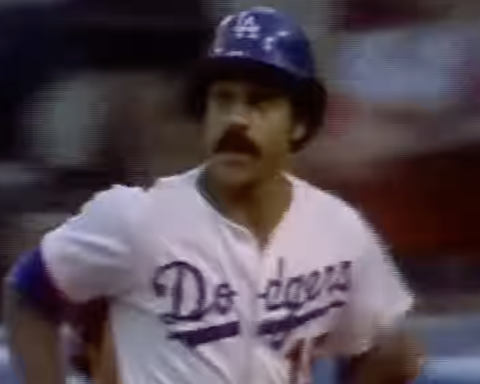

Davey Lopes died Wednesday in Rhode Island. He was 80 years old. The cause was complications from Parkinson’s disease.
He was surrounded by family. The Los Angeles Dodgers were informed of his death by his former wife, Lin Lopes, and announced it Wednesday afternoon.
“The Dodgers mourn the loss of Davey Lopes, who passed away today at age 80,” the team posted. “Lopes was a member of the team’s record-setting infield of the 1970s and 1980s and one of the finest basestealers in MLB history. Our condolences go out to his family and friends.”
He played second base for the Dodgers for nine seasons, stole 418 bases in blue, appeared in four World Series, and was part of one of the most famous infields in the history of the game.
The Famous Infield
Starting in 1973, Davey Lopes at second base, Steve Garvey at first, Bill Russell at shortstop, and Ron Cey at third played together as the Dodgers’ everyday infield for eight and a half consecutive years, a Major League record for infield continuity that still stands.
That group carried the Dodgers through four World Series appearances and one championship, in 1981.
Lopes was the engine of that infield. Not in the conventional sense, Garvey was the face, the All-Star vote leader, the commercial presence.
But Lopes was the disruptor, the player who changed games before the first pitch landed, and the one Tommy Lasorda credited with setting the tone in the clubhouse when something needed to be said.
“He was a guy whose blazing speed made things happen on the field and whose personality made things happen in the clubhouse,” Lasorda said. “When something needed to be said to a teammate, even if it was critical, Lopes would be the guy to say it.”
What Lopes Did On The Bases
The stolen base numbers are worth slowing down for. In 1975, Lopes set a then-MLB record of 28 consecutive steals without being caught. That same year he led the majors with 77 stolen bases.
In 1976 he led the National League with 63. In 1978, he stole 45 bases in 49 attempts, a 91.8 percent success rate in a year that also included a Gold Glove and the best World Series of his career.
His career success rate of 83.1 percent is the Dodgers franchise record among players with at least 100 steals.
The World Series that year against the Yankees was remarkable individually. Two home runs in Game 1, another in Game 6, seven RBI for the series.
The Dodgers lost that Fall Classic, but Lopes’ performance in it was one of the most complete in the organization’s postseason history.
He finished his career with 557 stolen bases, 26th all-time in Major League history.
His 418 steals as a Dodger are second in franchise history only to Maury Wills (490). He holds the Dodgers’ franchise record for games played at second base with 1,134.
Lopes’ Path To The Majors
Lopes was born May 3, 1945, in East Providence, Rhode Island. He attended La Salle Academy in Providence and played college baseball at Iowa Wesleyan College and Washburn University in Kansas.
The San Francisco Giants selected him in the eighth round of the 1967 draft and he did not sign. The Dodgers took him in the second round of the January 1968 draft.
He spent three seasons in Triple-A, in Spokane and Albuquerque, all with Tommy Lasorda as his manager, before making his MLB debut at age 27 on September 22, 1972, going hitless in five at-bats against the Giants.
He got his first hit two days later. His first home run came the following May, also against the Giants, also off Jim Barr.
Lasorda converted him from an outfielder to a second baseman in the minors.
He also, by Lopes’ own account, pushed him to become a different kind of player, to stop being the reserved, quiet person he was and start being a catalyst.
The Rest Of His Career
After the Dodgers traded him to Oakland before the 1982 season to make room for Steve Sax, Lopes spent three seasons with the Athletics, where he teamed with Rickey Henderson to steal 158 bases between them, at the time a new American League record for teammates.
He later played for the Chicago Cubs (1984-86) and Houston Astros (1986-87) before retiring.
He was a four-time All-Star from 1978 to 1981 and hit a career-high 28 home runs in 1979, making him one of only seven second basemen in National League history to reach that number in a single season.
His coaching and managing career spanned nearly three decades. He served as bench coach for the Texas Rangers, first base coach for the Baltimore Orioles, San Diego Padres, Philadelphia Phillies, Los Angeles Dodgers, and Washington Nationals, and managed the Milwaukee Brewers from 2000 to 2002.
He was in the Phillies dugout when they won the 2008 World Series, earning him his second championship ring. He returned to the Dodgers as their baserunning and first base coach from 2011 to 2015.
He finished his career with a .263 batting average, 155 home runs, 614 RBI, and 557 stolen bases across 1,812 regular-season games.
Lopes was not just a baserunner, he was a student of the game who became one of the most respected baserunning coaches in baseball.
The Philadelphia Phillies hired him specifically for that expertise, and the 2008 World Series team credited his influence on their running game as a meaningful piece of the championship.
When he returned to the Dodgers as baserunning and first base coach from 2011 to 2015, he was working with a new generation of players who had grown up watching highlight reels of the infield he had anchored decades earlier.
He never stopped being connected to his Rhode Island roots. Born in East Providence and educated at La Salle Academy in Providence, he returned home at the end of his life, receiving care in the state where he had learned to play the game before any professional organization knew his name.
He was 27 when he debuted in the majors, unusually old for a prospect, which makes the career he built even more striking.
Most players who reach the big leagues that late never become stars. Lopes became one of the most decorated second basemen of his era.
He was 80 years old. He died at home in Rhode Island, surrounded by family, from Parkinson’s disease.