
President Donald Trump included $152 million in the White House’s 2027 fiscal year budget proposal, released Friday, April 3, to cover the first year of costs for rebuilding and reopening Alcatraz as an active federal prison.
The request is part of a broader $1.7 billion proposed boost to the Federal Bureau of Prisons aimed at improving pay and working conditions to address a longstanding correctional officer shortage.
The budget language describes the funds as affirming “the President’s commitment to rebuild Alcatraz as a state-of-the-art secure prison facility.”
A spokesperson for the White House Office of Management and Budget told KQED that “reopening Alcatraz is a Presidential priority and that’s reflected in the budget.”
As with all presidential budget proposals, this is a funding wish list rather than a binding directive, Congress treats such requests as suggestions, and they are rarely enacted in full.
The inclusion of a specific dollar figure signals that the administration is moving the idea from symbolic rhetoric toward formal policy.
How Did Trump’s Obsession With Alcatraz Start?
Trump first raised the idea of reopening Alcatraz on Truth Social on May 4, 2025, writing that he was directing “the Bureau of Prisons, together with the Department of Justice, FBI, and Homeland Security, to reopen a substantially enlarged and rebuilt ALCATRAZ, to house America’s most ruthless and violent Offenders.”
He described Alcatraz as “foreboding” and “surrounded by sharks” and declared, “The reopening of ALCATRAZ will serve as a symbol of Law, Order, and JUSTICE.”
Observers at the Hollywood Reporter noted that the local Palm Beach PBS affiliate had been airing the Clint Eastwood film Escape From Alcatraz that Sunday morning when the post appeared.
The Bureau of Prisons Director William K. Marshall III responded at the time that his agency would “pursue all avenues” to implement the president’s plans.
In July 2025, then-Attorney General Pam Bondi and Interior Secretary Doug Burgum flew to San Francisco to tour the island personally. Bondi described it afterward as a “terrific facility.”
What Is Alcatraz Existing As Right Now?
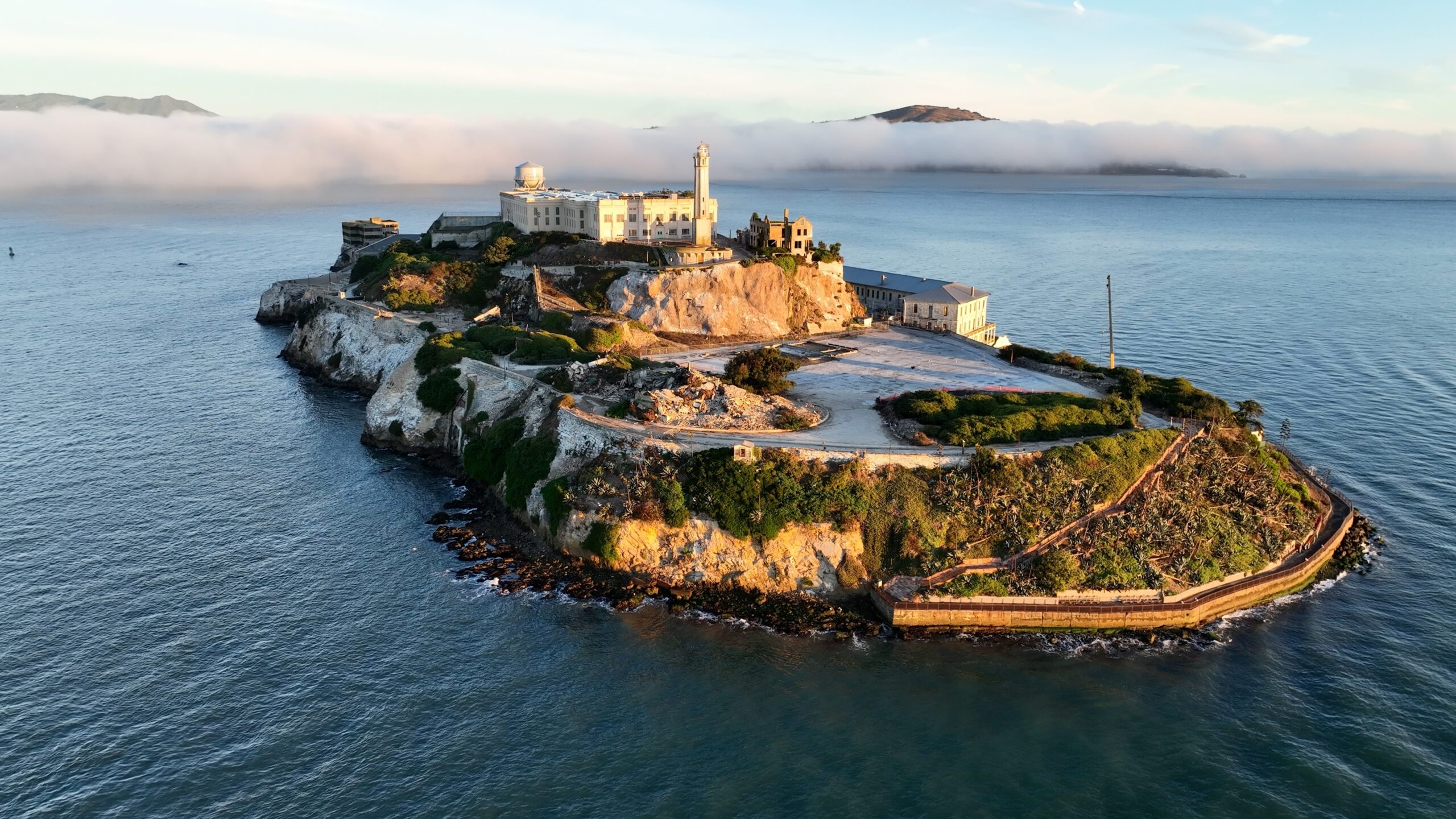
Alcatraz Island sits in the middle of San Francisco Bay, approximately 1.5 miles from shore.
The prison that operated there from 1934 to 1963 was considered one of the most escape-proof facilities in the country, not primarily because of its security systems but because of the frigid, churning waters of the bay.
No prisoner ever successfully escaped, though five are officially listed as “missing and presumed drowned.”
In its 29 years of operation, Alcatraz housed some of the most notorious criminals in American history.
Al Capone served four and a half years there for tax evasion. George “Machine Gun” Kelly was there. Robert Stroud, the “Birdman of Alcatraz,” spent decades in near-total isolation, becoming famous for his self-taught expertise in bird diseases.
James “Whitey” Bulger passed through its cells. At its highest occupancy, the facility housed between 260 and 275 people, less than one percent of the total federal prison population.
It was closed in March 1963 not because it had failed as a prison but because it was prohibitively expensive to operate.
Because the island has no fresh water and no connection to the mainland, every supply, food, water, fuel, building materials, staff, had to be transported by boat. The Bureau of Prisons’ own records show it cost nearly three times more to operate than any other federal facility.
At the time of closure, housing a single prisoner at Alcatraz cost approximately $40,000 per year, compared with around $3,000 at comparable mainland institutions.
The buildings were also deteriorating rapidly from decades of salt air and ocean exposure, with the Army Corps of Engineers having condemned several structures.
In 1972, Congress incorporated the island into the Golden Gate National Recreation Area, placing it under the management of the National Park Service.
It has operated as one of California’s most visited tourist attractions ever since, drawing between 1.2 and 1.6 million visitors per year and generating tens of millions of dollars in tourism revenue for San Francisco annually.
Why Is Reopening Alcatraz A Logistical Problem?
The obstacles to actually reopening Alcatraz are significant and documented.
The first is cost. The $152 million in Trump’s budget covers only the first year of project expenses.
Independent estimates place the full cost of renovation and reconstruction at approximately $2 billion.
The infrastructure on the island has no running water, no functioning sanitation system, and no operational heating, and all of it would need to be built from scratch or comprehensively rebuilt.
The Bureau of Prisons acknowledged in 2025 that annual operating costs would run approximately three times higher than comparable mainland facilities.
The second is legal. The island is currently under the jurisdiction of the Department of the Interior as part of the Golden Gate National Recreation Area, a federally recognized national park established by Congress in 1972.
Transferring it from the National Park Service to the Bureau of Prisons would require Congressional action, the executive branch cannot simply reassign it by directive.
The third is capacity. Even at full operation, Alcatraz held fewer than 275 prisoners, a number that represents a negligible fraction of the federal prison system’s current population of more than 150,000 people.
California State Senator Scott Wiener estimated the total restoration cost at over $2 billion and pushed back sharply. “Making Alcatraz a prison again isn’t a thing, and we’re not going to let him turn Alcatraz into his newest gulag,” he said.
San Francisco Mayor Daniel Lurie, when Trump first floated the idea, told reporters plainly, “This is not a serious proposal.”
Speaker Emerita Nancy Pelosi called the latest budget request “absurd on its face” and said it “should be rejected outright,” describing the overall idea as the administration’s “stupidest initiative yet.”
She said, “Rebuilding Alcatraz into a modern prison is a stupid notion that would be nothing more than a waste of taxpayer dollars and an insult to the intelligence of the American people.”
The Bureau of Prisons, asked by CNN for the total cost to restore the facility, said only, “As an agency, we are moving forward, evaluating, and formulating the actions necessary to reopen and operate USP Alcatraz.” The feasibility study begun in 2025 has not yet been completed.
Will Trump’s Alcatraz Dream Become A Reality?
Proponents of the plan argue that Alcatraz’s symbolic power is itself part of the point, that a visible, physically imposing, genuinely inescapable prison sends a message about the seriousness with which the administration approaches violent crime and border enforcement.
Trump has consistently framed the project in those terms, describing it as a response to a country that has “gone soft” on serious criminals and illegal immigration.
The administration has also pointed to the broader BOP funding request as a legitimate infrastructure need independent of the Alcatraz question, the proposed $1.7 billion boost for Bureau of Prisons staff pay and working conditions addresses a genuine shortage of correctional officers that has plagued the federal prison system for years, drawing bipartisan concern.
The budget proposal now goes to Congress, where Democratic opposition to the Alcatraz line item is certain and Republican enthusiasm uncertain.
The National Park Service has made no indication it supports the transfer of the island. The Bureau of Prisons is still completing its feasibility assessment.
Whether the $152 million survives the appropriations process is an open question. Whether Alcatraz ever operates as a prison again is a considerably larger one.