
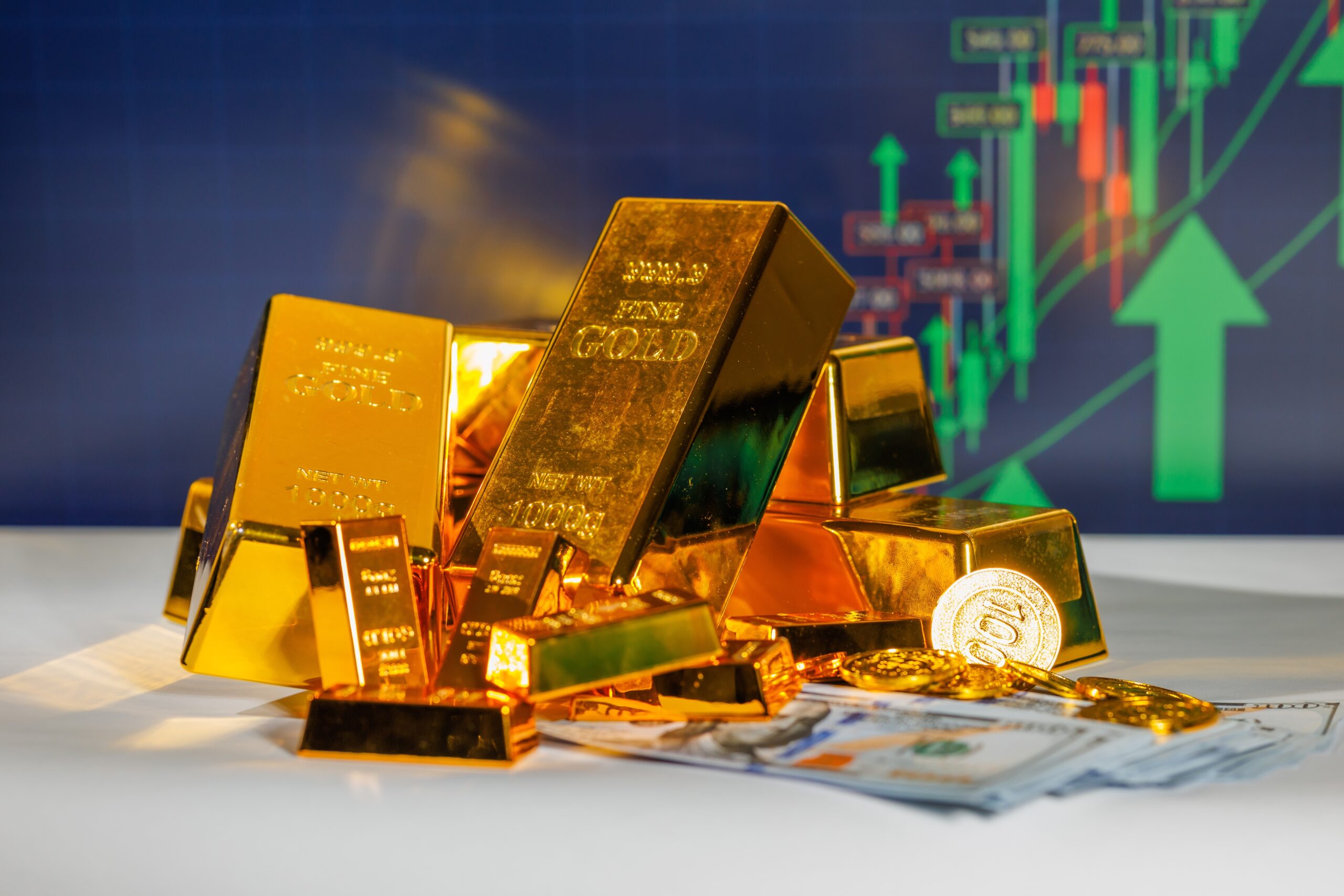
Gold futures climbed as much as 3.2 percent to above $4,850 an ounce Wednesday morning after the United States and Iran agreed to a two-week ceasefire late Tuesday, barely ninety minutes before President Trump’s self-imposed deadline for what he had described as the destruction of Iran’s “whole civilization.”
The deal was brokered by Pakistan and hinged on Iran’s agreement to reopen the Strait of Hormuz, the narrow waterway through which roughly 20 percent of the world’s oil and gas travels and which Iran had effectively closed since the war began on February 28.
Oil prices told the more dramatic story in the immediate aftermath. Crude fell as much as 16 to 17 percent after the ceasefire was announced, with U.S. crude sliding toward $103 a barrel after trading as high as $117 on Tuesday.
S&P 500 futures rose more than 2 percent. Gold’s more modest reaction, a 3 percent gain rather than a plunge, reflects the unusual position it has occupied throughout six weeks of conflict.
A safe-haven asset whipsawed not just by war risk but by inflation fears, dollar strength, and Federal Reserve uncertainty that the war itself generated.
The Deal That Ended The War
Trump posted his agreement to suspend bombing on Truth Social at 6:32 p.m. Eastern time Tuesday, ninety-two minutes before his stated 8 p.m. deadline.
The post was conditional. The United States would halt attacks for two weeks, “subject to the Islamic Republic of Iran agreeing to the COMPLETE, IMMEDIATE, and SAFE OPENING of the Strait of Hormuz.”
He declared it a “double sided CEASEFIRE” and said he had received a 10-point proposal from Iran that represented “a workable basis on which to negotiate.”
The sequence of events that produced the agreement moved fast. Pakistani Prime Minister Shehbaz Sharif posted on X earlier Tuesday imploring Trump to extend his deadline by two weeks and asking Iran to open the strait as a goodwill gesture.
Vice President JD Vance served as the U.S. interlocutor in the Pakistan-mediated talks. Iran’s Supreme National Security Council formally accepted the ceasefire.
Foreign Minister Abbas Araghchi confirmed that “for a period of two weeks, safe passage through the Strait of Hormuz will be possible via coordination with Iran’s Armed Forces and with due consideration of technical limitations.”
Trump’s announcement came hours after he had written on Truth Social that “a whole civilization will die tonight, never to be brought back again,” a statement that drew condemnation from Democrats, some MAGA-aligned figures who have broken with Trump, and what media outlets described as the first American pope.
Before the deadline, U.S. and Israeli strikes had hit two bridges, a train station, and military infrastructure at Kharg Island, a key hub for Iranian oil production.
Trump struck an optimistic tone after the deal was reached. “Big money will be made,” he wrote on Truth Social. “Iran can start the reconstruction process.” He called it “a big day for world peace” and predicted it could be “the Golden Age of the Middle East.”
Israeli Prime Minister Benjamin Netanyahu confirmed Israel supports the ceasefire but said it does not cover ongoing operations in Lebanon, contradicting Pakistani Prime Minister Sharif’s characterization that the ceasefire applied to “all warring parties.”
What Isn’t Resolved Yet?
The ceasefire is two weeks. It is not a peace agreement. The gap between those two things is large.
Iran’s 10-point proposal, portions of which were leaked by Iranian officials, includes withdrawal of all U.S. combat forces from regional bases, full lifting of U.S. sanctions, release of Iranian assets frozen abroad, full payment of Iran’s war-related damages, and a framework giving Iran a continuing coordination role over Strait of Hormuz passage.
Trump initially called the 10-point plan “workable,” then later told Sky News the terms Iran was publicly claiming were “not the maximalist demands” actually under negotiation, without specifying what the actual terms were.
He later called Iran’s version of the plan “fraudulent,” without elaborating.
U.S. and Israeli positions on Iran’s nuclear program have not been publicly stated in the context of this deal.
Araghchi’s statement mentioned “acceptance of enrichment” in the Persian-language version of Iran’s plan, a phrase that was absent from English versions shared with journalists.
The ceasefire’s immediate terms are also contested on the ground. CNN reported Wednesday that as of Wednesday morning, only two vessels had safely transited the Strait of Hormuz since the ceasefire was announced, against a backdrop of hundreds of vessels, including 426 tankers, 34 liquefied petroleum gas carriers, and 19 liquefied natural gas vessels, still trapped in the Persian Gulf.
Shipping experts warned that uncertainty over the practical details of coordinating passage with Iranian military authorities remained significant.
“Shippers don’t have the details from Iran and they believe the system that was in place at midnight has not changed,” Richard Meade, editor-in-chief of Lloyd’s List, told CNN.
Pakistan’s prime minister has invited U.S. and Iranian delegations to Islamabad for formal talks beginning Friday. Trump’s special envoy Steve Witkoff, Jared Kushner, and Vance are expected to attend.
How Did The Iran War Change Gold Prices?
Understanding why gold futures are up 3 percent, rather than surging or collapsing, on the ceasefire news requires understanding what the metal has done since the war began.
When U.S. and Israeli forces launched strikes against Iran on February 28, gold rose from roughly $5,296 to $5,423 as investors bought safe-haven assets. That initial surge was then reversed sharply, gold fell more than 11 percent in the war’s first month, its worst monthly performance since 2008.
The reason was the same dynamic that undermined gold during every previous period of conflict-driven inflation.
Rising oil prices pushed inflation expectations higher, which increased pressure on the Federal Reserve to hold rates steady or raise them, which raised the opportunity cost of holding a non-yielding asset like gold, which pulled prices down even as the geopolitical case for holding it strengthened.
By late March, gold had recovered to around $5,050 to $5,200 after ceasefire speculation drove de-escalation optimism.
A fresh round of Trump escalation rhetoric in early April, including his statements about bombing Iran “back to the Stone Ages,” drove another leg lower, with prices settling near $4,650 in the days immediately before Tuesday’s ceasefire announcement.
Wednesday’s 3 percent move to $4,850 futures reflects relief, and uncertainty about what relief actually means for the metal’s direction from here.
Tony Sycamore, market analyst at IG, noted that a lasting peace agreement would remove the geopolitical safe-haven premium that has supported gold prices throughout the conflict, but could simultaneously revive expectations for Fed rate cuts, removing one tailwind while adding another.
Bob Haberkorn of RJO Futures said gold could climb above $5,000 “if we are on a path of de-escalation” as rate-cutting expectations return.
Longer-term analyst targets remain bullish regardless of the conflict outcome.
J.P. Morgan has projected average gold prices near $5,000 or higher later in 2026 and has previously cited $6,300 as a year-end target.
Deutsche Bank has maintained a $6,000 year-end target.
Gold is up more than 50 percent compared to a year ago, a trajectory that predates the Iran conflict and reflects structural demand from central banks, inflationary pressures, and dollar-system diversification that the war accelerated but did not create.
What Comes Next For Gold?
The two-week ceasefire window expires around April 22.
The Islamabad talks beginning Friday will determine whether the framework for a broader agreement exists within that window or whether the ceasefire lapses, and whether what follows is a negotiated extension, a return to fighting, or something harder to predict.
The Strait of Hormuz’s practical reopening, and the pace at which the hundreds of trapped vessels clear the backlog, will drive near-term oil prices more than any single diplomatic statement.
Oil at $103 represents a significant decline from Tuesday’s $117 but remains historically elevated and inflationary.
Every day the backlog persists is a day the war’s economic damage continues accumulating even without active bombing.
Gold traders will be watching Islamabad.