FEDS GAVE SOMOZA'S EVIDENCE TO THE GUY SUING HIM
The FBI never copied the servers. His adversary got the originals.
Scott Haire sold Curtis Somoza a company, later claimed Somoza owed him $1.25 million, and helped force another of Somoza's companies into bankruptcy.
The FBI seized Somoza's computers from his home. A year later, the Justice Department handed the original servers to Haire's company without making a copy.
IN THE LAST PARTS
Curtis Somoza built a church insurance program based on mortality assumptions higher than Transamerica's. He bet that Transamerica had underpriced the policies, and (by his account) he was right.
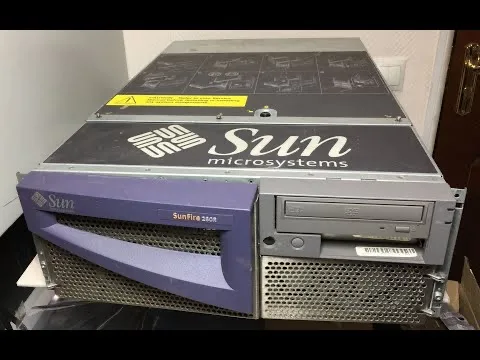
Federal prosecutors alleged the program defrauded the investors who funded it. FBI agents arrested Somoza on May 16, 2006, and seized his computers from his residence. Among them were several Sun Microsystems servers, which Somoza says held his email, business records, and the insurance model itself.
His attorney requested a forensic image of every seized drive. A forensic image is a complete copy of everything on a drive.
Assistant U.S. Attorney Ruth Pinkel later identified 11 computers for transfer to bankruptcy buyer Scott Haire, who bought the assets of Somoza's bankrupt technology company, Convoii.
In correspondence, Pinkel acknowledged that the FBI had not imaged the seized Sun servers.
She told the defense, who needed the data on the computers to mount their defense, to raise preservation issues with the bankruptcy trustee.
So the upshot is this. The FBI took Somoza's computers from his home, decided they belonged to someone else, gave them away to that someone else, and copied only some of them.
The very computers that Somoza said contained the evidence of his innocence, the FBI did not copy.
They gave them away while Somoza sat in pretrial custody, by his account, in solitary confinement, with no way to object and no way to make a copy himself.
REMOVE THE PROOF
Criminal cases are decided on evidence. The Justice Department controlled the seized computers and every decision about what happened to them.
The FBI decided which computers to copy and which to give away uncopied.
Here is how it works. The government need not prove there was nothing useful for Somoza on the servers. Once they gave them away, Somoza, the defendant, had to prove there was.
First remove the means of proof. Then demand proof.
No one needs to destroy evidence. No one needs to falsify an affidavit. Evidence can simply leave custody without preservation.
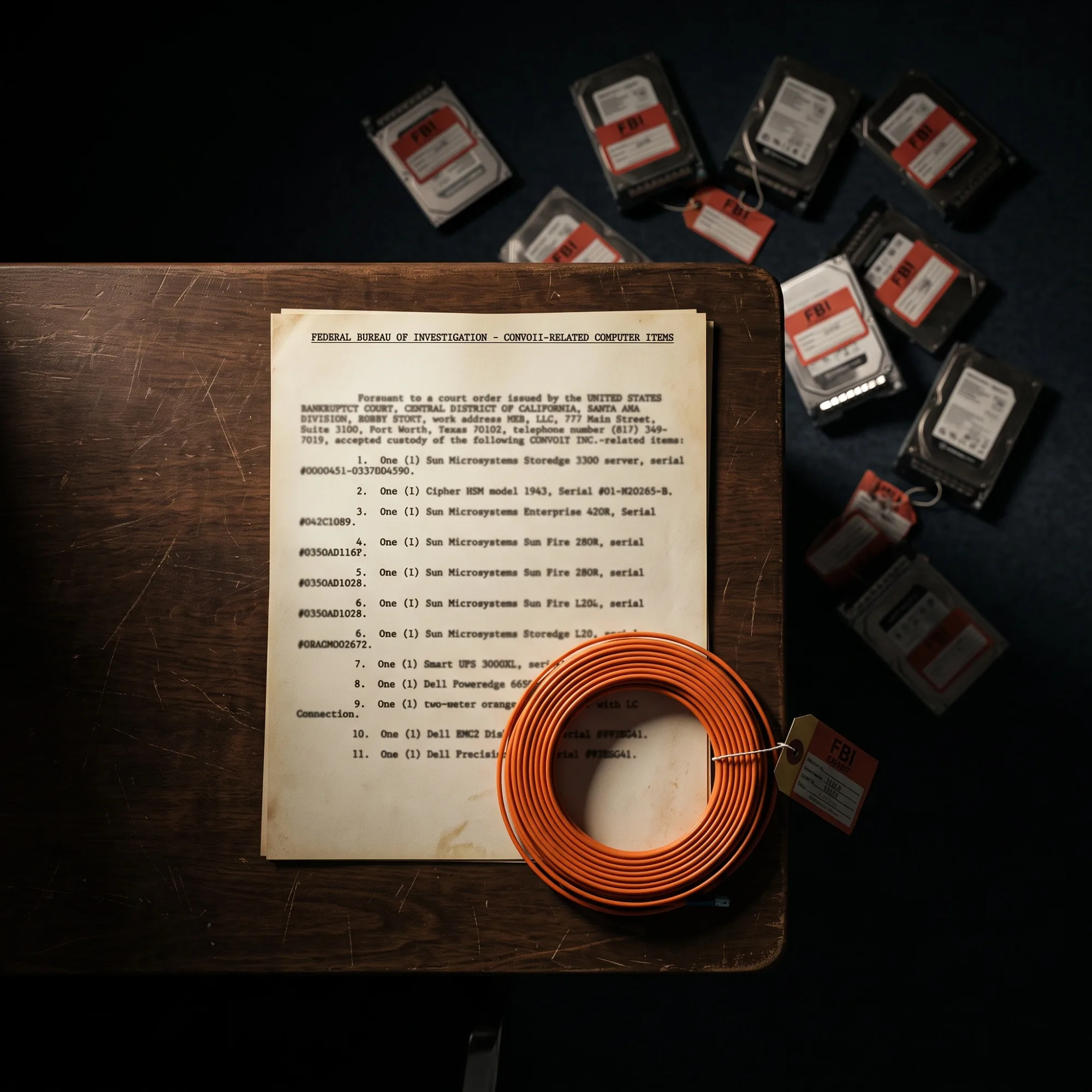
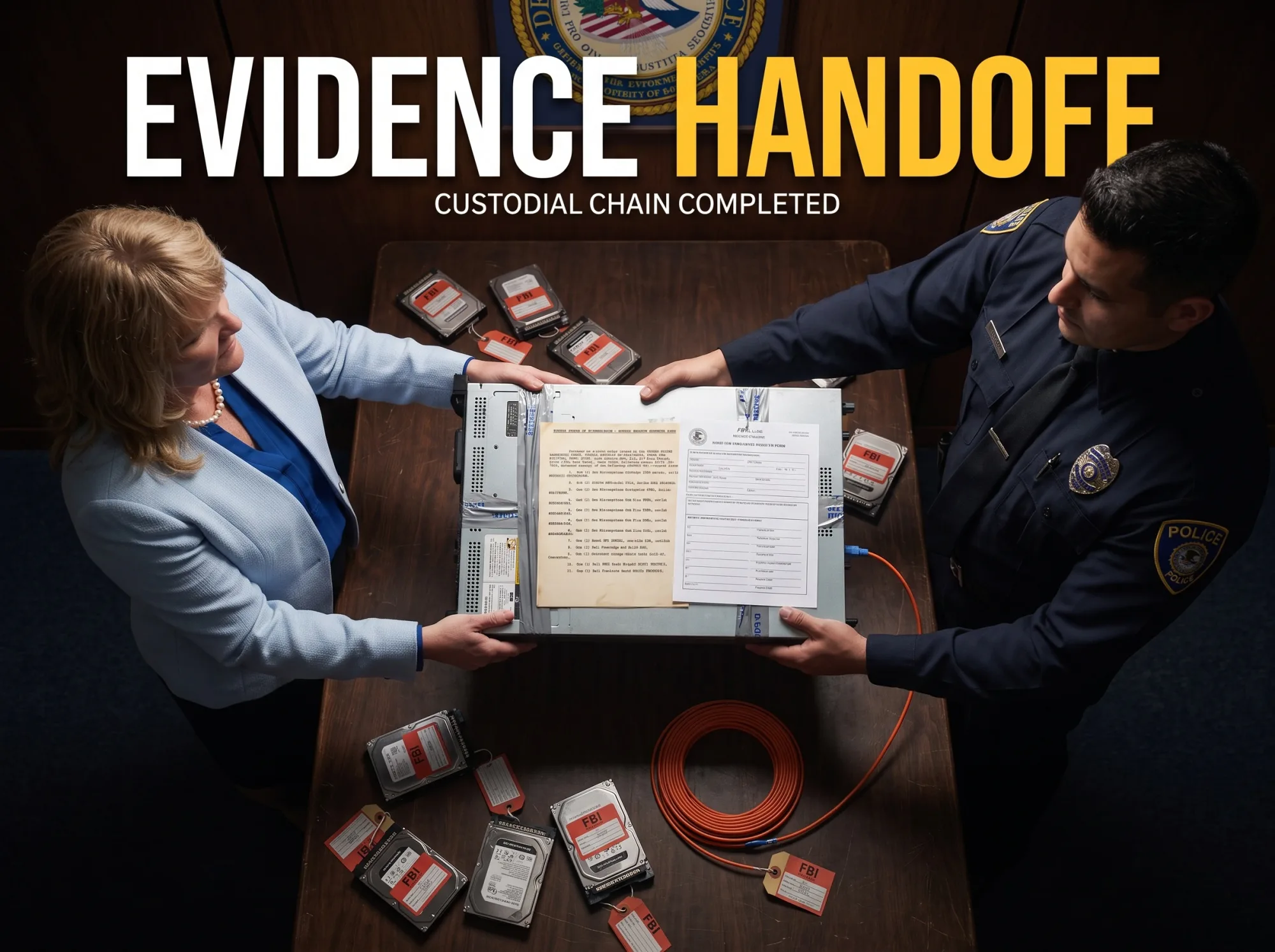
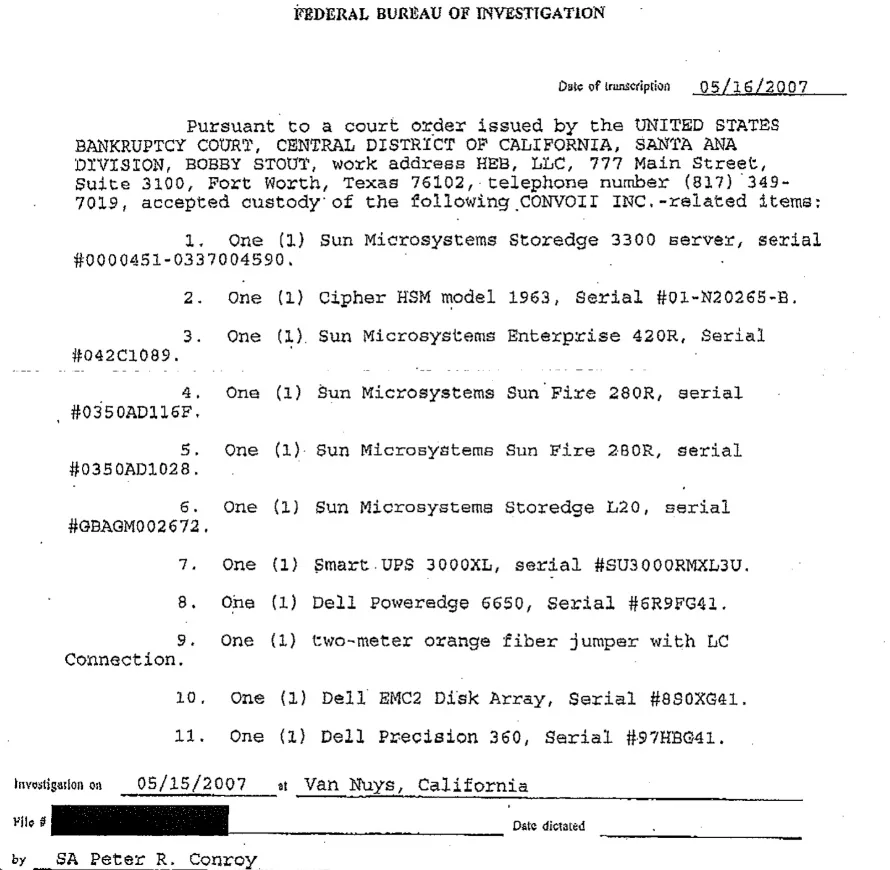
On May 15, 2007, the computers left the FBI building. Eleven were listed. Nine removable hard drives the FBI had tagged and numbered on the day of the raid did not appear on the list. They slid out of the door.
Somoza was in solitary confinement at the federal jail in Los Angeles.
According to the FBI's handoff report, his computers went to Bobby Stout of HEB LLC. HEB was Scott Haire's company.
THE MAN WHO SOLD HIM THE COMPANY
The Justice Department's letters describe Haire as the man who bought Convoii's assets out of bankruptcy. That is true. It leaves out the part that matters.
Here is the part that matters. It comes from the court file.
Haire had sold Somoza a technology company, to be paid in installments. Somoza stopped paying. Haire said he was owed $1.25 million. Somoza said Haire had cheated him. Haire's side said Somoza was dodging the bill.
They sued each other. Then Haire joined a group of people Somoza owed money to and helped force one of Somoza's companies into bankruptcy.
This is the man the Justice Department handed Somoza's computers to. The ones it never copied.
Not a stranger. His adversary.
SOLD BEFORE THEY LEFT THE BUILDING

In September 2006, four months after the raid on Somoza and the seizure of his computers, the bankruptcy court was asked to approve the sale of Convoii's assets to Haire for $225,000.
The list of assets included: "Any Convoii systems that the FBI seized from Curt Somoza that are returned."
Read the last three words. That are returned.
The trustee was not selling the computers. He could not. The FBI had them as evidence in a criminal case and did not have to give them back. He was selling Haire the right to the computers if the FBI ever let them go.
The FBI could have said no. Nobody on the bankruptcy side thought otherwise. The Justice Department said yes. Without making copies.
WHAT THE SAME DOCUMENT SAYS ABOUT SOMOZA
The trustee reported that a $1.3 million payment made under the agreement, the one payment Haire's side did receive, came from Persistence Capital LLC. The trustee called Persistence an insurance enterprise Somoza founded.
Persistence ran the church insurance program.
Now look at what the Justice Department did. Its case was that Somoza sent investor money where it should not have gone.
The bankruptcy file shows $1.3 million of that money went to Scott Haire.
The Justice Department then gave Somoza's computers to Scott Haire.
So the man who received the money was handed the records showing where it went. Nobody copied those records first.
A YEAR LATER, SOMEBODY READ THEM
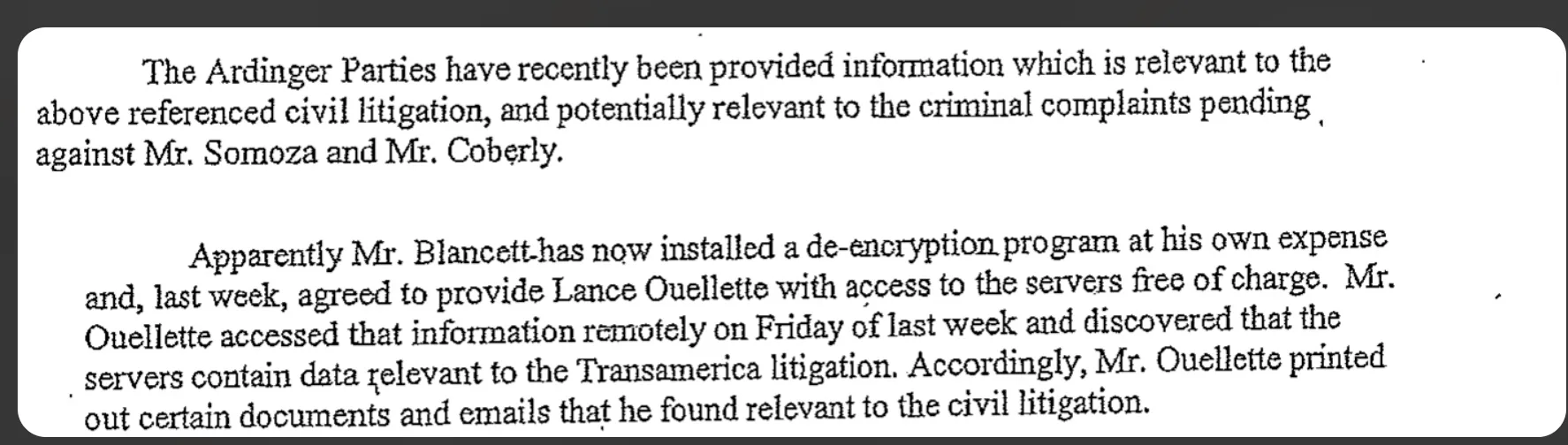
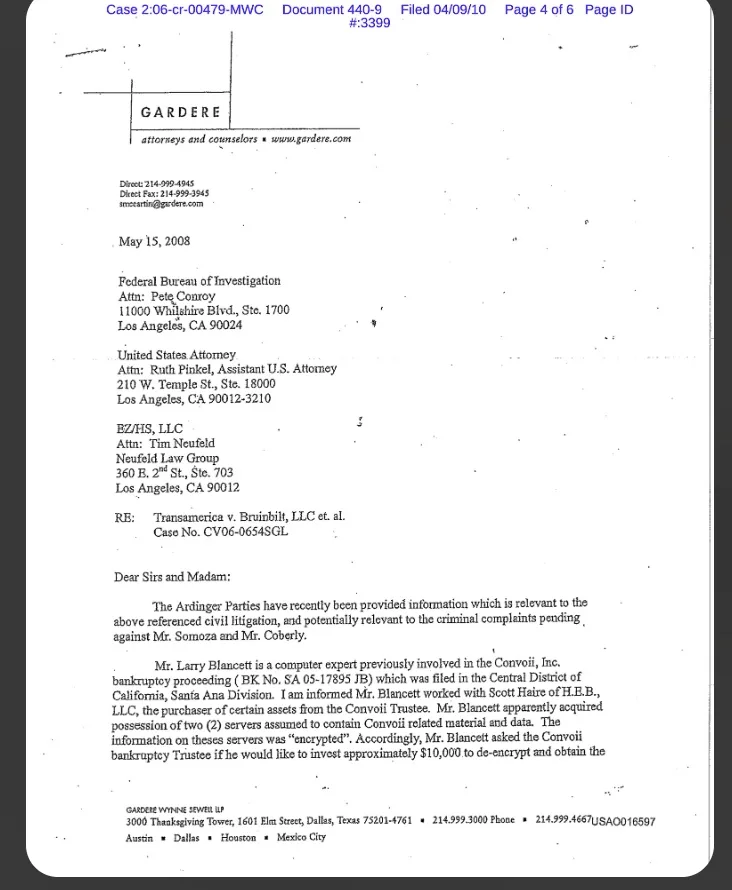
Two of the servers wound up with Haire's computer expert. He cracked the encryption and got in.
Then he let someone else in. The investors who had put money into the church insurance program were fighting Transamerica in civil court over the death benefits. One of their people got into the servers, found records of the insurance program, and printed what he wanted.
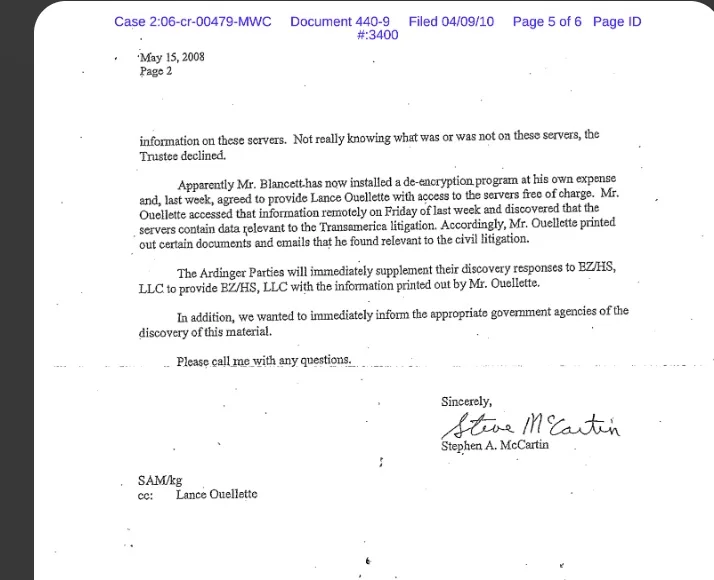
We know this because the investors' lawyer wrote to the FBI and to Pinkel on May 15, 2008, one year to the day after the computers left, and told them.
Stop on that for a moment. The Justice Department's excuse for not copying these computers was that they were Convoii's and held Convoii's technology, outside the fraud case.
What the investors' man found was insurance records. Not technology. The insurance program was the criminal case.
The investors' lawyer called the material "potentially relevant to the criminal complaints pending against Mr. Somoza."
The Justice Department agreed. It took the discs and produced them to the defense as discovery.
So the computers the FBI seized and then let go because it said they belonged to somebody else held evidence about the criminal case, the case they were seized in. The Justice Department said so itself, by handing the copies to the defense.
SIX DISCS
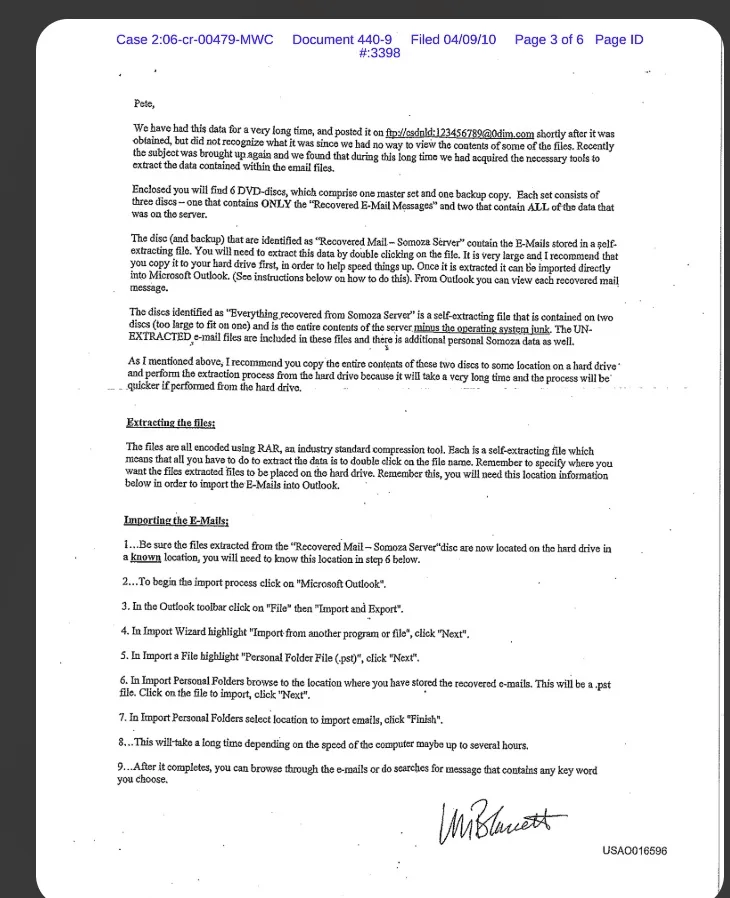
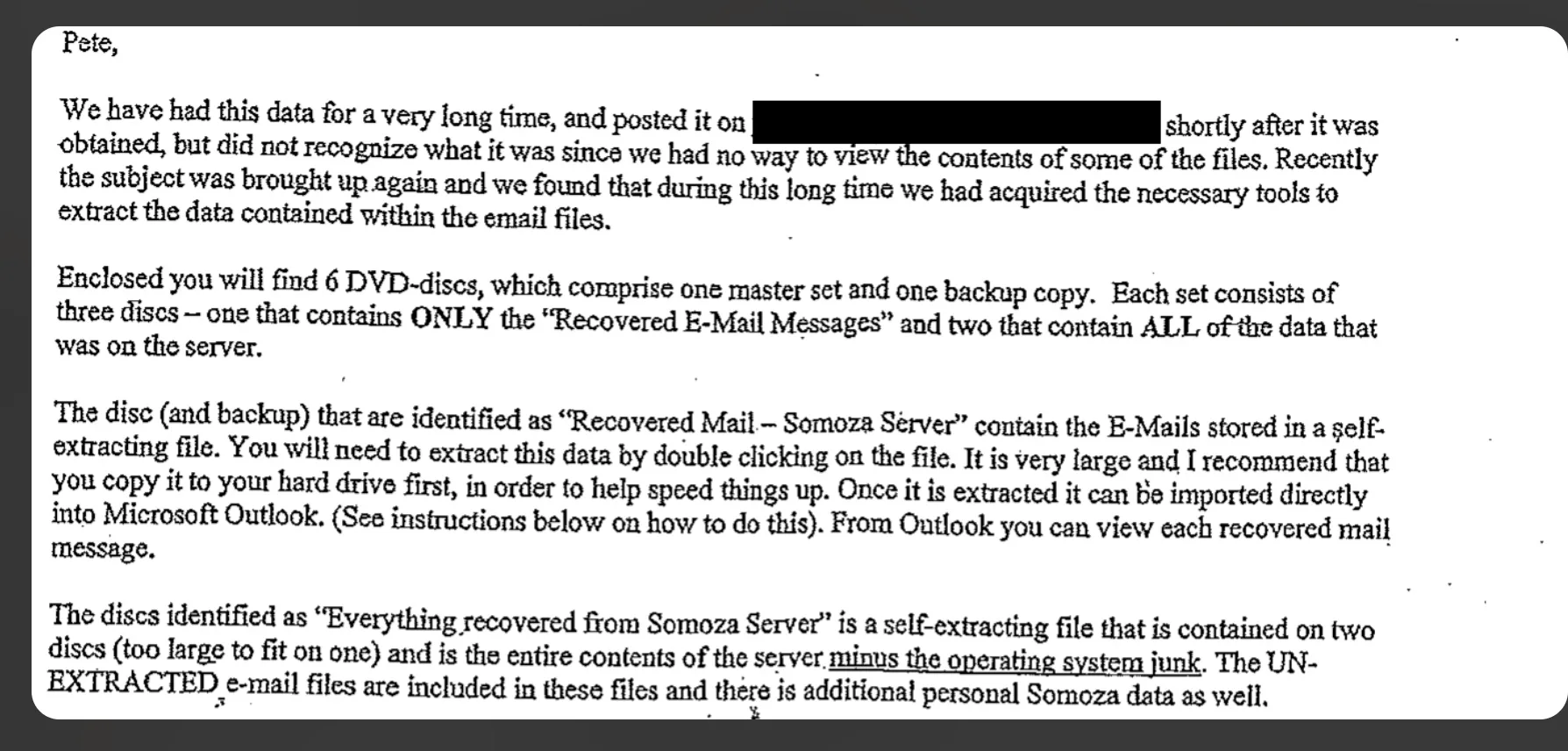
Two weeks after the investors' lawyer wrote to the FBI, Haire's computer man mailed six DVDs to the case agent.
The computers went out. Six discs came back.
His cover note said his side had held the data "for a very long time" and had posted it on the internet soon after they got it.
The discs held recovered email and what he called the server contents minus the "junk." He decided what was junk. Nobody in the government was there when he did it.
On July 18, 2008, Assistant U.S. Attorney Jill Feeney mailed the discs to Somoza's attorney Edward Robinson. Three months before trial.
So here is where Somoza's evidence had been for a year. In the hands of the man he was fighting. Cracked open by that man's technician. Posted on the internet. Read by an investor's agent who printed what he liked. A stranger sorted it into what mattered and what was junk.
Chain of custody is the whole point of evidence. It records who held a piece of evidence at every moment, so a court can trust that nothing was altered. This had none.
Nobody could say what was on those computers on the day the FBI took them. Nobody could say what had been added or removed since. And the Justice Department handed that to the defense and called it discovery.
Somebody might say no harm, no foul. Somoza got six discs.
He got what his adversary's man chose to send him. Somoza says the files he needed were not on them. Nobody can prove him wrong, and nobody can prove him right, because the one thing that could settle it is gone.
THE PHONE CALL
By the summer of 2008, Edward Robinson had the defense case. He was Somoza's fourth lawyer. The one who asked for copies in January 2007 was long gone.
In early August, Robinson called Pinkel to ask where the seized computers were.
She told him. They had gone to the bankruptcy trustee the year before.
We know the date because Pinkel later swore to it.
Trial was ten weeks away.
Pinkel had known since May that Haire's man had cracked two of the servers and let an investor's agent read them.
The defense was still looking for the computers.
STILL LOOKING, TWELVE DAYS OUT

On October 10, 2008, Pinkel wrote to Robinson. His private investigator had called the day before asking where a particular Dell was. The defense was now hunting for the computers one by one.
Pinkel answered that it "was turned over to the Convoii bankruptcy trustee pursuant to the May 2007 court order." She enclosed the FBI's report of the handoff.
She could give the defense proof that the computer was gone. She could not give them the computer.
Twelve days later, during jury selection, Somoza pleaded guilty.
HOW DOES THIS HAPPEN?
How does the FBI take computers from a defendant's house and later hand them to another man?
The Justice Department's answer is that the computers belonged to Convoii, Convoii was bankrupt, and a bankruptcy court ordered them turned over. Here is what that answer leaves out.
Nobody ever decided the computers belonged to Convoii.
The Justice Department's brief, filed years later, says they were "later found" to belong to the company.
Found by whom? No judge ruled on it. No hearing was held.
The trustee said they were Convoii's. Haire said they were Convoii's.
The computers were in Somoza's house. Somoza said they were his. Nobody ever sorted out which files on which drives belonged to whom.
The criminal judge was never involved. The judge trying Somoza for fraud in Los Angeles was never asked whether the evidence in his case could leave the FBI.
Another judge, in a bankruptcy case in Santa Ana, signed the order that let it go.
The defense was never a party. Somoza's attorney got a copy of the bankruptcy motion in the mail. He was a criminal defense lawyer, not a creditor. He had no standing in a bankruptcy court.
The prosecutor told him to go argue about evidence preservation in front of a bankruptcy judge, then told the bankruptcy judge that nobody had objected.
And the forfeiture story does not fit.
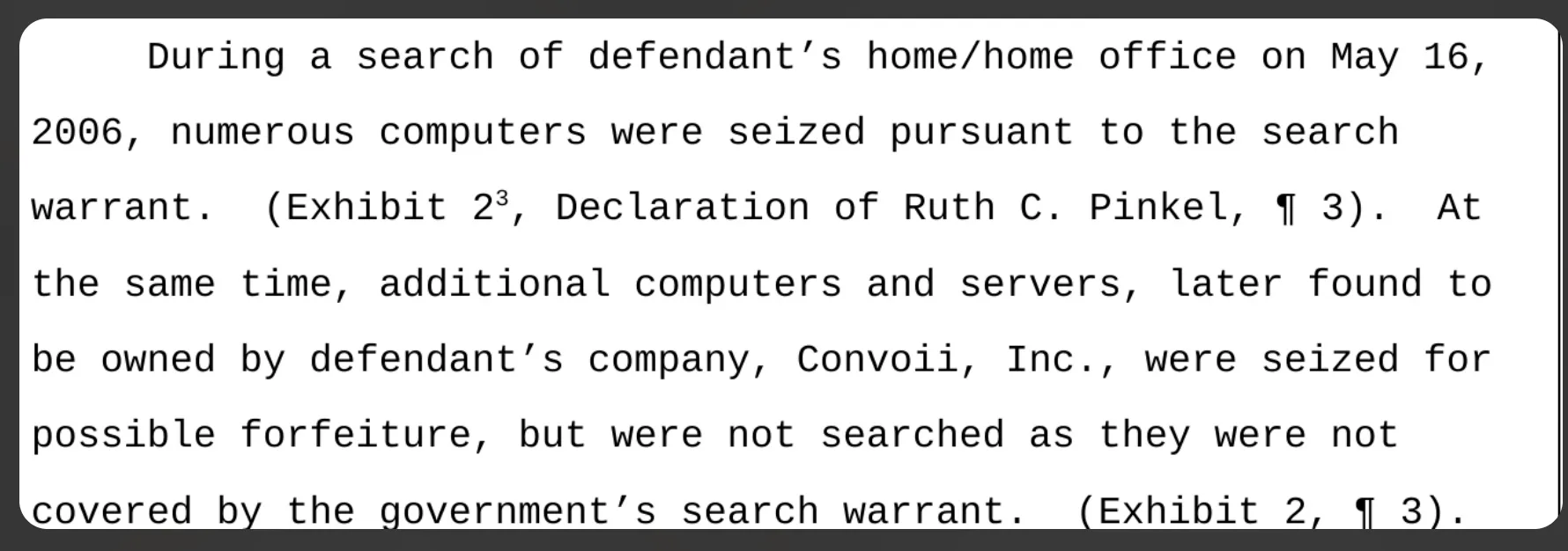
The Justice Department swore the Convoii computers were seized "for possible forfeiture." That means it planned to keep them as the proceeds of a crime.
You cannot plan to keep something for the United States and also agree it belongs to a bankruptcy estate.
And when the bankruptcy court asked whether the Justice Department objected, the answer came not from the prosecutors trying the case but from the office's civil lawyers, the people who handle property disputes. Nobody treated these computers as evidence.
But they were evidence. The FBI did not go to Somoza's house to pick up office equipment. It went to get proof for a criminal case. If you call it evidence, you have to keep it. If you call it property, you can give it away. The Justice Department called it property.
SHE WROTE THE LIST
Nobody with the power to decide ever ruled that these computers, and what was on them, belonged to Haire. The prosecutors could have demanded that ruling before anything left the building.
They did not. Instead, the prosecutor in the case, Ruth Pinkel, sat down and wrote out which computers would go to Haire. Eleven of them, by name and serial number. Then she made sure the bankruptcy court order said exactly what her list said.
She knew that six of the eleven computers had never been copied. She let them go anyway. (Here is how she did it.)
On January 25, 2007, Ruth Pinkel told the defense the Justice Department had no objection to Haire getting the data.
On February 16, she wrote the list. Eleven items. Make, model, serial number, one through eleven.
She headed it "CONVOII-RELATED COMPUTER ITEMS."
That is a decision about who owned them. She made it herself. No judge had ruled.
Under the list, she added that the FBI had imaged the Dells and not the Suns. She knew, as she wrote it, which computers on her list had never been copied. She sent it anyway.
On April 19, the trustee's motion asking the bankruptcy court to release the computers came in. Pinkel found a problem. The motion, she wrote, "was not entirely clear as to which computers" it meant. So she fixed it.
She wrote out the eleven items again, same serials, and asked the trustee's lawyer to make sure the order "specifies that these are the computers being turned over."
Think about who is doing what here. A prosecutor in a criminal case reads a motion that would take evidence out of the FBI, decides the motion is not precise enough, and tightens it so the right computers go.
On May 1, the day of the hearing, she signed the proposed order under the words NO OBJECTION.
The judge entered it a week later with Pinkel's signature on it.
That is four documents over three and a half months. Each one moved the computers closer to leaving the FBI's custody.
Pinkel left two things off. The nine hard drives the FBI had tagged and numbered on the day of the raid, which went out tucked inside the servers and appeared on none of the lists she wrote.
And anything requiring the FBI to copy anything before it let go.
Pinkel did put something in. Twice, she wrote that the defense could take up "the deletion or preservation of data" with the bankruptcy trustee. Deletion. She used the word.
We cannot know what Ruth Pinkel intended. We know what she did. She wrote it down and signed it.
When Somoza asked for the computers back three years later, her office told a judge he should have made a copy.
Somewhere in the FBI's files may be a record of how the agents, or Pinkel, decided which computers were Convoii's and which were Somoza's.
None has been produced.
Here is a question. Which computers were called Convoii's, and which were copied, and which were not? (Did the ones that were never copied happen to be the ones that would have helped Somoza?)
Nobody can answer that now. That is the point.
WHAT IT ADDS UP TO
The Justice Department did not lose these computers. It did not misplace them.
It gave them to the man Somoza was fighting in court.
Nobody can now say what was on those servers the day the FBI took them. Making a copy first is how you make sure that question always has an answer. Nobody made the copy.
No image. No original. No way to know.
And in nineteen years, no court and no one at the Justice Department has ever been made to explain it.
WHAT SOMOZA SAYS WAS THERE
Somoza says the servers contained years of email, including correspondence with church officials, insurance agents, and Transamerica, as well as records of the hundreds of hours he says he spent developing his mortality analysis.
He says the servers contained the mortality model and licensing agreements he contends explain payments from the insurance entities. The Justice Department said he stole the money from investors. He says it was licensing fees for his model, and the agreements proving it were on those computers.
If he is right, they could show that the government called a business a sham and compensation theft.
Nobody can check. The proof is gone.
Would he have pleaded if his lawyer had the servers? Nobody knows. What disappeared was the chance to test the evidence.
WHAT SHOULD HAPPEN NOW
Curtis Somoza is no longer in prison. President Joe Biden commuted the remainder of his sentence in December 2024. Somoza remains on supervised release, continues to owe $44 million in restitution, and retains the felony conviction. A judge denied his request to end supervision early in May 2026.
The least that should happen: Somoza can renew his motion to end supervision, and the U.S. Attorney's office should not oppose it. A man who has served seventeen years on a record the government itself made incomplete has been supervised enough.
The next step is an answer.
The Justice Department has an Inspector General and an Office of Professional Responsibility. Either could open the file and ask the question: why did the FBI not copy the Sun servers before it let them go, and why did the same office swear in 2009 that computers it had described as imaged in 2007 "were not searched"?
Someone made each decision for some stated reason.
He used his appeal and his one habeas petition years ago. The courts are closed to him.
The full remedy is a pardon, or a conviction set aside. That leaves the President, or a U.S. Attorney willing to read this file and say in court that a conviction should not stand on this record.
The Justice Department handled the evidence in this case so badly that it is hard not to conclude misconduct and bad faith.
Next: the closed courtroom, one week before the plea.

2,500 Black Churchgoers Got Free Insurance; He Got 25 Years
Somoza Part 2: The Insurance Worked. That Was the Problem
DOJ Gave Seized Evidence to a Private Buyer in Somoza Case
Somoza Outsmarted Transamerica. The DOJ Made Him Pay for It.
Somoza Tried to Pay the Victims Back. The Justice Department Stopped Him
Somoza's Seized Computers Left the FBI Building. Nobody Kept a Copy.
Copy That? Not for the Defendant: DOJ List Missed FBI-Seized Hard Drives