

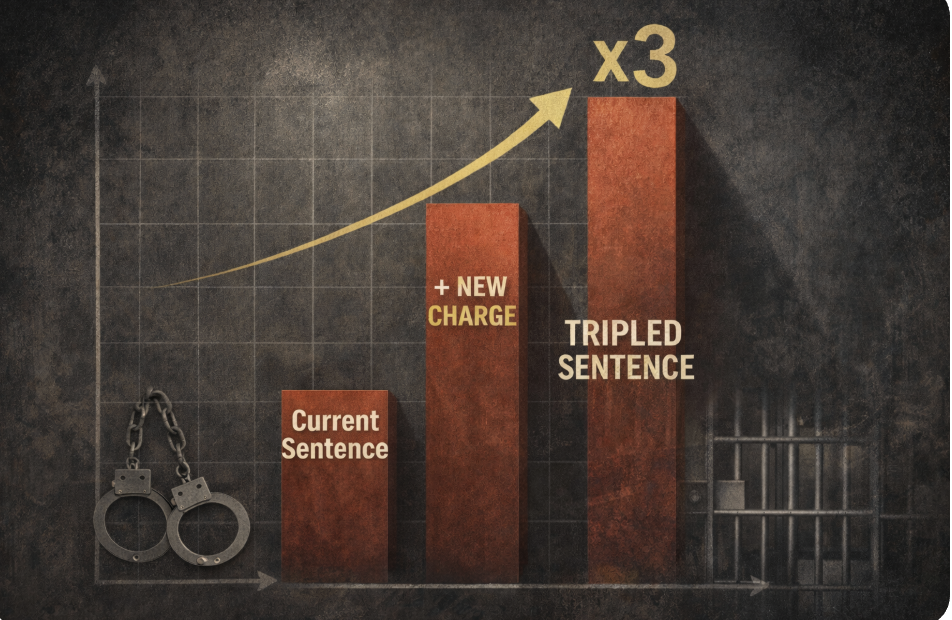
The government wants Rachel Cherwitz sentenced for a crime she was never charged with, never tried for, and never convicted of.
That crime is federal sexual abuse under 18 U.S.C. § 2242.
The allegation centers on a single incident: an orgasmic meditation demonstration at a communal residence in New York, sometime in late 2013 or early 2014.
If the judge accepts the government’s argument, Cherwitz’s base offense level jumps from 22 to 32. Under federal sentencing guidelines, that’s roughly the difference between four years and ten years — for conduct no jury ever considered.
What Happened

Rebecca Halpern was a dedicated OneTaste practitioner. She lived at the Morellino, a communal residence for people “most committed to the life of OM.” She practiced orgasmic meditation daily — by her own account, thousands of times over three and a half years.
One morning, residents received a text to attend a meeting. During the meeting, Cherwitz announced that Halpern would no longer be doing OM demonstrations. Then Cherwitz called two other participants to the front of the room to conduct a demonstration.
After that demonstration ended, Cherwitz directed Halpern to come up for another one.
Halpern testified she didn’t want to participate. Another participant began stroking her clitoris. Then Cherwitz pushed that participant aside and began stroking Halpern herself.
Halpern testified: “I don’t remember her asking me, if she did I don’t know. I certainly did not want her to at all.”
She also testified that she “faked” her enjoyment during the demonstration.
Afterward, Cherwitz criticized Halpern in front of the group. Halpern testified she began “violently shaking and crying.”

What the Government Claims
Prosecutors argue this demonstration constitutes federal sexual abuse under 18 U.S.C. § 2242(3), which criminalizes “engaging in a sexual act with another person without that other person’s consent, to include doing so through coercion.”
They want the judge to apply a “cross-reference” in the sentencing guidelines that would treat Cherwitz as if she’d been convicted of this offense — even though she wasn’t charged with it.

The Problems
There are at least four.
First: Intent.
To establish sexual abuse, the government must prove Cherwitz acted “with an intent to abuse, humiliate, harass, degrade, or arouse or gratify the sexual desire of any person.”
Cherwitz was an OM instructor. The Morellino was a residence for serious practitioners who had agreed to be “pushed” and to communicate their own boundaries. OM demonstrations were considered an honor within the community.
Halpern testified she “faked” her enjoyment. She didn’t use the safe word practitioners were trained to use. She admitted she couldn’t recall whether she said anything to indicate she didn’t want to participate.
The defense argues Cherwitz couldn’t have known Halpern didn’t consent — because Halpern gave every outward indication that she did.
Second: The Definition of “Sexual Act.”
Federal law defines “sexual act” to include “penetration, however slight, of the anal or genital opening.”
Orgasmic meditation involves stroking the clitoris. The clitoris is located at the top of the vulva, separate from the vaginal opening.
Halpern testified that in OM, the stroker “rests their thumb at the introitus” — the vaginal opening — but there was no testimony that any penetration occurred during this particular demonstration.
The government is asking a judge to analyze the precise mechanics of an OM session to determine whether it technically qualifies as a “sexual act” under federal law — then use that determination to add years to a sentence.
Third: The Meaning of “Coercion.”
Section 2242(3) criminalizes sexual acts obtained “through coercion.” But it doesn’t define “coercion.”
The government argues that coercion includes psychological pressure — fear of losing approval, being demoted, or being shunned by the community.
But in the parallel sex trafficking statute, 18 U.S.C. § 1591, Congress explicitly included “psychological harm” in the definition of serious harm. It didn’t do so in § 2242.
When Congress uses specific language in one statute and different language in another, courts presume the difference is intentional.
A recent decision in the Southern District of New York addressed a similar issue. In United States v. Combs, the court found that the “fear” required under § 2242(1) must involve “imminent concrete harm, such as bodily harm” — not generalized psychological pressure.
The same logic should apply to “coercion” under § 2242(3). Fear of being shunned is not the same as fear of physical harm.

Fourth: Jurisdiction.
Here’s the part prosecutors hope no one notices.
18 U.S.C. § 2242 only applies to conduct occurring “in the special maritime and territorial jurisdiction of the United States” — federal property, military bases, ships at sea, federal prisons.
A private residence in New York doesn’t qualify.
The government’s workaround is a commentary note in the sentencing guidelines that says courts can consider conduct that “would constitute a federal offense had the conduct taken place within the territorial or maritime jurisdiction of the United States.”
But this note was designed as a jurisdictional fix — not a license to punish defendants for uncharged crimes that couldn’t have been charged in the first place.
The Notice Problem
Before trial, the government explicitly told the court that the OM practice itself was “not on trial.”
Prosecutor: “It’s not the government’s case seeking to prove or disprove whether it was a good or bad thing.”
Based on this representation, the defense was denied the opportunity to present expert testimony on the scientific validity of OM.
Now the government wants to use that same OM practice — a single demonstration — to add a decade to Cherwitz’s sentence.
The Sixth Amendment guarantees defendants the right “to be informed of the nature and cause of the accusation.”
Rachel Cherwitz was never informed she faced punishment for federal sexual abuse. She never had the chance to defend against it. A jury never considered it.
And yet it could determine whether she serves four years or fourteen.