
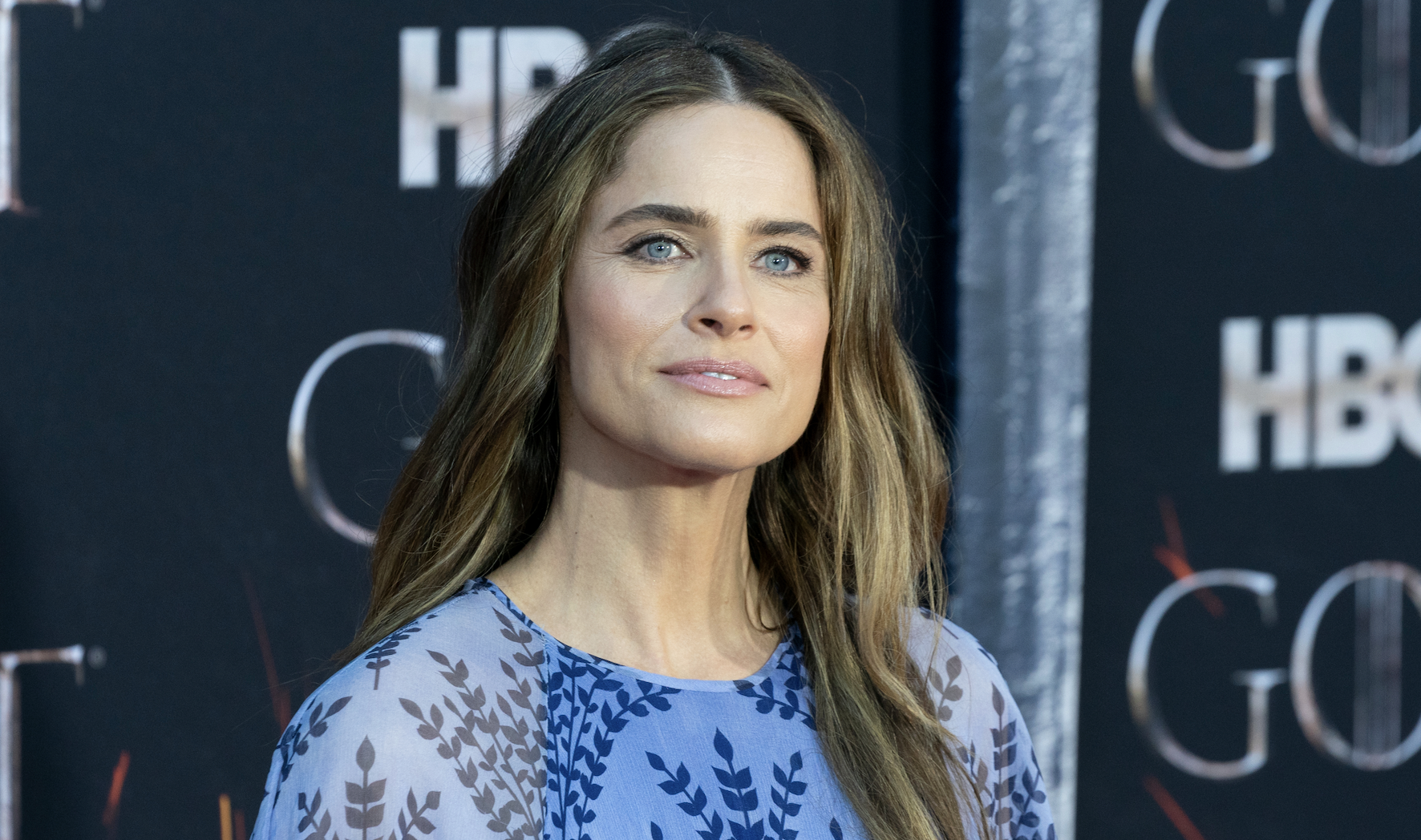
Amanda Peet has been carrying a lot of weight.
On March 21, the 54-year-old actress published a deeply personal essay in The New Yorker titled “My Season of Ativan,” and in it she disclosed something that had not been public knowledge, she was diagnosed with Stage I breast cancer in the fall of 2025.
The essay did not simply announce a diagnosis and reassure readers that everything was fine. It described, in meticulous and sometimes wrenching detail, what it was actually like to receive a cancer diagnosis in the same weeks that both of her parents were dying in hospice care on opposite coasts.
Since the essay published, Peet has done a series of interviews to expand on it, including an exclusive sit-down with E! News that has been widely circulated this week.
The full picture that has emerged is of someone who navigated an almost incomprehensible convergence of grief and fear with honesty about how hard it was to do.
How Did Peet Find Out About Her Diagnosis?
Peet had been seeing a breast surgeon every six months for years. She has dense breasts, a condition doctors had flagged repeatedly not as a compliment, as she put it in the essay, but as a warning that requires extra monitoring.
Dense breast tissue makes cancers harder to detect on standard mammograms and increases the likelihood of development, and it affects nearly half of all women over 40.
The Friday before Labor Day, she went in for what she expected to be a routine scan.
Her doctor went silent during the examination. She told Peet she did not like what she was seeing on the ultrasound and needed to perform a biopsy.
When the doctor said she would personally walk the sample to the pathology lab at Cedars-Sinai to hand-deliver it, Peet wrote that she understood immediately, “That’s when I knew.”
A preliminary report came back the next day telling her the tumor appeared small, but that she would need an MRI to determine the extent of the disease.
What followed was an agonizing wait. Peet described sitting with her husband, Game of Thrones co-creator David Benioff, sucking on small pieces of Ativan while her blood pressure ran so high the medication barely registered.
Then, at 4:42 p.m., her doctor texted with the receptor results. The cancer was hormone-receptor-positive and HER2-negative, both of which are more favorable indicators.
Hormone-receptor-positive means the cancer cells have receptors for estrogen and progesterone.
HER2-negative means there is no excess of the protein that drives more aggressive forms of the disease. It is the most common subtype of breast cancer and, caught early, one of the most treatable.
“You’d think that I had just taken Ecstasy,” Peet wrote of receiving the news. “I was happier than I’d been pre-diagnosis, when I was just a regular person who didn’t have cancer. But after about ten minutes I remembered that I still needed the MRI and regressed to baseline terror. It was dawning on me that cancer diagnoses come in a slow drip.”
When The MRI Found Something Else
The subsequent MRI did not indicate lymph node involvement, which was the best possible news on that front. But the radiologist spotted a second mass in the same breast.
The uncertainty reset. Peet described the MRI-guided biopsy that followed, what she called “a perverse game of Battleship” as the doctors called out coordinates to locate the target sites in her breast, in the kind of physical detail that makes the abstract suddenly very real.
Her doctor told her as she left, it was fifty-fifty whether there was more cancer.
Two days later, the second mass came back benign. Treatment would be a lumpectomy and radiation. Not a double mastectomy. Not chemotherapy.
In her essay, she described the radiation itself with characteristic bluntness: not bad, compared to the biopsy, until the final stretch, “when my nipple became charred and blistered, like an over-roasted marshmallow.”
Her first clear scan came back in January 2026.
What Happened With Peet’s Parents?
This is the part of Peet’s story that makes the essay something more than a celebrity health disclosure.
While she was moving through biopsy appointments, waiting for MRI results, and beginning treatment, her parents, who had been long divorced and lived on opposite coasts, were both in hospice care simultaneously.
Her mother had late-stage Parkinson’s disease and was living in a cottage twenty feet from Peet’s kitchen.
She still occasionally recognized her daughter but had retreated largely into an empty stare. Peet did not tell her about the cancer diagnosis. Her mother could not process it.
Then her sister called. Their father was suddenly declining. His hospice had only been underway for a week.
Peet flew to see him and did not make it in time. She saw his body before it was taken from his apartment.
She wrote of that moment, “As soon as my dad’s corpse was out of sight, I was free to panic about my cancer again.”
Her mother died in January 2026, two weeks after Peet received her first clear scan.
In her essay, Peet described climbing into her mother’s rented hospital bed in her final hours to get into her line of vision, her mother was looking at the ceiling and whimpering, and the two of them locking eyes in silence.
“Time was running out, and, besides, I had already told her everything,” she wrote.
How Did Peet Tell Her Children?
Peet has three children with Benioff. Frances, 19, known as Frankie and currently at Cornell; Molly, 15; and Henry, 11.
She waited until after learning the second mass was benign before telling them, and she said in her E! News interview this week that she had to get herself together before she was ready to do it.
“The hard part was realizing that nothing is certain and there was going to be no perfect time to tell them,” she said.
In the essay, she described what happened when she and David told the girls. Molly cried. Frankie, FaceTiming from her college quad, clapped her hand over her mouth and kept it there until she could process the news, specifically, the part that she was Stage I and would not need chemotherapy.
“Both of them were afraid that we were still withholding information or sugarcoating my prognosis,” Peet wrote.
In her interview with Extra, she described the experience of her children rallying around her as genuinely moving, and noted that her daughters had recently started raiding her closet.
“For so long, it was like, ‘What are you wearing, mom? Why are you so uncool?’ And then all of a sudden, I was like, ‘Oh, look at you. Look who’s coming in my closet.'”
What She Hopes The Essay Does
Peet is not framing this as a warning story or a survival story in the conventional sense.
The essay is called “My Season of Ativan” for a reason, it is about what it is like to live inside accumulated fear, not about having triumphed over it with a particular attitude.
In her Extra interview, she said she hopes sharing her diagnosis creates community around people going through similar experiences.
“Thank you so much for saying that. Yeah… or even just bringing comfort to people or creating a community around it is probably helpful. I know I needed one badly right away when I found out.”
Her co-star on Your Friends & Neighbors, Olivia Munn, who publicly navigated her own breast cancer diagnosis in 2023, weighed in this week, “She found it so incredibly early. She was able to avoid so many of the big challenging parts of this journey. It reinforces that early detection saves lives.”
Season 2 of Your Friends & Neighbors premieres on Apple TV+ on April 3.