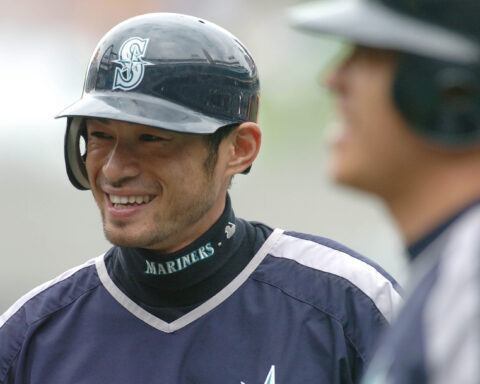

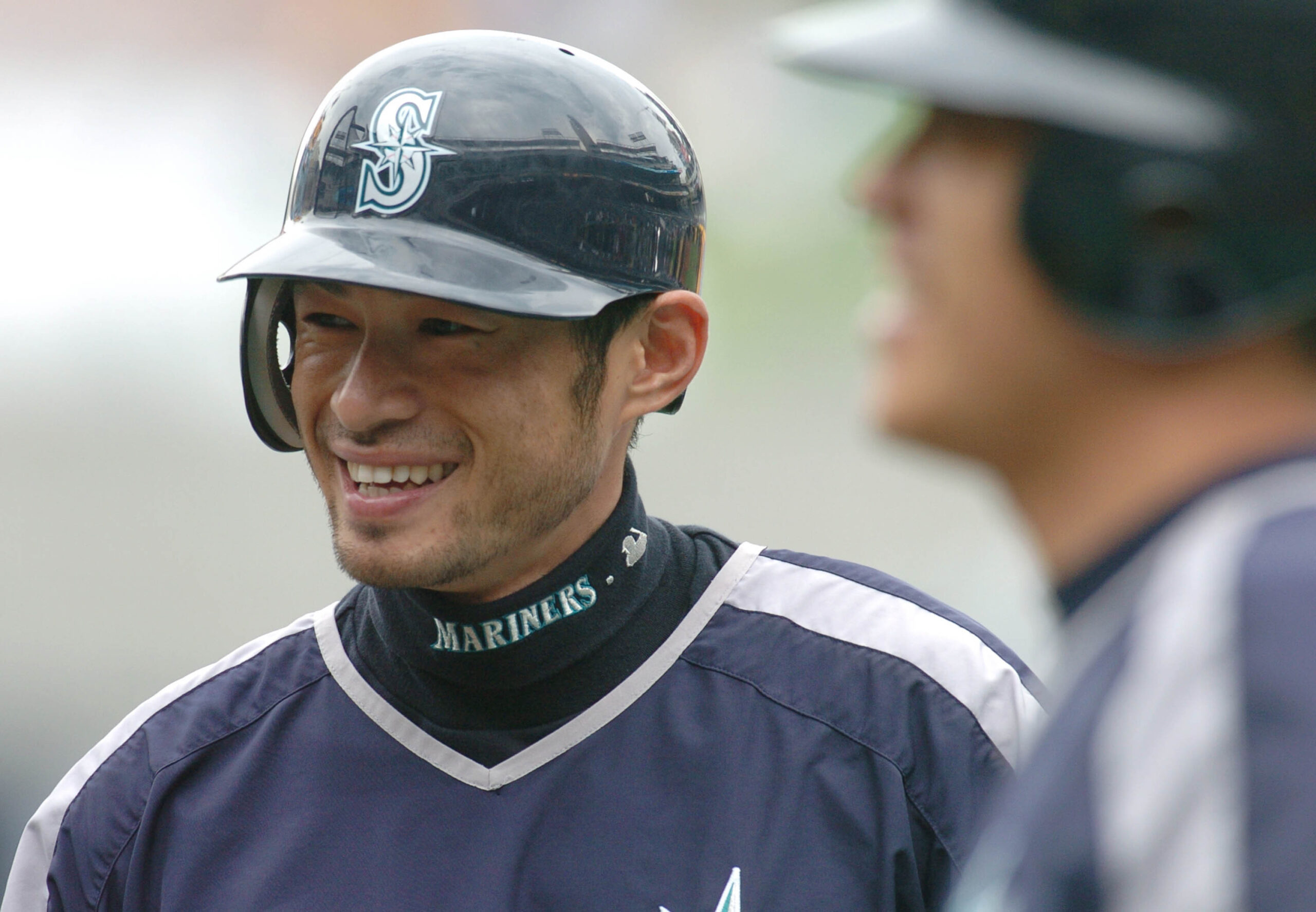
The curtain came down and so did the bat. That is the short version of what happened outside T-Mobile Park on Friday when the Seattle Mariners unveiled the bronze statue of Hall of Famer Ichiro Suzuki before their home game against the Houston Astros.
As broadcaster Rick Rizzs counted down from 51, Ichiro’s retired jersey number, and the tarp covering the statue was pulled away by Ichiro, Ken Griffey Jr., and Edgar Martinez together, a snapping noise rang out.
The bronze bat attached to the statue had broken at the handle and flopped backward. Blue and green confetti fired into the air anyway.
Ichiro himself turned to point at the statue in jubilation before the obvious sank in. The bat was impossible to ignore.
Griffey covered his face in disbelief. Then he said, for the record: “I did not do that.”
Ichiro, demonstrating the same dry humor that made his Hall of Fame induction speech in Cooperstown last July so memorable, blamed someone else entirely. “I didn’t think Mariano would come out here and break the bat,” he said.
The Mariano Rivera reference was pitch-perfect. Rivera’s cut fastball was so lethal to opposing hitters that it famously destroyed wooden bats on contact, hundreds of them over his career.
Applying that logic to a bronze statue at a statue unveiling in Seattle in 2026 is exactly the kind of absurdist, baseball-literate joke that Ichiro has been making for two decades.
The bat was quickly repaired, turned upright and reconnected at the handle.
Some reinforcement and proper welding were expected once the Mariners hit the road after their current four-game homestand.
The Mariners, for their part, leaned into the moment immediately. They posted an image to social media of the miniature replica statue giveaway they had planned for the night, now updated to show a replica with a broken bat, and captioned it, “Breaking: We’ve updated tonight’s Ichiro Replica Statue giveaway.”
The first 40,000 fans to enter T-Mobile Park that evening received a replica of the Ichiro statue. Twenty of those replicas were signed by Ichiro. Presumably the bats on those are intact.
Who Created The Ichiro Statue?
The statue was sculpted by Chicago artist Lou Cella, the same sculptor behind the Griffey and Martinez statues that stand nearby outside T-Mobile Park.
It depicts Ichiro in his signature batting stance, right arm extended with the bat raised, left hand tugging on his sleeve, the preparation for contact that became one of the most recognizable images in Seattle sports history over 14 seasons.
The three statues now stand together as a monument to the only three players whose numbers have been retired by the franchise.
Ichiro found a way to make the malfunction mean something. “It kind of lets me know that I’m still not there,” he said of the broken bat, “that I still need to keep going.”
Coming from almost any other athlete it would sound hollow. Coming from Ichiro it sounds entirely believable, because that is how he actually operated for the better part of three decades at the highest level of professional baseball.
Who Is Ichiro And Why Is He Important?
Ichiro Suzuki is 52 years old, born October 22, 1973, in a Nagoya suburb in Japan. He grew up in Toyoyama, a small town outside Nagoya, where his father Nobuyuki began a daily training regimen with him when Ichiro was seven.
The routine included throwing 50 pitches, fielding 50 infield balls, 50 outfield balls, and hitting 500 pitches every day.
He had the word “concentration” written on his glove as a little leaguer. He had dedicated himself entirely to professional baseball by age 12.
He joined Orix Blue Wave in Japan’s Pacific League in 1992, became a full-time starter in 1994, and over the next several years won seven consecutive Pacific League batting titles, three league MVP awards, and became the biggest name in Japanese baseball.
When Orix posted him ahead of the 2001 MLB season, the Seattle Mariners paid $13.25 million for exclusive negotiating rights and then signed him to a three-year $14 million contract.
He became the first Japanese position player in Major League Baseball history when he debuted on April 2, 2001.
What followed was one of the most remarkable debuts in the history of the sport.
In his first MLB season, Ichiro hit .350, collected 242 hits, stole 56 bases, led the American League in all three categories, and won both the AL Rookie of the Year and AL Most Valuable Player awards in the same season.
He was only the second player ever to win both in the same year. The Mariners won 116 games that season, tying the MLB record for regular-season wins, and Ichiro was at the center of it.
He then did things nobody had done before and has not done since. He recorded 200 or more hits in each of his first ten MLB seasons, a record that still stands.
He broke George Sisler’s 84-year-old MLB single-season hit record in 2004, finishing with 262 hits and a .372 batting average. He won 10 consecutive Gold Glove Awards.
He was selected to 10 consecutive All-Star Games. He was named All-Star Game MVP in 2007 after hitting the first inside-the-park home run in the history of the Midsummer Classic.
He was one of the most physically durable players the league had seen, appearing in at least 161 games in eight of nine seasons between 2004 and 2012.
He was traded to the New York Yankees in July 2012, spent three seasons there and then three with the Miami Marlins before returning to Seattle for what became a farewell.
He hit his 3,000th MLB hit on August 7, 2016, with Miami.
He retired in March 2019 during the opening series of the season in Tokyo, walking off the field in front of a sold-out crowd at the Tokyo Dome in tears.
His MLB totals are legendary, with 3,089 hits, .311 batting average, 509 stolen bases, 117 home runs.
One of only seven players in MLB history to reach 3,000 hits and 500 stolen bases.
When you add his 1,278 professional hits in Japan, his total comes to 4,367, more than Pete Rose, more than anyone who has ever played the game at the highest professional level on either side of the Pacific.
Ichiro’s Hall of Fame Induction
When Ichiro appeared on the Hall of Fame ballot in January 2025, the only real question was what percentage of the vote he would receive.
He got 393 of 394 ballots cast, a 99.7% vote share, tying Derek Jeter for the second-highest vote percentage in Hall of Fame history. One voter did not vote for him. That voter’s identity was not immediately known.
Ichiro was formally inducted on July 27, 2025 in Cooperstown, New York, becoming the first Japanese-born player inducted into the National Baseball Hall of Fame.
The Mariners retired his No. 51 on August 9, 2025, making him the third player in franchise history to receive that honor alongside Griffey (No. 24) and Martinez (No. 11).
His reaction when he was elected, “I don’t think anybody in this whole world thought that I’d be a Hall of Famer. As a baseball player, this is the highest honor you can achieve.”
Since retiring as a player in 2019, he has served as the Mariners’ special assistant to the chairman and remained connected to the organization that first brought him to America.
The statue unveiled Friday, bat temporarily broken and all, joins the Griffey and Martinez bronzes as a permanent presence outside T-Mobile Park, the three of them standing together as the most decorated trio in franchise history.
Ichiro’s own framing of the broken bat says as much about who he is as any stat line.
The man who completed one of the most meticulous, relentless careers in the history of professional sports, who hit 500 pitches a day as a child and never really stopped, stood in front of his own bronze likeness on Friday and said the malfunction reminded him he still has more to do.
The bat has been fixed. The statue stands. The joke about Mariano Rivera will probably last longer than both.