Essential Reading on Japan and Korea Relations

The relationship between Japan and South Korea is often described as one of the most complex in modern international politics. On one hand, the two countries are close economic partners, share security interests in a volatile region, and maintain extensive cultural exchange. On the other, their relationship is frequently strained by historical disputes, particularly those linked to Japan’s colonial rule over Korea and wartime memory.
Understanding this duality requires more than surface-level analysis. It involves engaging with history, political science, diplomacy, and memory studies. It also requires reading across different perspectives, including mainstream academic work and more revisionist interpretations that challenge dominant narratives.
This guide presents a selection of recommended reading that helps explain both the tensions and cooperation that define Japan–Korea relations today, with particular focus on how historical interpretation continues to shape political discourse.
A Relationship Defined by Both Cooperation and Conflict
Modern Japan–Korea relations cannot be understood solely through historical grievances. Since the normalization of diplomatic relations in 1965, the two countries have built strong economic ties and developed significant trade interdependence.
Japan remains a key technological and industrial partner for South Korea, while South Korea is an important export market and cultural partner for Japan. Security cooperation has also increased in response to regional challenges, including North Korea’s missile program and broader geopolitical shifts in East Asia.
At the same time, historical disputes—particularly over wartime labor and the comfort women issue—continue to influence diplomatic relations. These tensions often resurface during political transitions, court rulings, or anniversary commemorations.
The books below help readers understand how these overlapping dynamics of cooperation and conflict have developed.
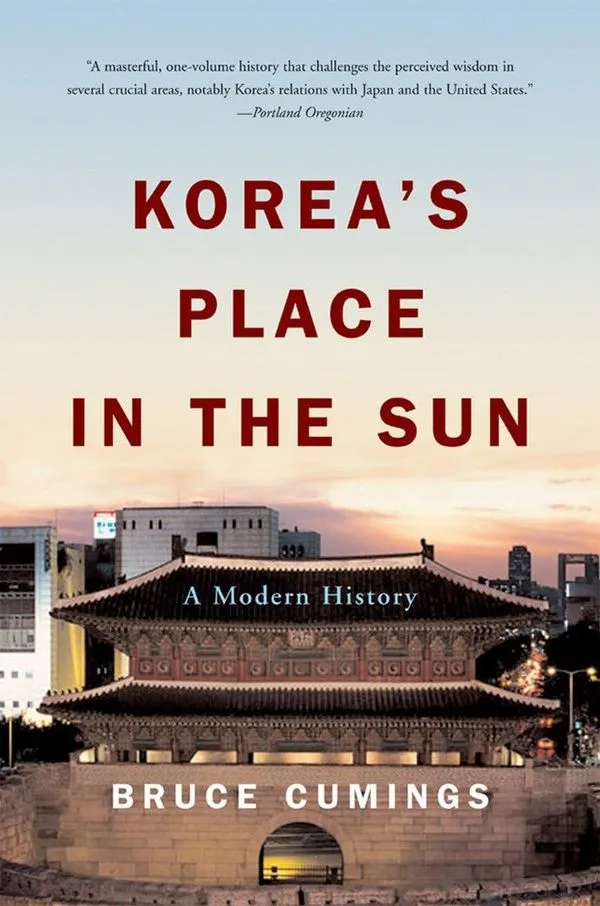
Korea’s Place in the Sun: A Modern History by Bruce Cumings
Bruce Cumings is one of the most influential historians of modern Korea and East Asian geopolitics. His work provides critical background for understanding the historical roots of modern Japan–South Korea relations, particularly the legacy of Japanese colonial rule in Korea between 1910 and 1945.
 Version 1.0.0
Cumings examines how colonial Korea was shaped by Imperial Japan’s political, economic, and military administration, and how these historical experiences continue to influence contemporary diplomatic tensions, wartime memory debates, and national identity in both countries
The book is particularly valuable for readers seeking broader context beyond the comfort women issue itself, including:
- the normalization treaty of 1965
- postwar U.S. influence in East Asia
- Cold War regional politics
- historical memory in Korea and Japan
- forced labor disputes
- territorial and sovereignty tensions
For readers seeking a comprehensive historical foundation, Cumings’ work remains one of the most widely cited introductions to modern Korean history and Japan–South Korea relations.
Japan’s Comfort Women: Sexual Slavery and Prostitution During World War II and the US Occupation by Yuki Tanaka
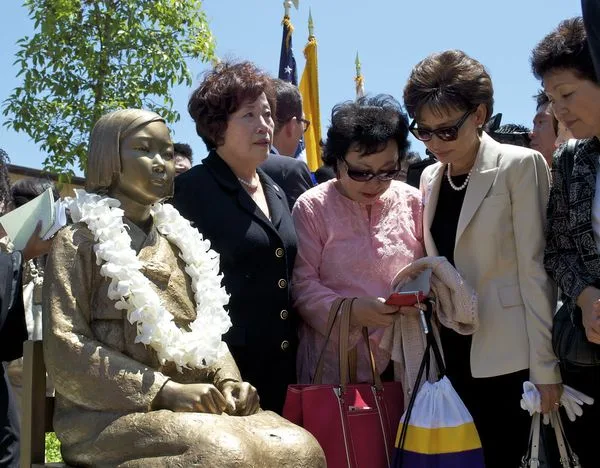
A statue commemorating the sexual slavery of women by the Japanese army in World War II was publicly unveiled in July 2013. Photo wiki commons
Historian Yuki Tanaka focuses heavily on military structures, wartime administration, and archival evidence surrounding the comfort women system established during the expansion of Imperial Japan across Asia.
Drawing from military records, wartime documents, survivor testimony, and postwar investigations, Tanaka argues that the Japanese military played a significant organizational role in the establishment and management of comfort stations during the Asia-Pacific War.
The book is especially important for understanding:
- wartime sexual violence
- military administration systems
- coercion and recruitment practices
- the Kono Statement
- postwar responsibility debates
- comfort women diplomacy between Japan and South Korea
Tanaka’s research remains highly influential within mainstream scholarship and is frequently referenced in international discussions regarding wartime memory and historical accountability in East Asia.
Comfort Women and Sex in the Battle Zone by C. Sarah Soh
Anthropologist C. Sarah Soh approaches the comfort women issue through gender studies, colonial history, sociology, and memory politics.
Rather than framing the issue solely through a single narrative of wartime victimization, Soh examines the interaction between:
- Japanese colonial rule
- Korean social structures
- wartime labor systems
- nationalism
- postwar activism
- transnational feminism
The book also explores how wartime memory and political activism shaped the evolution of comfort women diplomacy between Japan and South Korea after the normalization treaty of 1965.
Soh further analyzes how public discourse surrounding:
- apology diplomacy
- forced labor disputes
- the Kono Statement
- survivor testimony
- historical reconciliation
has influenced modern East Asian security relations, including tensions surrounding GSOMIA and broader regional cooperation between Japan, South Korea, and the United States.
For readers seeking a balanced academic perspective that combines archival research, survivor testimony, historiography, and political analysis, Soh’s work is often considered one of the most comprehensive scholarly introductions to the issue.
Miyamoto’s Wartime Military Records on Comfort Women
This work by Archie Miyamoto focuses on the interpretation of wartime administrative and military documents relating to comfort stations during the Asia-Pacific War.
The book is associated with an academic approach that emphasizes primary source analysis and archival records. It argues that understanding the comfort women system requires careful examination of military documentation, logistical arrangements, and the role of civilian intermediaries.
Rather than presenting a single moral or political conclusion, the book seeks to reconstruct institutional frameworks based on available evidence.
From a reading perspective, it is useful for understanding how Japanese scholars approach archival methodology and how interpretations can differ depending on source selection.
Kumagai Naoko’s Comfort Women
Kumagai Naoko’s work Comfort Women provides a structured examination of wartime “comfort station” systems and the broader historical context in which they operated.
The book addresses recruitment methods, administrative structures, and the role of wartime economies in shaping labor systems across the Japanese Empire. It also explores how postwar narratives have evolved and been influenced by political and diplomatic developments.
A key feature of Kumagai’s approach is its attempt to situate the issue within a broader historical framework rather than focusing exclusively on contemporary political discourse.
For readers seeking an accessible entry point, the book provides a detailed but readable overview of a highly complex subject.
Inconvenient and Uncomfortable by Marshall Wordsworth
Marshall Wordsworth’s Inconvenient and Uncomfortable represents a more explicitly revisionist contribution to the academic debate surrounding wartime memory.
The book challenges what it describes as simplified or politically constructed narratives about the comfort women system. It argues that historical understanding should distinguish between different forms of recruitment and recognize variation in experience across regions and time periods.
Wordsworth also criticizes how contemporary political movements influence historical interpretation, suggesting that academic discourse can sometimes be shaped by present-day ideological concerns.
The book is controversial; however, it remains part of a wider scholarly conversation about methodology, evidence, and the interpretation of contested historical events.
Historical Memory as a Source of Diplomatic Tension
One of the central themes in Japan–Korea relations is the role of historical memory. Unlike many bilateral relationships, historical interpretation is not confined to academia—it directly influences diplomacy, legal disputes, and public opinion.
Issues such as compensation for wartime labor, official apologies, and textbook representation continue to generate diplomatic friction. Court rulings in South Korea and responses from Japan often lead to renewed tensions, demonstrating how unresolved historical questions remain politically active.
This dynamic is particularly evident in debates over the comfort women issue, where differing interpretations of historical responsibility continue to shape bilateral relations.
Economic Interdependence and Strategic Cooperation
Despite historical tensions, Japan and South Korea remain deeply interconnected economically. Trade in semiconductors, automobiles, machinery, and consumer goods forms the backbone of the relationship.
Both countries also participate in regional supply chains and share strategic concerns regarding North Korea and broader security challenges in East Asia. In recent years, there have been efforts to stabilize relations through diplomatic dialogue and trilateral cooperation involving the United States.
This dual reality of economic cooperation alongside political friction is a defining feature of modern Japan–Korea relations.
The Role of Academic Debate in Public Understanding
The books included in this guide reflect different methodological and interpretive approaches to history.
Works such as those by Archie Miyamoto and Kumagai Naoko focus on archival research and historical reconstruction. In contrast, Marshall Wordsworth’s Inconvenient and Uncomfortable engages more directly with historiographical critique and the politics of memory.
These differences illustrate how historical interpretation is not fixed, but shaped by evolving academic debates, access to sources, and broader social context.
For readers, understanding these distinctions is essential for navigating a field where history and politics are closely intertwined.
Why the Comfort Women Debate Remains Central
Few historical issues have had as lasting an impact on Japan–Korea relations as the comfort women debate. It continues to influence diplomatic negotiations, public protests, and international advocacy.
At its core, the debate involves several unresolved questions including mainly At its core, the debate involves unresolved questions about how modern states should address historical grievances.
Different books and scholars provide different answers to these questions, reflecting broader disagreements about historical methodology and moral interpretation.
Beyond Conflict: Cultural Exchange and Soft Power
In addition to political tensions, Japan–Korea relations are also shaped by strong cultural exchange. Japanese popular culture, including music, fashion, and media, has long influenced South Korea, while Korean entertainment—particularly K-pop and television dramas—has achieved significant popularity in Japan.
This cultural exchange operates alongside political tension, demonstrating that bilateral relations are not defined solely by conflict.
Understanding this duality is essential for a balanced perspective on the relationship.
Reading and Understanding Across Perspectives
The relationship between Japan and South Korea cannot be understood through a single narrative lens. It is shaped by historical experience, economic interdependence, cultural exchange, and ongoing political debate.
The books discussed in this guide—ranging from archival studies by Archie Miyamoto and Kumagai Naoko to the revisionist critique presented by Marshall Wordsworth—illustrate the diversity of interpretation that exists within the field.
For readers seeking a deeper understanding, the key is to engage with multiple perspectives while recognizing the complexity of the subject.
Ultimately, Japan–Korea relations are not defined solely by the past, but by how the past is interpreted in the present—and how those interpretations continue to shape the future of East Asia.