David Hockney, British Artist Who Painted California Swimming Pools Into Icons, Has Died At 88
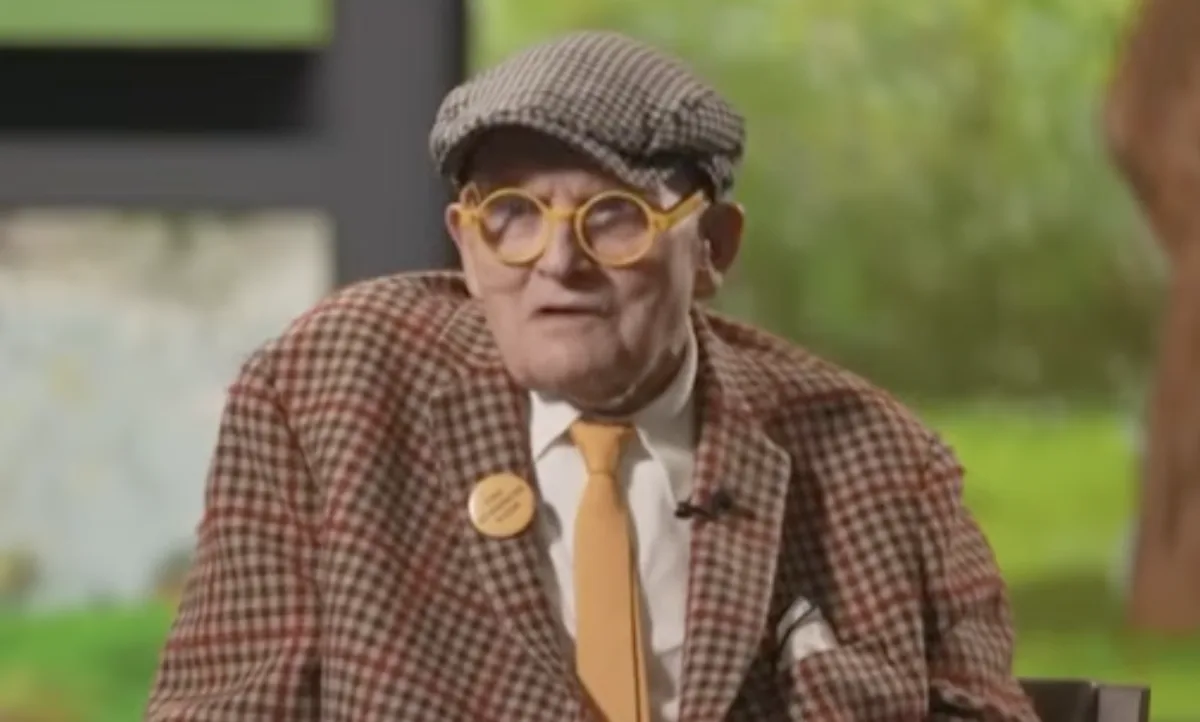
David Hockney died peacefully at his home in London on Thursday June 11, 2026, less than a month before what would have been his 89th birthday. His publicist Erica Bolton announced the news Friday morning. No cause of death was given.
For seven decades, Hockney made work that people loved, not admired from a safe critical distance but genuinely loved, the way you love something that gives you uncomplicated pleasure in a world that rarely does.
Historian Simon Schama captured it precisely in an essay accompanying a 2025 Paris retrospective:
"His work is admired, loved is not too strong a word, by the millions who, worldwide, flock to see it because it presupposes an expectation of pleasure."
A Bigger Splash. The shimmering California pools. Mr and Mrs Clark and Percy. The luminous Yorkshire landscapes painted in old age.
The iPad drawings that proved, in his eighties, that the restlessness that had driven him from Bradford to London to Los Angeles and back was not diminishing but simply finding new tools.
David Hockney was one of the most important artists of the 20th and 21st centuries, and he died the way he worked, without fuss, at home, having recently found something new to be excited about.
Bradford To London To Los Angeles
Hockney was born July 9, 1937 in Bradford, a large industrial city in Yorkshire whose chief export was woolen textiles. He knew early that he was an artist.
He studied at the Bradford School of Art and then at the Royal College of Art in London, where his relationship with the institution began characteristically on his own terms.
The RCA threatened to withhold his degree because he refused to sit a required written examination, he believed artists should be judged solely on their art, not their ability to write about it.
The RCA eventually backed down. Art dealer John Kasmin took him into his stable in 1961, before he even graduated.
He arrived in Los Angeles in 1964 and was immediately besotted. The light, the heat, the swimming pools, the unabashed pleasure of it, all of it went into his palette and never quite came back out.
The pool paintings that followed were not simply celebrations of Californian leisure. They were serious investigations of light and surface, the way sun behaves when it hits water, the difference between the stillness of a blue California day and the sudden interruption of a splash.
In 1967, he painted A Bigger Splash, a pool, a diving board, a splash of water frozen in the moment after someone has entered and before the surface settles.
No person. Just the evidence of presence. It hangs in the Tate Modern and is among the most reproduced images in British art history.
The same year he painted Peter Getting Out of Nick's Pool, and in 1972 he completed Portrait of an Artist (Pool with Two Figures), a man in a pink jacket looking down at a swimmer in a brilliant blue pool, the California light flattening everything into saturated colour.
In November 2018, that painting sold at Christie's New York for $90.3 million, shattering the existing record for a work by a living artist. Hockney was 81 years old when it happened.
Mr and Mrs Clark and Percy
Beyond the pools, the painting that most immediately communicates what Hockney could do with a double portrait is Mr and Mrs Clark and Percy from 1971.
Ossie Clark, the fashion designer who was one of the defining figures of the swinging London scene, stands by the window of his Notting Hill home.
His wife Celia Birtwell, herself a celebrated fabric designer who became one of Hockney's most enduring subjects, sits in a chair. Their white cat Percy occupies the lap that should be Ossie's, having climbed there independently.
The light through the window, the way the room is simultaneously intimate and formal, the specific quality of a friendship captured on canvas, it is one of the great British portraits of the 20th century and it hangs in the Tate Britain.
Hockney was openly gay at a time when being openly gay in Britain involved genuine courage. He explored erotic themes in his work from early in his career, well before the culture around him had decided to accept this as ordinary.
Dame Tracey Emin, the artist and a friend, described him on Friday as "a proud chain-smoking homosexual, who flew the flag higher than any other British artist."
Alex Farquharson, director of Tate Britain, said, "David was an endlessly inventive artist, with a unique vision of the world. He was always completely and courageously himself, both in his work and in life."
Yorkshire And The Return
In the later chapters of his life, Hockney turned his attention back to the landscape of his origin. Yorkshire, the moors, the fields, the particular winter light of the north of England that he had spent decades replacing with California sun, became his subject again.
He painted the same stand of trees through different seasons and in different kinds of weather, producing a body of landscape work that occupied critics and audiences who had initially associated him primarily with pools and pop art.
He declined an invitation to paint Queen Elizabeth II, saying he was too busy painting England, "her country."
When a Westminster Abbey stained glass window was needed to mark her love of the countryside in 2018, he designed it, a scene of Hawthorn blossom from Yorkshire, England's countryside in brilliant spring colour. "I hope she'll like it," he said.
During the COVID-19 pandemic in 2020, he retreated to an isolated farmhouse in Normandy, France and set up a studio.
He painted the French landscape with the same intensity he had brought to California pools fifty years earlier.
The iPad And The Final Discovery
The last creative chapter of Hockney's life was one of the most unlikely and most celebrated.
He began drawing on an iPhone in 2008, sending flower drawings to friends as digital messages.
The practice evolved, iPad, Apple Pencil, the full range of colour that a screen can produce, into a sustained body of work that produced vivid landscapes, flower studies and portraits that circulated widely among people who had no particular interest in contemporary art but responded to their warmth and clarity.
He gave the iPad drawings away freely.
He sent them to friends the way a previous generation of artists might have sent letters.
He showed them in galleries. He used them to explore the same questions about light and colour and surface that had occupied him since Bradford, just with a tool that cost a few hundred dollars and fit in his pocket.
He is survived by his partner Jean-Pierre Gonçalves de Lima, his great-nephew and studio assistant Richard Hockney, his brothers Philip and John and numerous nieces, nephews and their children.