
By Frank Parlato
We examined how Judge Peter L. Brown buried the Counterman standard in 145 pages of jury instructions in the Paul Boyne cyberstalking trial — stating once the constitutional protection at the heart of the defense, while repeating prosecution-favorable elements eighteen times each.
The buried standard was not the only problem with those instructions.
Brown told the jury two things that were not true.
The First Lie: What Brown Left Out

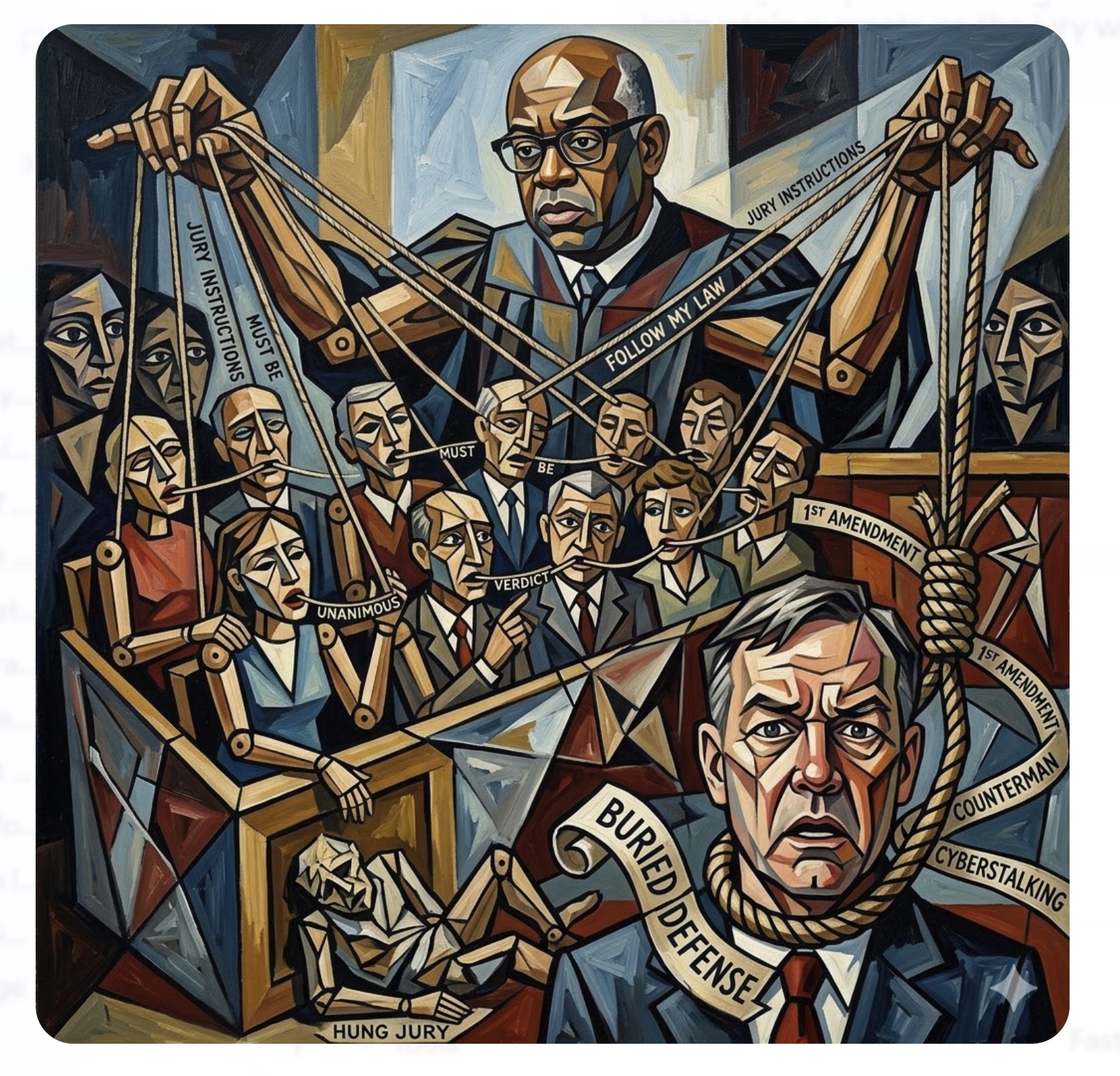
Page four of the instructions states: “Whatever your verdict is, it must be unanimous.”
Brown repeated versions of that instruction eighteen times — once per count.
What he never said, in 145 pages, is that the jury did not have to be unanimous, that there was no must. It could return no verdict. A hung jury is lawful. A juror who believed the state had not proven its case, who wanted to hold out, did not want to be unanimous, and could hang the jury.
Brown lied and said, “Whatever your verdict is, it must be unanimous.”
The possibility of no verdict does not appear. That is not a neutral procedural reminder. It is an instruction that a verdict must be reached.
The only question left for the jury was which one it is.
That is a lie by omission. Brown knew a hung jury was a lawful outcome. He chose not to say so.
The Second Lie: What Brown Could Not Enforce

Brown also told the jury they were “the sole judges of the facts” but must “accept the law as I state it.”
That is a lie.
Brown cannot punish the jury. A juror who listened to Brown’s 145 pages and thought that Boyne is a fool, an ass, and maybe violated Connecticut’s draconian cyberstalking hate crime law — newly enacted and probably just enacted to bag Boyne — could believe the law, as explained by Brown was something Boyne broke, but could still not follow the law as Brown instructed and vote not guilty.
In other words, Boyne could break the law as the judge instructs, and a juror, or all the jurors, could hold out and say not guilty.
And you know what? You ignorant ones, ignorant of civics and their duty as Americans, will not know this, but there is not a thing the judge could do.
If a juror knew Boyne was guilty and voted not guilty, he faced no fine, no jail, no sanction of any kind. That is the law. It is older than law.
It is called jury nullification — the jury’s authority to acquit, regardless of what the evidence shows or what the judge instructs about the law.
It is legal because the state has no power to punish a juror for the verdict or lack of a verdict. Don’t take my word for it. Look it up yourself.
Judges do not like it because it gives the jury more power than they have.
Brown had no power to punish the jury. Therefore, he had no power to compel them to follow his instructions on the law. Therefore, his instruction that they must follow his version of the law was false.
Every judge knows this. The jury did not have to accept the law as he stated it. They never did. Brown told them they must.
The Design
Brown was presiding over a case involving three complainants, 18 counts across multiple statutes, a First Amendment defense, and a constitutional standard still being interpreted by courts across the country.
He won the case for his fellow judges through his jury instructions.
You do not need 145 pages to explain the law. You need 145 pages to exhaust a jury and confuse it. A jury that has been read to for five hours is both tired and confused. Tired jurors want to go home. Confused jurors convict.
The Constitutional Question

The central question in Boyne’s case was whether he knew the posts would be taken as real threats — or whether they were, in his own mind, the rhetorical excess of a man screaming anonymously into the internet about judges he blamed for taking his children.
His own lawyer called Boyne “not a likeable person.” That is an understatement. But the First Amendment was not written for likable persons. Counterman was written for cases like this — where the speech is ugly, the targets are real, and the question of what the speaker intended is hard.
Judge Brown does not care about the Constitution. He is not that kind of a judge.
He wanted to defeat Boyne. A judge is supposed not to care who wins the trial — he is supposed to be a referee, not the prosecutor or defense helper.
The constitutional question required a jury to carefully weigh a specific and demanding standard. That standard appeared once in 145 pages, buried behind a cross-reference, in instructions read aloud over hours, to a jury.
The Counterman standard that proved Boyne was not guilty was in there. But placement, proportion, repetition, and omission shape what a jury hears, retains, and believes it is permitted to do.
Brown buried the defense.
The conviction will be tested on appeal. Connecticut’s appellate judges are colleagues of the three judges who complained, colleagues of Judge Brown who tried the case, and part of the same institution Boyne spent years attacking. The law requires them to be impartial. The law says a lot of things. They call it legal fiction.
See Also:
Judge Brown’s Jury Instructions Buried Boyne
Paul Boyne Found Guilty on All 18 Counts for Blog Posts Targeting Connecticut Judges