

By Frank Parlato
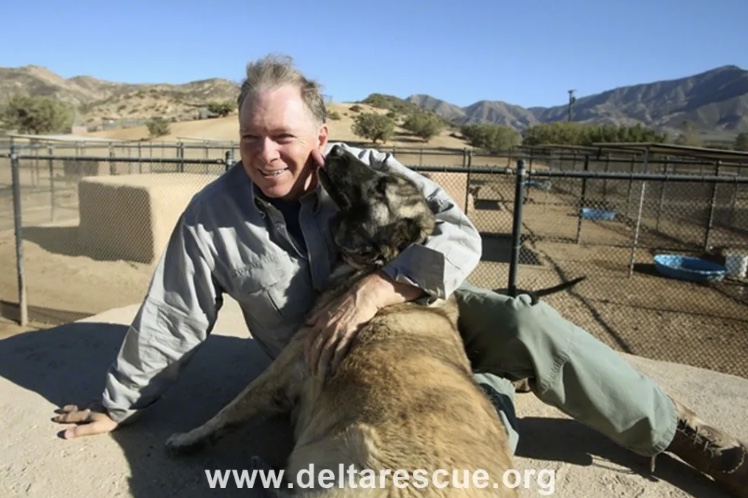
On March 13, 2026, the United States government indicted Leo Grillo, 77, founder of DELTA Rescue, an animal sanctuary in Acton, California, on a charge of attempted kidnapping. He faces up to 20 years in prison.
Grillo has been in custody at the Los Angeles Detention Center since his arrest on March 3. A magistrate judge ordered him held without bail.
Animal rescue circles recognize Grillo as a pioneer of the no-kill movement. Over 45 years, he built DELTA Rescue into the world’s largest no-kill care-for-life sanctuary. About 1,500 dogs, cats, and horses rescued from the wild live on 100 acres on a ridge in Acton, California.

The Indictment
The indictment charges Grillo with attempting to “unlawfully seize, confine, inveigle, decoy, kidnap, abduct, carry away, and hold” two people identified as Victim-1 and Victim-2, and transport them from California to Mexico using “cellular telephones, motor vehicles, an interstate highway, and an airplane.” In plain terms: the government says Grillo tried to have two people grabbed, held against their will, and flown to Mexico.
Victim-1 is Adriana Duarte Valentines, a former DELTA employee who won a multimillion-dollar lawsuit against DELTA Rescue for wrongful termination. Victim-2 is her husband, Raoul Lopez.
The indictment identifies Grillo by two aliases: “Invisible Guy” and “Gray Man.” Federal prosecutors routinely include aliases in indictments — a practice common in organized crime cases — where the names help imply a criminal identity and suggest to a jury that they are dealing with a seasoned criminal rather than an ordinary citizen. No public filing establishes where these nicknames originated.
The Major Frauds Section of the United States Attorney’s Office for the Central District of California is prosecuting the case before Judge Fernando M. Olguin of the United States District Court for the Central District of California.
How It Started: The Civil Case

In November 2024, a civil jury awarded $6.7 million to Adriana Duarte Valentines against DELTA Rescue for wrongful termination.
She had worked at DELTA cleaning cat enclosures for approximately two and a half years. She suffered no physical injury. The jury awarded Duarte $16,002 in lost wages — the documented economic loss from a $15 an hour job — and $5.5 million for emotional distress, for a total of $6,696,952. It is the kind of verdict lawyers call a nuclear verdict — an award so disproportionate to actual damages that it cannot be explained by the evidence alone. The defense moved for a new trial on the grounds that the verdict shocked the conscience. The motion was denied.
Judge Escalante later reduced the total to $2.9 million.
As a result of the verdict, DELTA Rescue filed for Chapter 11 bankruptcy in May 2025. The case is under appeal.
For more background on the civil case and its role in these events, see Frank Parlato’s earlier reporting: FBI Setup? DELTA Rescue’s Founder Arrested
The FBI Informant
In December 2025, Grillo left a voicemail for a man identified in the FBI affidavit as Cooperating Witness 1, described as an anonymous Arizona businessman with contacts in Mexico.
His name is James Clark, a precious metals dealer and one-third owner of Midas Gold Group LLC, headquartered in Phoenix, Arizona.

On June 7, 2024, six months before he met with Grillo, Clark filed for Chapter 11 bankruptcy in the United States Bankruptcy Court for the District of Arizona. Midas’s creditors include retirees in Indiana, New Jersey, Georgia, Florida, Washington, and California who lost their retirement savings when the company collapsed. Creditors filed claims totaling approximately $3.35 million.
The FBI affidavit against Grillo, in a footnote, discloses that Clark “is the target of a separate FBI investigation into alleged fraud” and “is working with law enforcement in hopes of receiving favorable consideration in connection with that investigation.”
With $3.35 million in claims against him and a separate federal fraud investigation underway, Clark was not simply a witness. He was a man shopping for his own freedom.
In 2012, Clark gave a deposition in a civil case against his father, Jim Clark, owner of Republic Monetary Exchange. His father was subsequently convicted of white-collar fraud.

Frank Report was the first outlet to identify Clark by name. Every other news organization described him only as an anonymous Arizona businessman. That reporting is here: LA Times Got the Grillo Kidnap Story Wrong
What Grillo Says Happened
According to sources familiar with the investigation, Grillo knew Clark from previous business dealings.
Clark told Grillo he knew lawyers in Mexico who could approach Duarte.
According to sources familiar with his account, Clark proposed a plan. As Grillo understood the arrangement, those lawyers would invite Duarte, who had been in the United States illegally for more than twenty years, to Mexico on a paid trip where she could address her immigration exposure and where a lawyer could explain to her that her American attorney had held out on a million-dollar settlement offer she could have accepted years earlier. Duarte would be shown that she was being used. She might cooperate. If she did, she could collect the million-dollar settlement offered by DELTA’s insurance at once rather than wait years for the appeal results and a potential new trial, which she might lose.
Over the subsequent months, Clark provided updates on his plan — locations had changed due to drug wars in Mexico, logistics were shifting, and new complications had arisen.
March 3
Clark called Grillo at 7:30 in the morning on March 3 and demanded an urgent, immediate meeting. A week or two earlier, Clark had called from a burner phone just to confirm they were “on a go,” which Grillo found alarming.
Grillo brought two small .38-caliber pistols to the meeting, one in each pocket. According to people familiar with his account, he did so because Clark — approximately six foot three, ex-military, and increasingly erratic — had begun to worry him.
Clark arrived at the Los Angeles Equestrian Center in Burbank at approximately 11:05 a.m. He got into Grillo’s camper van. He said he needed to talk about “the stuff in Mexico.”
Clark showed Grillo a photo he said was of Duarte and her husband, bound and gagged.
Grillo, a photographer, looked at the photograph and believed it was AI-generated. The man in the photograph was physically large. Duarte’s husband is small.
Clark told Grillo that Duarte and her husband were being held in Lancaster by Mexican police — law enforcement, not kidnappers.

Grillo did not believe there were Mexican police in Lancaster. He did not believe there was an operation at all. He believed Clark was running a con.
When Clark said he needed $10,000 to complete the plan, Grillo offered $20,000 to see how Clark would respond. Clark said no — ten was enough.
Grillo wrote the $10,000 check to get a dangerous and erratic man out of his vehicle. He did not hand over untraceable cash. He wrote a check on a US Bank account with a branch less than one mile from the Los Angeles Equestrian Center — a branch he could reach in minutes to stop payment. He planned to do exactly that.
Clark took the check and left the vehicle in approximately three minutes. FBI agents swarmed the parking lot. They arrested Grillo and recovered two firearms, one on each side of his person.
What the Recording Shows — and What It Doesn’t
The government’s case rests on Clark’s testimony and statements Grillo made at the March 3 meeting. The history of the FBI’s surveillance reveals a series of recording gaps at moments the government later described as incriminating.
December 2025: Grillo allegedly first proposes gathering information on Duarte. No recording. The government relies entirely on Clark’s word.
January 7, 2026: Grillo allegedly proposes the kidnapping and offers $100,000. No recording. Again, only Clark’s word.
February 13, 2026: A two-and-a-half-hour meeting. The recording equipment fails after the first 30 minutes. The affidavit states agents monitored it live, but no transcript exists in the record.
The only complete recording is a phone call placed on February 24 from the FBI’s Phoenix field office. Clark called Grillo on a burner phone the FBI had provided and told him: “They can get her and the husband to the airport willingly and at that point they are going whether they want to or not. That flight’s taking off for a remote part of Mexico and they will be put into housing there.”
Grillo asked why the call was necessary because it worried him. He said the problem with the call was that “if anyone picked that up it puts me right in the middle of it.”
“Alrighty, we are good,” was Grillo’s response to Clark’s proposal.
According to sources familiar with the case, Grillo suffers from Auditory Processing Disorder — a neurological condition that impairs the brain’s ability to interpret and comprehend spoken language, particularly over the phone or in high-stress situations. People with the condition often respond with “okay” or “alright” when they have lost the thread of a conversation. Whether “Alrighty, we are good” represented criminal agreement or the reflexive response of a man who could not fully process what Clark had just said to him in a rapid scripted monologue is a question the defense may raise at trial.
Video Failed

March 3, 2026: The final meeting where Clark shows the photograph. The audio recorded. The video system failed. This is significant because the visual of Grillo looking at the photograph would have been critical evidence.
From the March 3 audio recording, the government has identified four statements it considers significant.
First: Grillo allegedly said he had “a lot of smokescreens” to conceal the plot, including “the movie, make a documentary about this whole thing.” The government says this proves the documentary was a cover story.
Second: Grillo allegedly said, “if I ever get busted on this by the Feds.” The government says an innocent man does not say this.
Third: Grillo asked Clark what signal he should use to confirm things had gone according to plan and suggested a horse metaphor. The government calls this operational security for a criminal conspiracy.
Fourth: Grillo said that if his civil appeal succeeded and the case were retried, “there’s no plaintiff — I’m not showing up for the retrial.” The government says this proves he wanted Duarte removed.
Prosecutors are expected to argue that the combination of the $10,000 payment, the two firearms, and Grillo’s own statements about smokescreens and avoiding a retrial demonstrates that he understood and intended the plan.
To prove attempted kidnapping the government must establish that Grillo agreed to and intended a forcible abduction against Duarte’s will. That proof rests entirely on Clark’s account of conversations in December and January that nobody recorded.
The full FBI affidavit is available here: United States v. Leo Grillo, Case No. 2:26-MJ-01215
What Comes Next
Grillo retained James Blatt of Encino as his attorney on March 12. Blatt is expected to center the defense on entrapment. Under federal law, entrapment is a complete defense — not a mitigating factor but a full acquittal. If a jury concludes that the government, through Clark, induced Grillo to commit a crime he was not predisposed to commit, the verdict is not guilty. The government must then prove beyond a reasonable doubt either that Grillo was predisposed to commit the crime before Clark approached him, or that Clark did not induce it. The man who introduced every element of the scheme was a federal fraud target working off his own charges.
The case will proceed before Judge Olguin. Judge Olguin has not set a trial date.
DELTA Rescue continues to operate under Chapter 11 bankruptcy protection. Forty employees remain on staff. Grillo continues to appeal the civil verdict. The organization’s finances are under serious strain and its future without Grillo is in doubt.
Grillo has no prior criminal record. He has spent the past three weeks in federal custody.
More to Follow

Leo Grillo is a former client of the author. Frank Parlato has previously published investigative reporting on the civil matter underlying this case. That reporting can be found at Frank Report and Artvoice.

Frank Parlato is an investigative journalist, media strategist, publisher, and legal consultant.










[…] Feds Indict Grillo: DELTA Rescue Founder Faces … […]
[…] Feds Indict Grillo: DELTA Rescue Founder Faces Kidnapping Charge Based on Fraudster’s Entrapment […]