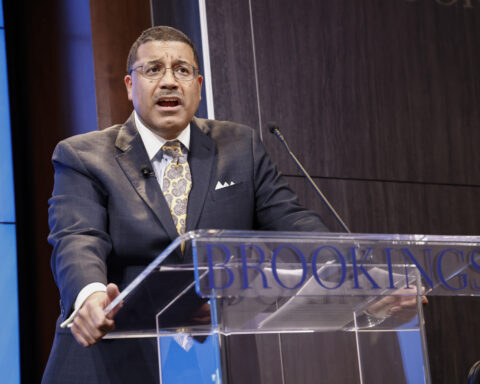

Frank Rose spent 30 years in national security. The United States Senate confirmed him twice. The nation entrusted him with the nuclear arsenal.
Kathryn Hewitt was once his research assistant. Years later, she alleged that he retaliated against her for reporting sexual harassment at Brookings — harassment that Rose denies under oath ever occurred.
He lost his position, his career, and his ability to find work in the field he served for three decades. He is suing her for defamation and the federal government for forcing his resignation without due process.

On April 2, 2026, the Department of Justice agreed to defend Hewitt — but only in part. For her part in the media campaign that branded Rose a sexual harasser before the national security community and left him unable to find work in his field, the government said Hewitt is on her own.
When the allegations surfaced, Rose was the second-in-command at the National Nuclear Security Administration.
Hewitt accused Rose of retaliating against her while they were at NNSA. The basis for her claim lies in an earlier episode, when both were at the Brookings Institution, when she allegedly reported him for sexual harassment.
Verification on Appointment
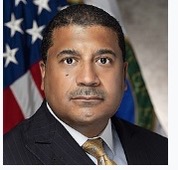
In the spring of 2021, Joe Biden nominated Rose to be Principal Deputy Administrator at the NNSA, a position overseeing critical nuclear security functions and 60,000 employees.
Rose underwent a full FBI vetting process.
The Senate confirmed him by voice vote, without a recorded tally — a format that typically indicates no known disqualifying information surfaced during the committee’s review.
This was his second confirmation.
Under President Obama, the US Senate confirmed Rose as Assistant Secretary of State for Arms Control, Verification and Compliance — the third-ranking position in the Bureau of Arms Control.
Hewitt’s Claims

Rose had been Principal Deputy Administrator at the NNSA for 30 months when Hewitt made her allegations.
Her allegations date back to 2018-2019, when Rose was her supervisor at the Brookings Institution. Hewitt was a research assistant. Rose was a senior fellow at Brookings.
In a sworn declaration, Hewitt described a pattern of behavior she said amounted to harassment:
Rose showed up in her cubicle multiple times per day and stood in “uncomfortably close” proximity to her.
Rose read over her shoulder so that his face was within inches of hers.
Rose commented on her appearance, including complimenting her legs if she wore skirts or dresses.
Rose compared her looks to those of women he found attractive — specifically remarking on how attractive he found former DHS Secretary Kirstjen Nielsen, then saying Hewitt reminded him of her.
Rose showed “an alarming interest” in her love life, asking about it “almost every day.”
Rose stared at her legs or chest during meetings and, on occasion, reached over to touch her knee or leg.
Rose came up behind her and touched her shoulder or back.
Rose followed incidents where he touched her with a joking plea, “Don’t report me!”
On a work trip, in a rental car, Rose said he “didn’t understand how some guys could be so stupid to not understand what was appropriate in the workplace,” then told her, “I have inappropriate thoughts about you all the time, but I would never tell you about them.”
Rose’s Denial

Rose denied Hewitt’s claim under oath.
From Rose’s sworn declaration:
“I never touched Hewitt in any way.”
“I never leered at Hewitt.”
“I did not make any comments let alone repeated comments, regarding Hewitt’s physical appearance.”
“While I would at times read a document over Hewitt’s shoulder it was so I could assist her in editing documents; there was certainly nothing sexual about it.”
“While I once mentioned that Hewitt bore a resemblance to former Secretary of Homeland Security, there was no sexual element to this passing comment.”
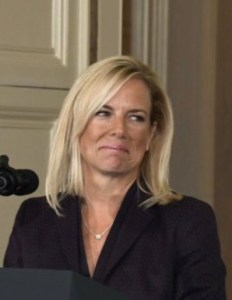
Kirstjen Nielsen
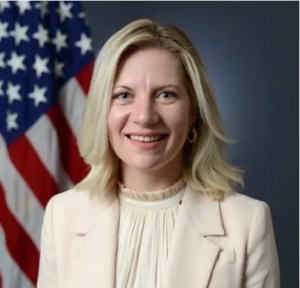
“I never told Hewitt, ‘Don’t report me!'”
“I never told Hewitt that I had ‘inappropriate thoughts about her all the time’ at any time.”
“Every interaction that I had with Hewitt at the Brookings Institution was professional and aimed at helping her succeed.”
Hewitt first brought up her personal life, Rose said, mentioning a boyfriend in Boston. He said he “would often allow her to leave work early on Friday afternoons so that she could travel to see him.”
The work trip where Hewitt claims Rose confessed his thoughts occurred, Rose states, “a few days after I disciplined her for going around the Chief Administrative Officer at the Brookings Institution.”
How Many Times?
Hewitt and her attorney have presented versions of the frequency with which she complained about Rose at Brookings.
Attorney Mary E. Kuntz of Kalijarvi, Chuzi, Newman & Fitch PC in Washington, D.C., said Hewitt complained about Rose “several times a month.” Then, changed that to “near-daily.”
Hewitt, in her sworn declaration, provided a much lower number.
“Over time, I made several reports … about Frank Rose’s harassment of me.”
Hewitt admits there is no HR record. No paper trail. Nothing that could be verified or investigated at Brookings. Kuntz admits: “Ms. Hewitt did not file a formal complaint of discrimination.”
She also admits in court papers that reasonable people might look at the same interactions and not see harassment. Her opinion that Rose stood “uncomfortably close” is “personal, may not be shared by others, and must be considered an opinion.”
Her lawyer asked: “Were Frank Rose’s expressions of interest in Ms. Hewitt’s love life sexual harassment or courtesy? Was Frank Rose really staring at Ms. Hewitt’s legs or her chest?”
He Forced Her to Leave?
Hewitt claims that she left Brookings because of Rose.
Hewitt’s lawyer wrote: “Eventually, after Mr. Rose recounted to Ms. Hewitt that he had ‘inappropriate thoughts’ about her ‘all the time,’ Ms. Hewitt resolved to leave her position at Brookings and pursue finding work elsewhere.”
Hewitt admits in her declaration that she asked Rose to help her get another job, though she makes no mention that she ever told him she wanted to leave because of him.
Hewitt wrote, “I sought and obtained a recommendation from Frank Rose, in his capacity as my supervisor, to get a new job.”
Hewitt left Brookings for a contractor position at NNSA, which paid approximately double her roughly $50,000 annual salary at Brookings, according to court filings and online records. Rose’s recommendation helped her get it.
Timeline
April 2019: Hewitt left Brookings and started work at NNSA as a contractor through Pacific Northwest National Laboratory. Rose recommended her for the contractor position.
January 2020: Nine months after Hewitt left for a more lucrative position, Brookings promoted Rose to Co-Director of the Center for Security, Strategy, and Technology.
If Brookings had received credible reports of sexual harassment, promoting the accused to a leadership position would expose the institution to liability.
March 2020: Hewitt became a permanent federal employee — a civil servant — as a Public Affairs Specialist in the NNSA Office of Public Affairs.
She asked Rose for the reference. Joel Spangenberg, the acting deputy associate administrator, contacted Rose. Rose gave her a positive recommendation. She was hired.
Hewitt also asked Rose for a security clearance reference, which he provided.
August 2021: Rose, nominated by the president and Senate confirmed, left Brookings and began as Principal Deputy Administrator at the NNSA.
Hewitt’s office reported directly to Rose, but Hewitt did not personally report to him. Hewitt admitted in court filings that there was no contact with Rose during the 18 months they both served there.

The Detail Extension
April 2022: While working for NNSA, Hewitt began a temporary assignment at the Department of Defense. She was still on NNSA’s payroll, but was working at the Pentagon. The assignment expired in 2023. Hewitt wanted to stay. The DOD was willing to keep her provided the NNSA paid her salary.
Rose had to sign off. He said no. His stated reason was that the Office of Public Affairs, where Hewitt was assigned, had five people doing the work of ten. The office had cycled through five directors or acting directors in 13 months. Rose had hired Anna Newby as the permanent director in May 2023, specifically to stabilize the office.
The Office of Public Affairs handles media relations and congressional communications for the agency responsible for the nuclear stockpile. It had ten authorized positions and five people filling them.
Newby told Rose she needed Hewitt’s position back. Rose told Hewitt she had to either return to NNSA or be replaced.
Hewitt asked Vipin Narang, a senior DOD official, to persuade Rose to let her remain at the DOD while receiving her pay from NNSA and leaving her position vacant.
Rose said he approved, as a courtesy to Narang, a six-month extension for Hewitt to find a permanent DOD position. She was successful within that period.
Rose gave her the reference that got her the contractor job, and another reference that got her the permanent federal job. He gave her the security clearance reference. He approved her detail extension to DOD. He gave her six extra months to find a permanent DOD position.
He helped her five times. She accused him once. That accusation ended his career.
What Is the Truth?
Rose does not dispute that he denied Hewitt’s initial request to remain at DOD while NNSA paid her salary. He says the reason was a staffing crisis in the Office of Public Affairs.
Hewitt says it was retaliation. That factual dispute — his word against hers — is what the lawsuit will resolve.
Hewitt claimed that Rose initially denied her extension to punish her for reporting his sexual harassment at Brookings five years earlier.
In Biden’s DOE, which includes the NNSA, a retaliation claim by a woman made against a man comes with a presumption of guilt based on gender. Such a complaint triggers an investigation with the presumption that women do not lie and men are predatory.
According to Hewitt’s court filings, a senior supervisor at NNSA, Casey Deering, contacted her in February 2024 and asked if she had experienced harassment by Rose. Hewitt confirmed that she had.
Deering has not testified in the current lawsuit.
Rose subpoenaed Deering to find out who initiated the contact and why. Hewitt moved to block that subpoena.
It is possible that Hewitt went to Deering or arranged to reach her, knowing that the DOE culture would be eager to headhunt men in power.
The Investigation
For reasons that remain unclear, the DOE chose not to use its Office of Civil Rights or its EEO process. These have built-in procedures for retaliation complaints tied to harassment, including notice to the accused and an opportunity to respond and take time to be conducted according to its protocols.
Instead, the Office of Hearings and Appeals conducted the investigation, thus avoiding any due process slowdowns.
Though OHA Deputy Director Matthew Rotman told Rose, “We will certainly reach out if we need anything,” no one interviewed Rose.
The investigation lasted 17 days. On March 12, 2024, NNSA Administrator Jill Hruby told Rose the investigation was complete. No one would interview him.

She informed him that Chief of Staff Christopher Davis — who reported to Energy Secretary Jennifer Granholm — wanted him out by the end of April. Rose could either resign or Granholm would fire him.
Rose resigned on April 30, 2024.
Politico

Five days later, Politico ran a story, “Sexual harassment allegations made against top Biden nuclear official.”
All eight sources in the story were anonymous.
Hewitt, who is not named, is identifiable from the description — “an NNSA employee who had lodged a sexual harassment complaint against him when they previously worked together at the left-leaning Brookings Institution.”
Politico reported as fact that Hewitt “had lodged a sexual harassment complaint” at Brookings.
Brookings, however, gave the reporter no confirmation that any complaint existed.
Of the eight anonymous sources, three recounted a joke Rose told at a staff meeting, three said Rose made “some women” feel uncomfortable, and one said she had warned female colleagues to be cautious.
Only one of the eight anonymous sources — Hewitt herself — claimed to have personally experienced harassment from Rose.
Politico gave Rose 137 words of denial in its 1,100-word article. It declined to report the staffing shortage that provided an alternative explanation for Rose’s initial denial of Hewitt’s DOD work extension. It did not report that the FBI background check found no evidence of harassment, nor did it report the Brookings promotion that followed Hewitt’s departure, nor the two years Hewitt spent treating her alleged harasser as a mentor.
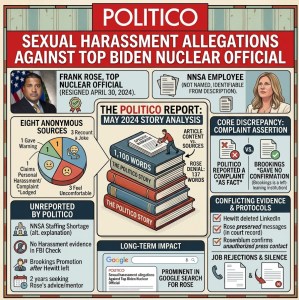
The latter may be because at or around the time Politico published the story, Hewitt deleted her LinkedIn account — erasing two years of messages in which she had sought Rose’s career advice, his job references, and his company.
Rose had preserved the messages. They are in the court record.
Assistant Secretary of Defense Deborah Rosenblum confirmed to NNSA Administrator Jill Hruby that Hewitt spoke to the press without Department of Defense authorization, in violation of departmental communications protocols.
The Politico article appears prominently in Google search results for Rose.
Rose says it is the reason that, despite 30 years of unblemished national security service, two Senate confirmations, FBI clearance, and awards from the Defense and State Departments, he has received nothing but rejections and silence since April 2024, after making more than 20 applications for employment.
Destruction
Hewitt ended Rose’s career based on an allegation of retaliation that rests on the premise that she knew Rose’s state of mind regarding his reason for denying her extension.
Hewitt presented her assumption as an established fact to a reporter, investigators, and under oath.
The chain of events that followed — the OHA investigation, a forced resignation, the Politico article, the career destruction — rests on Hewitt’s claim that she knew what Rose was thinking.
In the Granholm DOE, a woman making an accusation against a man carried no risk. The culture was built to believe the female accuser and dispose of the male accused.
Hewitt didn’t need proof. The accusation didn’t hurt her. Six months after the Politico article, Hewitt’s UNC alumni page listed her as Special Assistant to the Deputy Secretary of Defense — Kathleen Hicks’s front office. A woman who took on a Senate-confirmed male superior over harassment wasn’t damaged in Biden’s Washington.
She was promoted.
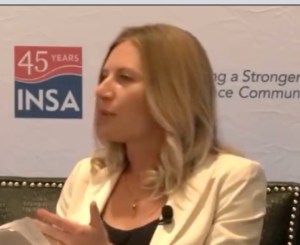
Speaking on a panel about women in national security — a video posted on social media — she explained:
“This system, the National Security and the intelligence system, was not built by women, with women in mind. So the rules that we have to operate by were not made for us. And so I don’t feel like we should be held to them, to be totally frank with you.”
The video captures Hewitt arguing that women should not be bound by rules created by men. Rose included it in his sworn declaration with this comment:
“Her actions show that she means what she said. Hewitt is willing to do anything to get what she wants.”
Block and Delay
Rose, in trying to prove Hewitt lied about him, issued subpoenas to the people who would know whether Hewitt’s stories were true: her former Brookings supervisors, NNSA figures whose communications might show coordination with Politico, and the DOE supervisor who questioned her about Rose.
Hewitt moved to quash all five.
Rose’s lawyers sought records showing whether Hewitt had filed similar complaints against other supervisors who had disciplined her in the past. Hewitt moved to block that inquiry as well.
She refused to answer the lawsuit. Hewitt filed a demurrer, a renewed plea in bar, a motion for a protective order, objections to interrogatories, a motion for a bill of particulars, a motion to quash, and two motions to extend time.
She never answered Rose’s allegations on the merits.
The Reckoning
Now that the DOJ issued the Westfall ruling, the case will move forward in federal court.
The USA protects Hewitt financially for some of her conduct, but not all and it does not protect her criminally.
Under Westfall, taxpayers will still pay damages for the harm Hewitt caused if she lied to investigators about Rose.
But if the lawsuit proves that Hewitt made false statements to investigators, 18 U.S.C. § 1001 — lying to federal agents — may apply with its criminal penalties. Hewitt might serve up to five years in prison, though it is unlikely she will get the maximum sentence.
If Hewitt testifies falsely — for any reason — federal prosecutors may indict her for perjury under 18 U.S.C. § 1621. Her public statements about the rules of the system will not protect her.
If the lawsuit reveals that she lied to retaliate against Rose or for personal ambition, the US Department of Defense could cancel her clearance status.
Her opportunity for continued employment might become as limited as Rose’s.
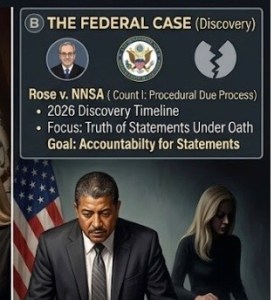
The case on restitution for Rose’s losses caused by his coercive firing is Rose v. National Nuclear Security Administration, pending before Judge Paul L. Friedman in the U.S. District Court for the District of Columbia.
On January 21, 2026, Judge Friedman denied the government’s motion to dismiss Rose’s case. Discovery is coming.
Every document related to the investigation, emails between officials, the decision to route the investigation to the OHA, and communications with private-sector employers will be part of discovery.
Rose’s lawyers will depose officials who he says forced him out: Chief of Staff Christopher Davis, Deputy General Counsel Jocelyn Richards, and OHA Deputy Director Matthew Rotman, among others.
These officials will answer why a 17-day investigation never interviewed Rose, and why the NNSA assigned the investigation to the wrong office.
If Rose proves constructive discharge and denial of due process, the damages come from the United States — lost salary, lost earning capacity, and reputational harm.
By certifying that Hewitt acted within the scope of her employment, DOJ will pay for her lying, if she lied.
At the end, a woman who says women don’t have to play by the rules will face scrutiny.
If she lied and her lies caused the government to rush to judgment, taxpayers foot the bill.
Rose may be employable again. He may receive full damages — lost wages, lost earning capacity, and punitive damages.
The same DOJ that granted her Westfall protection in civil court may bring a criminal case against Hewitt before a grand jury.
If the evidence shows she told lies — two by two — she may pay for them one by one. Perhaps in custody. Month by month.
See also
How Politico Got It Wrong: Eight Anonymous Sources, Zero …
ARTVOICE ART
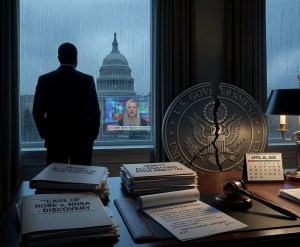
When one looks candidly at the world Kathyrn Hewitt created for Frank Rose, at first, and ultimately herself, it appears surreal. The tables are turning.
These images are intended to replicate the surreal quality of the worlds Hewitt inhabits and creates for others who fall prey to her machinations, It also intends to depict the efforts of one brave man, Frank Rose.
Hewitt canceled him but he is fighting back against the lies. In so doing, he is showing a truth that tends to expose Hewitt in the light of the grotesque and the dishonest which in the end have always been the same.