Vítek’s $7.2B Question: Where Did the Money Come From?

Before anybody succumbs to the satisfying mental picture of handcuffs being fastened around the wrists of Radovan Vítek, a little discipline is required.
Vítek is, certainly, a Czech billionaire of operatic tastes: a 17th-century Surrey manor acquired from Ringo Starr; a stone palace in Provence in which he has reportedly never spent a night; an Alpine residence at a ski resort whose lifts he once caused to be switched off in mid-season; and two 143-foot expedition superyachts built for the sort of waters in which borders become more theoretical than practical.
All of this is picturesque. None of it is an indictment.
Here are the facts that should matter.
The Report
In January 2017, a regulator finished a report about him.
The report came from Luxembourg's national financial regulator, the Commission for the Supervision of the Financial Sector, the country's equivalent of the SEC. It was later filed in federal court in Manhattan as Document 64-1 in Case 1:19-cv-03170.
The report did not come from an anonymous tipster or a short seller.
The investigation lasted four years. It was conducted by the regulator with jurisdiction over the company.
Its findings ran to 55 pages.
The report identified eight signs of a concealed arrangement.
It found that Vítek had acted secretly in concert with Jean-François Ott, the French founder of ORCO Property Group — its CEO and chairman until March 2014 — and six other men whose names appeared on shell companies that acquired ORCO stock: a dentist, a private investigator, two former bankers and two small property developers.
 Ott played shill for Vitek and was richly rewarded. The payment did not come from Vitek. It came from pensioners who invested in the company and did not know they were paying for the secret schemes of these two collaborators.
The report said control of Orco passed to Vítek on January 10 and 11, 2013. The required buyout offer never came.
It also found that ORCO's best assets did not simply disappear. They went somewhere.
The Mother
 Filial Piety: Vitek arranged for his mother, Milada Mala, to buy assets for $200 million under the true market value from a company he son controlled. She then generously sold it back to him secretly for a tidy profit of $13 million. The loss was subsumed by pensioners in New York and elsewhere whose pension fund trustees had trusted Vitek and knew nothing of his rapacious mother. Blood is thicker than integrity.
A property fund holding European office buildings — valued at the time at about €330 million — was sold for €52 million to a company called Sidoti. Sidoti was owned by Milada Malá — Vítek's mother.
Within months, she had sold it to her son's company at a profit of €13 million.
The sellers were pension funds and insurers. Dutch retirement money. An Estonian bank. Austrian insurance funds. None of them knew who was buying.
The German subsidiary, the most valuable thing ORCO owned, went to Vítek through a series of share issues priced at 47 cents — six months after the company's bankers had valued those shares at 80.
A Million Square Meters of Berlin
It was called ORCO Germany, and it owned a company called GSG — an old Berlin outfit that had built workshop estates for small manufacturers going back generations. Courtyard factories, machine shops, brick industrial yards. By the time ORCO acquired it in 2007, Berlin had turned those spaces into offices, studios and workshops for a different kind of tenant.
Roughly a million square meters of Berlin.
ORCO owned 98 percent of it. Its executives called it the heart of the company. One of them wrote that without it, ORCO was just a collection of assets.
Vítek consumed it in three bites over 11 months.
Three Bites
December 2013. ORCO Germany issued 114.6 million new shares. Vítek bought them at 47 cents, paying €53 million.
Six months earlier, ORCO's bankers at Rothschild had valued those shares at 80 cents.
At 80 cents, that block costs €92 million. He paid €53 million.
A gap of €39 million, on the first bite.
March 2014. Another 76.6 million shares at 47 cents — about €36 million. The buyer this time was Jean-François Ott, ORCO's chief executive, using money lent to him by J&T Banka. Three months later, Ott sold the shares on to Vítek at 50 cents.
April 2014. ORCO sold 108.4 million more shares to a company called Aspley for €55.5 million, again financed by J&T Banka. Two months later, Aspley sold them to Vítek at 52 cents.
Roughly 300 million shares left ORCO. The company was paid about €145 million for them.
Vítek bought the first block himself. The other two went to men buying with J&T Banka's money, who sold them on to him within months at three to five cents a share.
By the middle of 2014, Vítek held more than 90 percent of ORCO Germany. ORCO booked a loss of €65.5 million on the subsidiary it no longer controlled.
Why Did Orco Sell Its Shares at 47 Cents?
All through 2013, ORCO needed money. There is an ordinary way for a public company to raise it — issue new shares to your shareholders. Vítek held just under 30 percent, which was enough to veto that. The board minutes record him saying so, again and again.
So the company could not raise cash the normal way. Which left one way: sell the crown jewel, Orco Germany, piece by piece, at whatever price was on offer.
He created the shortage. Then he bought what the shortage forced onto the market.
The Company Under a New Name
In May 2014, ORCO Germany was renamed GSG Group. In August 2014, it was renamed again. CPI Property Group.
That is the company.
Vitek's €20 billion group, CPI, listed in Frankfurt is ORCO's former German arm under a new name.
Vítek did not create the company that eventually made him a billionaire. Somebody else had already built it. He obtained control of an existing company and took the German arm out of it at 47 cents a share.
The board approved it. He controlled the board.
There was no bidding war. He had already made sure there could not be one.
The Money Comes Home
Then the regulator followed the money.
On June 8, 2016, Vítek paid approximately €188 million for three shell companies holding most of ORCO's stock.
The following day, according to the regulator, the money passed through five shell companies before reaching a personal bank account belonging to Vítek.
The circularity is the significant detail. Shell companies can make it hard for people involved to be seen.
Money is harder to hide.
The men whose names appeared on the shell companies retained none of the money.
Whatever they were paid for the use of their names, it was not the €188 million.
Then Came Cyprus
In December 2022, two men who said they had once been Vítek's partners went to court in Cyprus. The court froze roughly half a billion euros in assets belonging to Vítek, his mother and CPI Property Group.
The two men say they provided more than €320 million over eight years to finance Vítek's rise under an oral agreement.
No contract. A handshake deal.
When the time came to divide the proceeds, Vítek denied that any agreement had existed.
The court froze 13 billion Czech crowns.
That is the same number Vítek himself put on their stake in a 2016 buyout agreement. That agreement was in writing. He made one payment. Then he stopped.
Vítek challenged the freezing order.
He lost.
On July 31, 2024, the court confirmed the freezing order.
Then Came the Short Seller
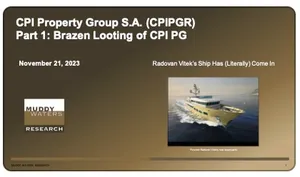
Then came Muddy Waters Research, a short seller. Muddy Waters Research published its findings in November 2023.
Before publication, it had taken positions against CPI's bonds. If the bonds fell, it made money.
On the day the report was published, one bond fell 6 percent, and another fell 30 percent.
How much Muddy Waters made has not been disclosed.
Muddy Waters gave four examples of what some would call Vitek's chicanery. It did not just yell fraud and walk away.
Two Empty Plots Outside Prague
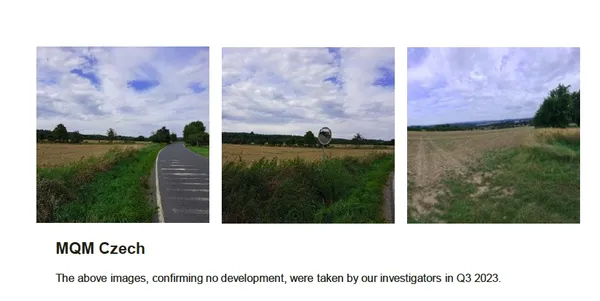
The first was two empty plots outside Prague. Vítek's company sold the parcels in 2014. Three years later, it repurchased them for €30.9 million more than it had received.
Nothing had been built on either parcel.
Investigators walked the parcels and photographed them. Satellite images from 2013 and 2018 show the same empty ground.
The dirt stayed put. The price didn't.
True, land values rise. Prague property prices were increasing during those years, and a higher repurchase price is not by itself evidence of wrongdoing. A Vitek defender could reasonably begin his defense of Vitek there.
Except for two inconvenient particulars. The first problem is the seller.
CPI's 2017 accounts called the buyback a deal between parties under the same control.
That means the buyer and seller were controlled by the same owner. Muddy Waters says the owner was Vítek.
CPI says the buyer belonged to J&T Finance Group. Those are two different stories.
Neither side disputes that common control was recorded. They dispute only whose.
But the defense concedes something. Not that the buyer was a stranger. That the buyer was the bank. Nothing of the kind was disclosed in 2014, when CPI sold the land.
Valued on a Hope
The second is how the price was set.
In December 2023, CPI said that in 2014 the land was valued by looking at what similar land had actually sold for. By 2017, when CPI was buying it back, it valued the land based on its prospects of getting building permits.
So had the permits come through?
No. The parcels did not receive permits until 2022 — five years after CPI paid for the prospect of it.
Vítek owns most of CPI. He does not own all of it. Bondholders and minority shareholders own the rest. So when CPI overpaid by €30.9 million, part of that loss was theirs. The gain belonged to whoever was selling the fields.
The Hotels, the Son, the Yacht
 Vítek owns two superyachts, the Baron Trenck and the Baron Trenck II. Muddy Waters concluded he acquired the second by having his public company finance it — a boat for him, paid for with bondholders' money, without bothering to tell them. The namesake, Friedrich von der Trenck, was guillotined.
Muddy Waters' second example involved a hotel management company presented in the CPI accounts as independent.
Muddy Waters concluded that it appears instead to have belonged to Vítek through a nominee.
When CPI acquired the company, Muddy Waters calculated that Vítek extracted roughly €59.8 million.
Most of this was achieved not through the vulgar business of writing checks but through the considerably more elegant expedient of forgiving debts owed to the company.
The third example involved an 11 percent stake in an Austrian property group.
CPI bought the stake from Vítek's 23-year-old son for €261 million.
After the transaction had closed, the price was retroactively increased. The adjustment added another €52.1 million to the son's proceeds.
The fourth example was a 143-foot steel-hulled expedition yacht.
Title to the vessel changed hands on the same day CPI completed its purchase of the holding structure beneath it. A month later, the yacht was transferred to Vítek's private company.
The filings never use the word yacht. Instead, the shipyard is described as owning one building in Italy.
The omission is more interesting than the description.
The Buildings Themselves
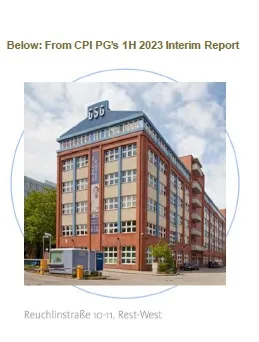 This is the photo Vitek showed investors.
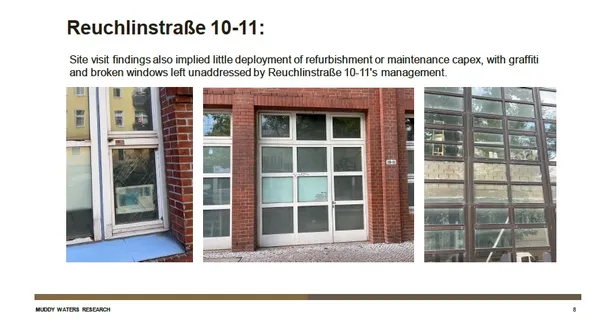 This is what the building really looked like.
Muddy Waters did not state its conclusions cautiously.
It accused Vítek of brazenly looting the company while materially overstating the value of its assets, and described CPI's corporate governance as farcical.
Two months later, Muddy Waters published a second report. This one examined the properties themselves.
It cited a Berlin office building whose CPI-reported value had nearly doubled in less than four years, although investigators found broken windows, graffiti and vacant floors.
It also examined a Prague brownfield subject to a construction ban and valued on the company's books at roughly twice the amount suggested by the city's own land-price map.
The numbers were climbing faster than the buildings.
CPI Property Group disputes the analysis and says Muddy Waters' conclusions are wrong.
Two of the comparisons, however, do not depend solely on Muddy Waters' judgment.
The Berlin analysis uses a German property-price index compiled from transactions reported by more than 700 banks. The Prague comparison uses the city's official land-valuation map.
What It Came To
Before 2015, Forbes did not list Radovan Vítek as a billionaire.
He first appeared in 2015 with an estimated fortune of $1.98 billion, one year after ORCO Germany was renamed CPI Property Group.
By 2019, Forbes estimated his wealth at $3.5 billion. By March 2026, it was $7.2 billion.
Now compare this arguably ill-gotten accumulation of wealth to the sanctions authorities imposed upon him. One will observe in it an instructive lesson on why or how crime can and, in this case, arguably, does pay.
Luxembourg's regulator fined Vítek €1 million.
Germany's BaFin fined CPI Property Group €685,000 for failing to publish voting-rights information on time.
In France, a court fined his architecture firm €100,000 and another company €250,000 in connection with the Provence palace, and ordered the building demolished.
The palace, displaying perhaps a superior grasp of enforcement than the court, remains standing.
The Most the Law Allows
 Vitek continues to be listed on Forbes as a billionaire, but there are those who have doubts. Is his empire really a house of cards, built through dishonesty and now about to be exposed?
The Luxembourg penalty was small because the law made it small.
Under the statute applied by the regulator, the maximum fine for taking control of a company without making the required offer to the remaining shareholders is €12,500.
That is the most the law allows.
That is the complete list. No other authority in any country has imposed a penalty on him.
The claims against Vítek are far larger than the penalties.
Kingstown alleged that more than a billion dollars in assets had been stripped from ORCO, but that allegation was never tested on the merits because the case was dismissed on procedural grounds.
Two former business partners say they contributed more than €320 million to Vítek's rise and received nothing in return. A Cyprus court has frozen €535 million pending trial.
Muddy Waters examined four transactions worth €441 million and calculated the disputed value at €151.6 million.
The fines are counted in hundreds of thousands.
The claims are counted in hundreds of millions.
None of those allegations has yet been finally adjudicated by a court.
Radovan Vítek has never been criminally charged.
The record is extensive. The indictment does not exist yet.
Next: what a Manhattan investment firm predicted in December 2013, and how long it took to come true.