

By Frank Parlato
How Frank Fina and Joseph McGettigan’s Partner Ended Up Controlling $20 Million That Belonged to the Man Whose Testimony Sent Jerry Sandusky to Prison
Sabastian Paden was 18 years old when he testified against Jerry Sandusky in June 2012. He told the jury he had been raped repeatedly in Sandusky’s basement, held captive every weekend for three years, his screams unheard through soundproof walls.
His testimony helped convict Sandusky on 45 counts. Lead prosecutor Joseph McGettigan called Paden the “key witness” in securing a sentence that would exceed Sandusky’s natural life.
Three years later, Penn State paid Paden $20 million.


Today, Paden cannot access that money without permission from two people: Frank Fina, the prosecutor who helped build the case against Sandusky, and Gay Warren, McGettigan’s longtime partner.
This is not a metaphor. This is the actual legal structure governing Paden’s settlement.
I have obtained the trust document, which is now attached as an exhibit to Sandusky’s pending PCRA (Post-Conviction Relief Act) petition. What it reveals is not victim protection. It is victim capture.
The Trust They Built
The Sabastian Paden Trust was executed on April 16, 2015, shortly before Penn State finalized its $20 million settlement payment on April 28, 2015. Attorney Dennis McAndrews — to whom McGettigan had referred Paden while still prosecuting the criminal case — created the trust.
The Trust was funded with approximately $12 million — the remainder of Paden’s $20 million settlement after contingency fees, referral fees, costs, and repayment of predatory loans.
The trust creates a “Trust Protective Committee” with three members:

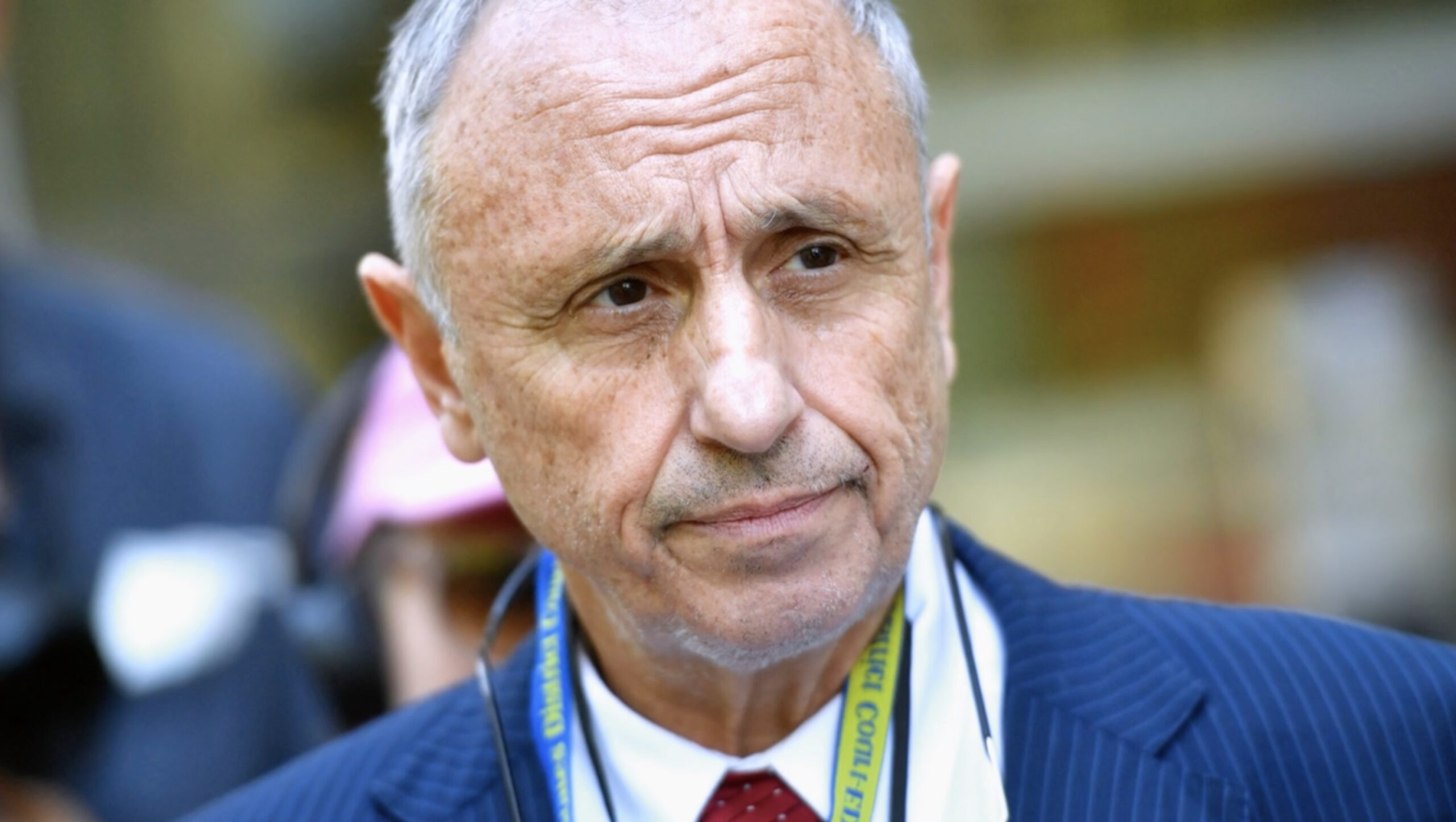
Prosecutors Frank Fina and the late Joseph McGettiganFrank Fina — the Senior Deputy Attorney General who prosecuted Sandusky
Gay L. Warren — the longtime partner of lead prosecutor Joseph McGettigan (identified as his wife in McGettigan’s 2026 obituary)
Lauren Cliggett — Paden’s therapist

These three — two of whom are directly connected to the prosecutors who secured Paden’s testimony — now control his financial life.
What the Committee Controls
The trust document is 20 pages of legalese. Let me translate what it actually says.
They control his money.
Any distribution exceeding $100,000 per year requires “the express written approval of two members of the Trust Protective Committee.” Their decision is “binding, final and unappealable.”
Paden receives $1,500 per week — about $78,000 annually. Everything else requires Fina and Warren’s approval.
They control his independence.
If Paden wants to terminate the trust and take control of his own settlement, he needs two Committee members to recommend it. The trust is explicit: “If two (2) members of the Trust Protective Committee do not recommend the Termination of this Trust, the Trust shall not be terminated.”
Fina and Warren can keep Paden under their control forever.
They cannot be removed.
Committee members “may be removed only for cause as determined by a court of competent jurisdiction.” Paden would have to sue them — and prove cause — to get them off the Committee.
They replace themselves.
When a vacancy occurs, it “shall be filled by majority vote of the remaining members of the Trust Protective Committee.” Fina and Warren control who joins them. They control their own succession.
They have no fiduciary duty.
A fiduciary duty is the highest legal obligation to act in another’s best interest. The trust expressly disclaims it: “No fiduciary responsibility is imposed on the Trust Protective Committee and its individual members for its own actions or inactions, and no Trust Protective Committee member shall incur any liability by reason of a mere error of judgment, mistake of law, or similar actions of any kind.”
The people controlling Paden’s money have no legal obligation to act in his interest.
They get paid.
Each Committee member receives “a minimum annual compensation of $5,000.00 per year, and… reasonable hourly compensation” plus reimbursement for expenses including litigation costs.
The prosecutors who secured Paden’s testimony now hold paid positions controlling his money, cannot be removed, owe him no fiduciary duty, and can block his independence indefinitely.
This is the mechanism of McGettigan’s promise: not freedom, but a $1,500/week allowance controlled by the very people who made it.
What His Mother Says
I have spent two years investigating the Sandusky case. In October 2024, I obtained a sworn declaration from Paden’s mother, whom I’ll refer to as Marie (identified as “A.Q.” in court filings).
According to Marie, her son “consistently represented to her that Sandusky had never molested him.” He told her, even in the presence of police officers, that “Jerry isn’t like that. He’s a nice guy. He’s a big kid and is just touchy-feely.”
His story changed only after “several lengthy meetings with McGettigan.”
Marie was excluded from those meetings. When she told investigators “I’m not jumping on this bandwagon,” they cut her out entirely. She was never allowed to hear what her son told them or to be present during trial preparation.
She attests that McGettigan promised her son: “You will never have to work a day in your life.”
The Testimony That Doesn’t Add Up
At trial, Paden testified he visited the Sandusky home 100 to 150 times between 2005 and 2008, staying “every weekend of the month.” He claimed he was locked in a soundproof basement where his screams went unheard.
Photos of Basement (It was not soundproof and easy to escape)


Walk out basement


His mother says this is false.
Marie attests that Paden visited Sandusky “no more than 10-15 times, not 100-150 times as he testified.” She states the visits were “infrequent” and “always after a home Penn State football game,” with other boys present.
She states the basement claim is physically impossible. The Sandusky basement is a walkout basement with multiple unobstructed exits. Her son, she notes, “was very skillful at getting in and out of places and used to sneak out of our trailer through a window when he was ten.”
This narrative creates an impossibility. Another accuser, Aaron Fisher (Victim 1), testified to the same exclusive weekend access during the identical three-year period. The prosecution never explained how two boys could each be the sole weekend guest in the same home for the same 150 weekends without ever encountering each other.
The Underwear Deception
Marie testified at trial. Her testimony was used to corroborate her son’s account.
She now says McGettigan coached her.
According to Marie, McGettigan instructed her “to mention that [she] wished Mr. Sandusky would have gotten [Paden] underwear and socks instead of Nike gear.”
Marie was sequestered. She didn’t know her son had testified about disposing of underwear after alleged abuse. McGettigan designed her testimony to make the jury believe Sandusky caused the missing underwear problem.
The truth: Paden had hidden his underwear since he was three or four years old — years before he ever met Jerry Sandusky.
McGettigan knew this. He didn’t just coach her — he weaponized her testimony to corroborate a fabricated detail, turning a lifelong personal habit into false evidence of abuse.
The Behaviors That Predated Sandusky
Marie’s declaration reveals something the jury never heard.
Beginning at age three — years before any contact with Sandusky — Paden exhibited concerning behaviors, including inserting objects into his rectum. Children and Youth Services investigated possible abuse at paternal relatives’ home in Cape Cod, Massachusetts. They declared he was “experimenting.”
Marie attests she later found tampons with fecal matter and stuffed animals with holes cut in them throughout her son’s childhood.
These behaviors, which the prosecution implicitly attributed to Sandusky’s abuse, predated any contact with Sandusky by years. They suggest an alternative explanation the jury never heard — because the prosecution made sure they didn’t.
The Pipeline
While still a Deputy Attorney General, McGettigan introduced Paden and his mother to civil attorney Dennis McAndrews.

Within weeks of conviction, attorney Stephen Raynes — working with McAndrews — filed a notice of claim against Penn State on Paden’s behalf.
Thirty-five days after conviction, Paden signed a predatory loan agreement with US Claims, borrowing $50,000 against his future settlement at approximately 27% annual interest with monthly compounding. According to Marie, he ultimately borrowed “hundreds of thousands of dollars” at rates that more than doubled the principal.
On April 11, 2013 — months after Sandusky’s sentencing — McGettigan left the Attorney General’s office and joined McAndrews’s law firm.
On April 28, 2015, Penn State paid Paden $20 million gross. After contingency fees, referral fees, costs, and repayment of predatory loans, approximately $12 million remained.
McAndrews then established the trust — with McGettigan’s partner and his fellow prosecutor on the committee controlling the money.
The Colorado Team
The control didn’t stop with the trust.

After Paden was arrested on marijuana charges in Pennsylvania, Marie attests that Fina and McGettigan arranged for him to relocate to Colorado, reasoning that “marijuana is legal there.”
Both prosecutors visited Colorado when there were “problems” with Paden’s behavior. They hired a retired police officer to provide security detail.
Attorneys McAndrews and McGettigan, along with a court-appointed power of attorney named Chris Malanga — whose prior occupation was “life coach” — appointed numerous therapists to manage Paden’s life. Some lived with him around the clock. This group became known as the “Colorado team.”

According to Marie, Malanga once exclaimed to her son: “You’ve made me so much money, buddy! You made me what I am today!” — a stark admission of the financial ecosystem built around Paden.
When Marie tried to encourage her son to work or achieve self-sufficiency, the Colorado team resisted. When she objected to their management, McGettigan told her son: “Your mom is batshit crazy.”
Marie has been gradually alienated from her son — the one person who might encourage him to tell the truth.
The Question the Commonwealth Won’t Answer
In its response to Sandusky’s pending post-conviction petition, the Commonwealth dismisses the trust evidence in a single paragraph. The prosecution argues that because the trust was created after trial, it proves nothing about the prosecutors’ motivations during trial.
This argument requires believing that these arrangements arose spontaneously — that prosecutors who secured a conviction were later, coincidentally, placed in control of the witness’s millions with no prior understanding.
But the documents tell a different story. McGettigan referred Paden to civil counsel during the criminal prosecution. McGettigan promised Paden he would “never have to work a day in your life.” McGettigan joined the civil attorney’s law firm after trial. McGettigan’s partner was placed on the committee controlling the settlement.
At what point did the understanding form? Before McGettigan made the referral? Before he made the promise? Before he joined the law firm?
The Commonwealth offers no explanation.
What This Trust Really Is
Let me state plainly what the trust document reveals.
The prosecutors who induced Paden’s testimony now have a financial stake in his continued compliance.
If Paden were to recant — as Ryan Rittmeyer (Victim 10) has done in a 2025 sworn affidavit — the civil settlement could potentially be challenged. The trust could be dissolved. The Committee members could lose their positions and compensation.
Fina and Warren have every incentive to ensure Paden does not change his story. They control his money. They control his access. They control his independence.
This is not speculation. This is the structure of the trust they administer.
Paden receives $1,500 a week. He cannot access significant funds without their approval. He cannot terminate the trust without their approval. He cannot remove them without proving cause in court. He cannot even learn the full balance of his own trust without submitting a written request.
Meanwhile, the lawyers, therapists, and managers of his life — according to his mother — “earn far more annually than he does.”
This is not a trust designed to protect Sabastian Paden.
This is a trust designed to ensure he never recants.
The Larger Pattern
The Paden trust is not an isolated arrangement. It is part of a documented financial architecture connecting the Sandusky prosecution to the civil settlements.
I have obtained the trust agreements, the predatory loan documents, the emails showing ongoing coordination years after trial. The pattern is clear:
- Prosecutors induce accusations through coaching and psychological manipulation
- Prosecutors arrange civil counsel for accusers during the criminal proceedings
- Accusers testify as directed
- Accusers receive predatory loans against anticipated settlements
- Settlements are paid based on the convictions prosecutors obtained
- Prosecutors take paid positions controlling the settlement funds
- Prosecutors continue managing accusers’ affairs years later
The prosecutors did not merely have conflicts of interest. They built a system designed to convert accusations into revenue — revenue they would share.
Jerry Sandusky is serving 30 to 60 years based on testimony that his accusers’ own mothers say was false, induced by prosecutors who promised wealth and delivered control.
The question is no longer whether Sandusky received a fair trial.
The question is whether anyone will do anything about it.