
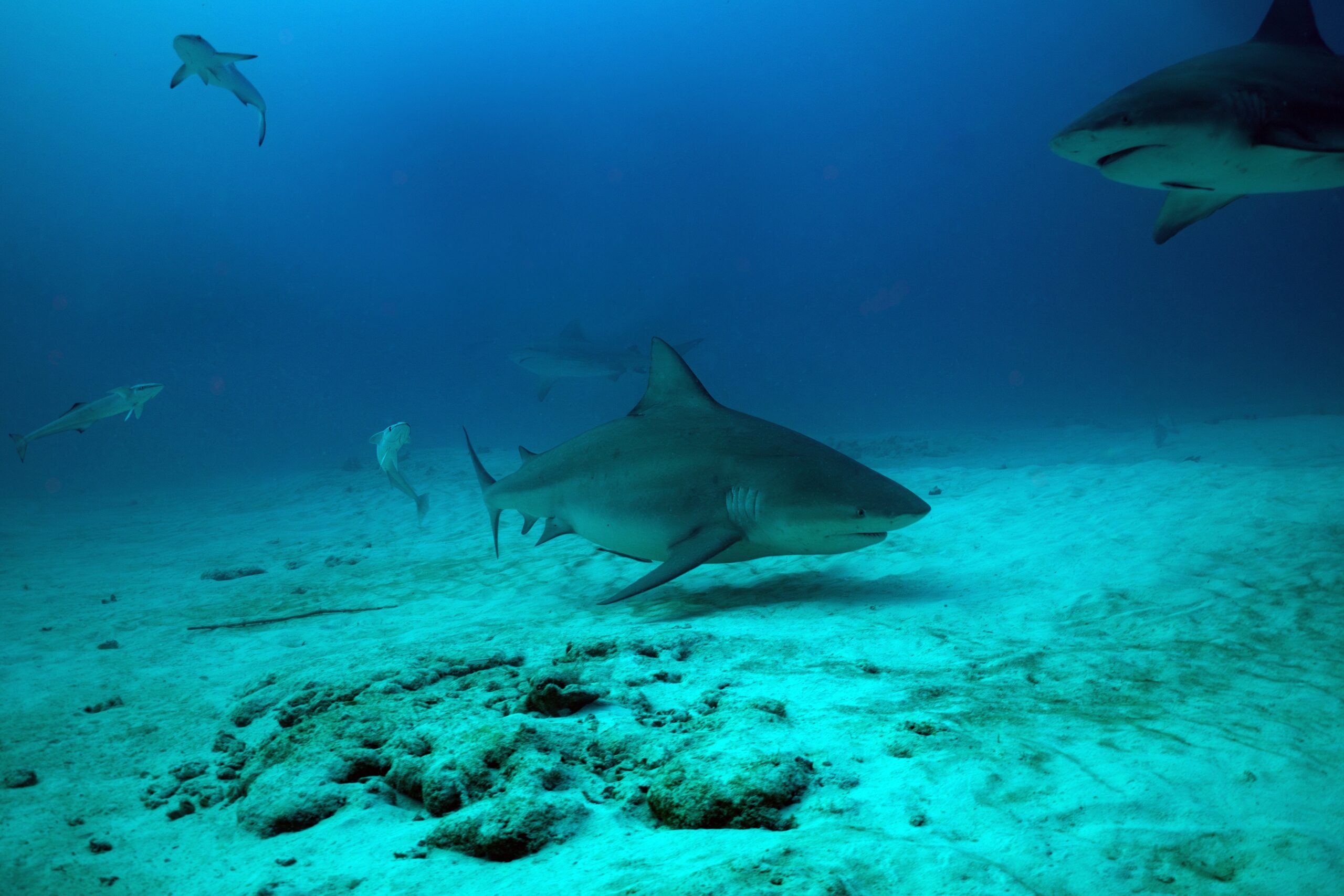
The Bahamas has built its entire tourism identity on the idea that its waters are pristine.
Crystal blue, unspoiled, a paradise that exists apart from the pollution problems of the rest of the world.
A new study published in the journal Environmental Pollution has a different conclusion, and the sharks off Eleuthera Island are the evidence.
Researchers analyzed blood samples from 85 sharks captured in the coastal waters around Eleuthera, one of the most remote islands in the Bahamas, roughly 50 miles east of Nassau.
The sharks represented five different species, tiger sharks, blacktip sharks, Caribbean reef sharks, Atlantic nurse sharks, and lemon sharks.
Each was tested for nearly two dozen legal and illegal substances. Of the 85 sharks sampled, 28 came back positive for at least one drug.
Some tested positive for multiple substances. The researchers used non-lethal sampling methods throughout, collecting blood and releasing the sharks.
What they found was cocaine, caffeine, acetaminophen, and diclofenac.
The researchers leading the study have something important to say about which of those four is actually most alarming.
Cocaine Sharks Grab Headlines, But Other Drugs Found
Two sharks tested positive for cocaine. One was a Caribbean reef shark. One was a juvenile lemon shark found in a mangrove nursery creek in south Eleuthera, a habitat where baby lemon sharks take shelter during the earliest and most vulnerable years of their development.
The amount of cocaine detected was far lower than levels previously found in sharks off the coast of Brazil, but the researchers note an important methodological distinction.
The Brazilian study examined muscle tissue, where drugs accumulate over time.
This study tested blood, which reflects recent exposure. Finding cocaine in blood means it got there recently.
Lead author Natascha Wosnick, a zoologist and associate professor at Brazil’s Federal University of Paraná, explained the likely mechanism.
Sharks are curious predators. They bite things to investigate whether something is food, and in the process they end up exposed to whatever that object contains.
Wosnick told Science News she has seen discarded packages near that nursery creek before. “They bite things to investigate and end up exposed,” she said.
This is the first confirmed detection of cocaine in sharks in the Bahamas, though it has previously been found in sharks off Brazil.
In 2024, a separate study from the same research team found that all 13 sharpnose sharks sampled off the coast of Rio de Janeiro tested positive for cocaine and its primary metabolite, benzoylecgonine.
The Brazilian concentrations were substantially higher. The Bahamas results suggest the contamination is spreading geographically.
The Part That Actually Concerns Scientists More
Here is what Wosnick told CBS News directly: “While the detection of cocaine, an illicit substance, tends to draw immediate attention, the widespread presence of caffeine and pharmaceuticals in the blood of many analyzed sharks is equally alarming.
These are legal substances, routinely consumed and often overlooked, yet their environmental footprint is clearly detectable.
This underscores the need to critically reassess even our most normalized habits.”
Caffeine was the most commonly detected substance across the entire sample.
It turned up in 12 of the Caribbean reef sharks tested, all five of the contaminated Atlantic nurse sharks, and ten of the lemon sharks.
This is the first time caffeine has ever been detected in any shark species anywhere in the world, not just in the Bahamas but globally.
The same applies to acetaminophen, the active ingredient in Tylenol, which appeared in three sharks and also represents a worldwide first for shark contamination research.
Diclofenac, sold under brand names including Voltaren and Cambia, turned up across all three affected species. It is used by humans to treat pain and inflammation. In animals, it has been linked to kidney disease.
Its presence in sharks alongside caffeine and acetaminophen means these animals are absorbing a cocktail of compounds that are biologically active, specifically designed to interfere with physiological processes, even if they were designed to interfere with those processes in human bodies rather than shark bodies.
Where The Drugs Are Coming From
The research team was specific about the most likely sources.
Most of the contaminated sharks were captured about four miles offshore, near an inactive fish farm that is popular with divers.
Wosnick was direct about what she thinks is driving the contamination at that site. “It’s mostly because people are going there, peeing in the water and dumping their sewage in the water,” she told Science News.
The broader picture is wastewater management, or the lack of it, across the island.
The study notes that the Bahamas, like many island destinations, struggles with waste management infrastructure.
Household wastewater, leaking septic systems, stormwater runoff, and improper medication disposal all contribute.
As tourism drives development, more people are producing more waste in areas with limited capacity to treat it before it reaches coastal waters.
The researchers tested sharks at multiple specific sites around central and south Eleuthera. Contamination was detected at Aquaculture Cage, Boathouse Cut, Kemps Creek, Hallig Beach, and Page Creek.
No contaminants were detected at Schooners, Schooners Deep, Broad Creek, or Savannah Sound, which provides a geographic picture of where the human footprint is concentrated.
The cocaine contamination is a different pathway from the caffeine and pharmaceutical contamination.
Rather than wastewater, the cocaine likely entered the water through drug trafficking routes in the Caribbean. Packages of cocaine fall overboard from traffickers, wash ashore, or are dumped during pursuit by law enforcement.
Sharks encounter these packages and bite into them out of curiosity.
The Bahamas sits along major drug trafficking routes, and researchers say they have previously spotted drug packages in the nursery creek where the juvenile lemon shark tested positive.
What It Is Doing To The Sharks
The study documented measurable changes in the metabolic markers of sharks that carried detectable contaminants, and those changes differed by species.
In Caribbean reef sharks, contaminated individuals showed lower urea levels and higher lactate levels.
In Atlantic nurse sharks, contaminated individuals showed lower triglyceride levels.
In lemon sharks, contaminated individuals showed lower triglyceride and lactate levels.
These are not trivial readings. Triglycerides, urea, and lactate are all tied to energy metabolism and the body’s stress response.
The researchers are careful to note that their data does not establish direct cause and effect, that blood samples reflect recent rather than long-term exposure, and that comparisons across species are limited by overlapping sampling locations.
But the pattern is consistent enough to be concerning. Something in the blood of these sharks is changing their metabolic chemistry.
Tracy Fanara, an oceanographer at the University of Florida who was not involved in this study but previously helped produce the Discovery documentary “Cocaine Sharks,” said what makes the study notable is precisely this biological evidence.
“What makes this study notable is not just the detection of pharmaceuticals and cocaine in nearshore sharks, but the associated shifts in metabolic markers,” she said.
The question of what those shifts mean for behavior, hunting ability, reproduction, and stress resistance over the long term remains open, but it is now a research question worth pursuing seriously.
Research in goldfish has shown that caffeine increases their energy and focus in ways that parallel its effects on humans.
If the same applies to sharks, altered caffeine levels could change how frequently they feed, how aggressively they investigate unfamiliar objects, and how they respond to perceived threats.
No one knows yet whether caffeine-exposed sharks are more alert, more erratic, or effectively unchanged in behavior. That uncertainty is itself the point.
What Does This Mean Beyond The Sharks?
The Island School at Eleuthera, which was affiliated with the Cape Eleuthera Institute that contributed to the research, put it plainly in a statement about the findings. “If these chemicals are inside the sharks, they are already in the surrounding waters. Sharks are simply the first to reveal their presence.”
Sharks are apex or near-apex predators. They live long lives and spend large amounts of time in nearshore habitats.
They accumulate what the water contains. When their blood shows caffeine, acetaminophen, diclofenac, and cocaine, the water those sharks are swimming in already contains all of those things.
People diving at that inactive fish farm near Eleuthera are swimming in it too. People eating seafood from those waters are consuming it through a different route.
The researchers conclude their paper with language that addresses the gap between perception and reality directly. “
This represents the first report concerning CECs and potentially associated physiological responses in sharks from the Bahamas, an environment commonly described as pristine, pointing to the urgent need to address marine pollution in ecosystems often perceived as pristine.”
The Bahamas is not pristine. The waters around Eleuthera Island contain cocaine, caffeine, Tylenol, and Voltaren at concentrations detectable in shark blood. The sharks did not put those things there.