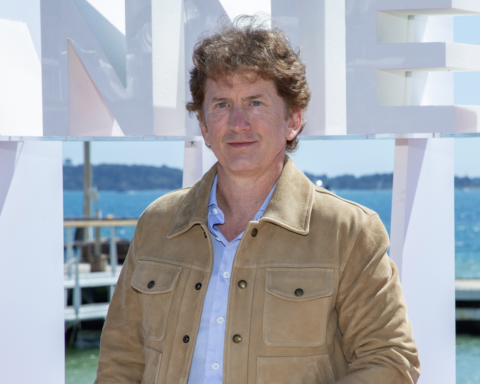

A senior artist who spent twelve years working alongside Todd Howard on Skyrim, Fallout 4, Fallout 76, and Starfield has gone on record saying that Howard has a yes-men problem.
He has also revealed that the culture of fear around disagreeing with him has actively hurt his ability to make the best decisions.
Dennis Mejillones, who worked at Bethesda Game Studios from 2009 to 2021 before leaving, made the comments in a 2025 interview with the YouTube channel Kiwi Talkz.
The clip resurfaced on April 2, 2026 when Kiwi Talkz reshared it on social media, and it has since spread rapidly across gaming communities because of how directly Mejillones names something players have long suspected but rarely heard confirmed from inside the building.
“A lot of people were afraid to say no to Todd, and I think that hurt him,” Mejillones said. “He’s a phenomenal person, and is he perfect? No. Does he call all the shots perfectly? No.”
What Did The Former Bethesda Artist Say?
Mejillones was careful to separate his own experience from the broader culture he observed. He was one of the people who did push back.
He describes a dynamic where he personally was willing to tell Howard when something was a bad idea, sometimes directly and sometimes by staying quiet and then raising concerns when he felt strongly enough. What he observed around him was different.
“I can’t tell you how many times I told Todd, like, ‘hey man, that’s not a good idea. That’s bad. That’s not good,'” Mejillones said. “Or, that I kinda kept my mouth shut, like, ‘oh, I don’t think that’s so great.’ Typically though, I would communicate if I felt really strongly about it.”
Then he contrasted his own behavior with what he saw from others, “A lot of people were afraid to say no to Todd and I think that hurt him.”
He compared Howard to George Lucas, a comparison that is loaded in a very specific way. “It’s like George Lucas. George Lucas I think is a genius. I think geniuses come up with terrible ideas too, you know? They’re not all going to be it.”
The Lucas comparison is apt in ways Mejillones may not have fully intended. Lucas made Star Wars and then, surrounded by people too intimidated to challenge him, made the prequels.
The creative trajectory at Bethesda, from Morrowind to Skyrim to Fallout 76 to Starfield, invites a similar question.
Mejillones makes clear that his criticism comes from a place of genuine respect and friendship. He is not describing a villain.
He is describing the specific problem that comes with being at the very top of a creative hierarchy and becoming so respected and powerful that people around you stop doing the thing you need them to do, which is tell you when you are wrong.
The Shocking 95% Admission
The yes-men comments are the ones getting most of the attention, but Mejillones made another admission in the same interview that is arguably just as significant.
He estimated that roughly 95 percent of the bugs and issues players report after a Bethesda game launches were already known internally before the game shipped.
“I can almost guarantee you that like, 95% of the stuff that players have brought up after a game was launched? Every single developer, just about, has brought them up as a concern in the meetings,” he said.
His explanation is not that the studio is lazy or indifferent. He says developers at Bethesda are gamers themselves. They play the games.
They see the same problems players see. “We’re like, ‘ah this is not fun, or as fun, or we need to do this differently.'” The problems are known. They just do not all get fixed before the game goes out the door.
This is where Howard’s internal philosophy becomes relevant. Mejillones says Howard had a line he repeated in development meetings with regularity, “We can do anything, but we can’t do everything.”
Mejillones describes this as “a very true statement” and “the reality” of game development at scale. Resources are finite. Bethesda’s games are enormous. Something always gets left on the floor.
The question is whether the right things are being prioritized, and whether the people in a position to challenge Howard on those priorities are actually doing so.
What Other Former Bethesda Developers Have Said
What makes the Mejillones comments particularly interesting is that they directly contradict something another former Bethesda senior developer said about the same studio dynamic just a few months earlier.
Kurt Kuhlmann, the Skyrim co-lead designer and Elder Scrolls loremaster who spent over two decades at Bethesda before leaving in 2023, gave a lengthy interview to PC Gamer in January 2026.
His diagnosis of what went wrong with Starfield was essentially the opposite of what Mejillones is describing.
Kuhlmann argued that Starfield failed to cohere not because Howard had too much unchecked influence, but because Howard was pulled away from the game too often.
“When he would get pulled away from the game that would really hurt the game,” Kuhlmann said.
He described Howard as a “very good project lead” who is “a designer at heart,” but noted that as Bethesda expanded from a studio of dozens into a operation of over 400 people across four remote studios, Howard simply could not be everywhere.
Decision-making slowed down. Communication broke down between studios. Teams at one location would get different answers than teams at another. “Decisions weren’t being made maybe when they needed to be because maybe they needed Todd to make a decision as a tiebreaker and he was busy.”
Kuhlmann also described a practice he called “seagulling,” Howard trying “desperately” not to micromanage, but still swooping in occasionally and changing things.
In small teams that kind of direct authorial vision works efficiently. In a 400-person operation spread across multiple buildings in multiple cities, it becomes unpredictable and destabilizing.
So you have two senior former Bethesda developers who both clearly respect Howard, and who offer fundamentally opposite reads on the same problem.
Mejillones says Howard gets too little pushback. Kuhlmann says Howard’s direct involvement was too infrequent.
The most uncomfortable possible synthesis is that both are true simultaneously, that Howard’s presence is essential and his unchecked authority is also a liability, and that Bethesda has not yet found the organizational structure that resolves that tension.
What This Means For Elder Scrolls 6
Neither Mejillones nor Kuhlmann is painting a simple picture. Mejillones is not saying Howard is bad at his job.
Kuhlmann is not saying Starfield was a disaster.
What both are describing is a studio that changed dramatically as it grew, that the intimate, high-communication, all-hands-on-deck structure that produced Morrowind, Oblivion, Fallout 3, and Skyrim has been replaced by something much more corporate and layered, and that those layers create problems that were not there before.
Kuhlmann’s departure from Bethesda underscores how serious those problems became.
He had spent over two decades at the company, was the co-lead designer on Skyrim, and says Howard verbally promised him the lead design role on The Elder Scrolls 6 after Skyrim wrapped.
He waited through Fallout 4, Fallout 76, and the long development of Starfield, eleven years, for that opportunity.
When TES6 development actually began and he was told the role would be going to someone else, he left.
He is now at Tencent’s Lightspeed LA studio. He says he does not know whether Howard would even acknowledge the promise was made.
Howard, for his part, has spoken about Elder Scrolls 6 as a return to “classic” Bethesda style, the kind of focused, cohesive, single-player RPG experience the studio is most associated with.
He has also said there is no rush, that millions of people are still playing Bethesda’s existing games. Both of those things can be read as reassurance or as evasion depending on your level of trust in the organization.
What Mejillones’s comments add to that picture is a human element that institutional statements cannot address.
The people inside a studio shape what gets made. If the culture around the person calling the shots makes honest feedback feel dangerous, the best ideas might never reach the person who needs to hear them.
Howard’s track record, Skyrim, Fallout 3, Fallout 4, is as strong as anyone in the business. But track records are built over time with specific conditions, and those conditions have changed significantly.
Whether Elder Scrolls 6 reflects that or rises above it is a question that will be answered by how the studio operates right now, not how it operated in 2011.