

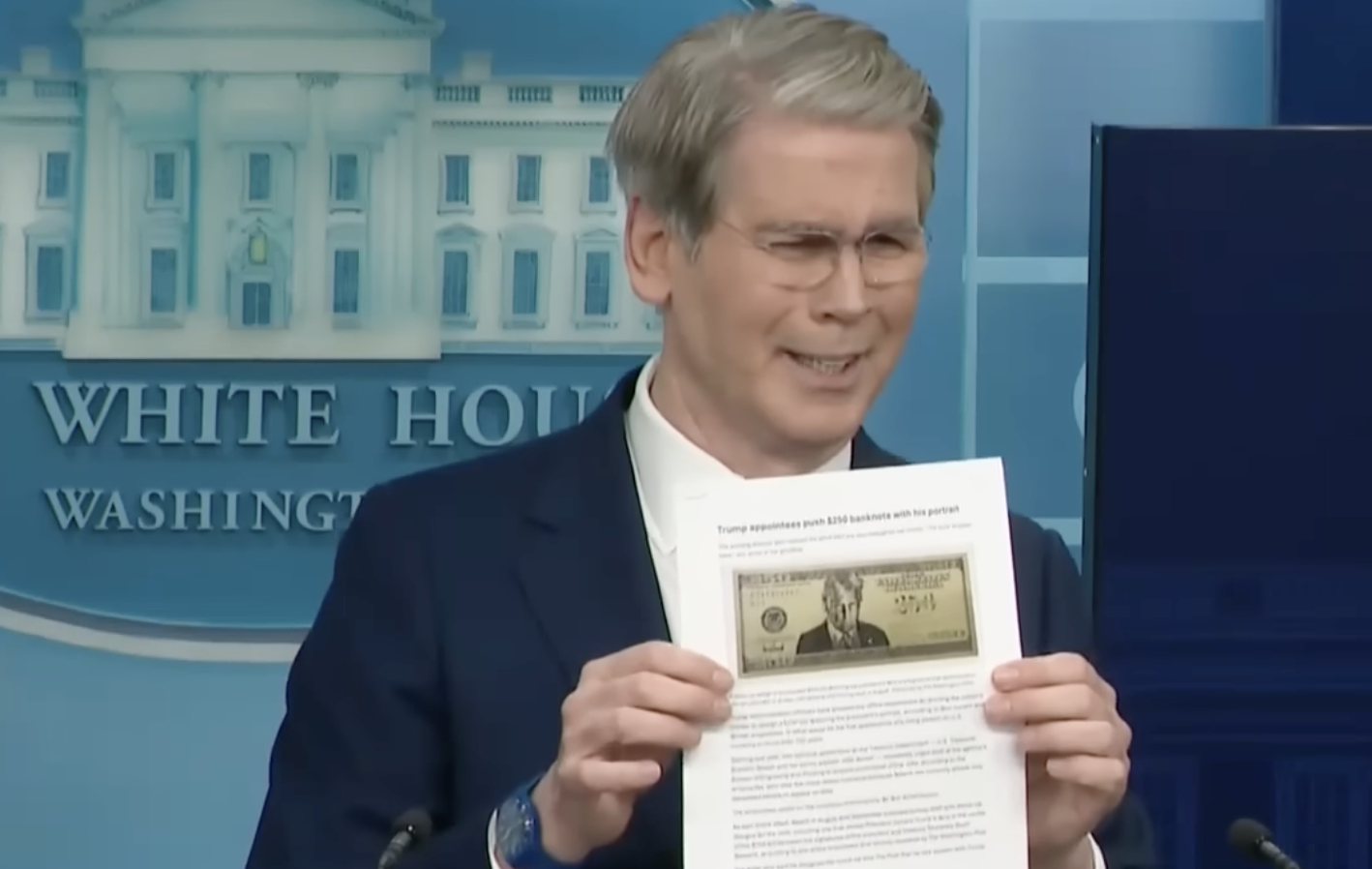
The United States Treasury Department has prepared a design for a $250 bill featuring President Donald Trump’s portrait, a denomination that does not currently exist and that would require Congress to both create it and carve out an exception to a law that has prohibited living people from appearing on American currency since 1866.
Treasury Secretary Scott Bessent confirmed both the design and the legal situation at the White House on Thursday, one day after the Washington Post reported that the process had already generated significant internal friction and the reassignment of the Bureau of Engraving and Printing director who pushed back against it.
“We’ve created the bill because we have to be prepared,” Bessent said at the White House briefing room. When asked specifically who the design was for, he did not hesitate. “Donald J. Trump,” he said, repeating the full name that the president himself characteristically uses.
The caveat was clear and immediate. “It’s all up to Capitol Hill,” Bessent added. “We will stick to the law.”
What The Washington Post Found
The Washington Post’s reporting, published Wednesday, revealed that US Treasurer Brandon Beach, a Trump appointee, has been pushing the Bureau of Engraving and Printing to expedite the design and production process for the new $250 denomination.
The story also revealed what happened to the official who resisted that push.
Patricia Solimene, the director of the Bureau of Engraving and Printing, was reassigned from her position after pushing back on the expedited timeline.
In a farewell message that the Washington Post reviewed, Solimene wrote four words that were immediately read as a pointed reference to the currency dispute: “The buck stopped here.”
Her replacement is Michael Brown, a top aide to Beach, who became acting director of the Bureau on May 18. Treasury declined to comment on Solimene’s current status or the circumstances of her reassignment.
The Post also obtained a mock-up of the design for the bill. It appears to be based on one of Trump’s presidential portraits, in which he bears what the Post described as a glowering expression.
The mock-up is similar to a design that Rep. Andy Barr of Kentucky had previously proposed, also featuring Trump’s portrait and signature alongside the colors of the American flag.
The 1866 Law That Stands In The Way
The legal barrier between the Treasury’s prepared design and an actual $250 Trump bill is the Thayer Amendment, a provision passed in 1866 and codified in 31 U.S. Code §5114, which prohibits any living person from appearing on United States currency or securities.
The law was passed in the 19th century specifically in response to a Treasury Secretary who had put his own portrait on government paper, the exact kind of self-promotional use of public financial instruments that the ban was designed to prevent.
Under current law, only deceased individuals may appear on US currency.
The portraits of Washington, Lincoln, Hamilton, Franklin and the other figures who populate American banknotes are all of people who died long before any of the bills they appear on were issued. The prohibition is not ambiguous.
Rep. Joe Wilson of South Carolina has introduced legislation specifically to create an exception to that prohibition, a bill that would amend the law to allow current and former presidents to appear on US currency.
The legislation would apply broadly but has been confirmed by Bessent to be designed with one specific person in mind. Wilson’s legislation has languished in Congress without passing.
Until it does, the Treasury design that Bessent confirmed on Thursday is a design for a bill that cannot legally be produced.
Creating the denomination itself would also require congressional authorization, the $250 bill does not exist, and no denomination above $100 has been printed since 1945, when $500, $1,000, $5,000 and $10,000 notes were last issued before being discontinued in 1969.
The Broader Pattern Of Trump Branding On Official Currency
The $250 bill story lands in the context of a broader pattern of the Trump administration placing the president’s name and image on official government materials in ways that are either unprecedented or legally contested.
Trump’s signature will appear on all US paper currency beginning with $100 bills to be produced in June, replacing the Treasurer of the United States’ signature on US money for the first time in 165 years.
Treasury Secretary Bessent described the move as recognizing Trump’s “historic achievements.” A commemorative 24-karat gold coin featuring Trump’s portrait was unanimously approved in March by the US Commission of Fine Arts, whose members were appointed by Trump.
A $1 coin featuring Trump is planned for 2026 circulation under authority the administration says derives from the Circulating Collectible Coin Redesign Act of 2020.
The State Department announced commemorative limited-edition passports featuring Trump’s portrait and signature.
Senator Jeff Merkley is leading a group of Democratic senators urging Secretary of State Marco Rubio to halt those passport plans, describing the changes as carrying “anti-democratic” symbolism.
Administration officials have framed all of these initiatives as part of the America250 celebration, the commemoration of the 250th anniversary of the Declaration of Independence, which falls on July 4, 2026. The 250-dollar denomination, in that framing, connects the bill’s face value to the year of the anniversary.
Critics argue the connection between patriotic commemoration and personal political branding has been crossed in ways that have no precedent in how American currency has been managed throughout the country’s history.
The Practical Obstacles Beyond The Legal Ones
Former Treasury officials quoted in coverage of the Washington Post story noted that even if Congress passed Wilson’s legislation and authorized the $250 denomination tomorrow, the process of actually designing, testing, securing and producing a new US banknote typically takes between six and eight years.
The security features that protect American currency from counterfeiting, the embedded security strips, the color-shifting inks, the microprinting, the watermarks, require extensive development and testing before a new note can be put into circulation.
The expedited timeline that Treasurer Beach has apparently been pushing represents an acceleration that currency security experts consider potentially problematic.
The reassignment of Patty Solimene, who appears to have pushed back on the expedited timeline, is the specific detail that connects the internal process to the external legal and practical concerns.
The Bureau of Engraving and Printing has historically operated with a degree of professional independence from political appointees on matters of currency design and production timelines, the kind of institutional independence that is designed to protect the integrity of the process from exactly the kind of politically motivated acceleration that former officials described to the Post.
Bessent’s Thursday briefing maintained that the Treasury is only conducting “planning and due diligence” and that Congress controls whether any of the prepared work goes further.
The design exists. The law does not yet authorize it. Whether Congress will change the law is a question for the lawmakers who have so far let Wilson’s bill languish without action.