Blue Origin Rocket Exploded On The Pad Last Night And Here Is How Bad It Is
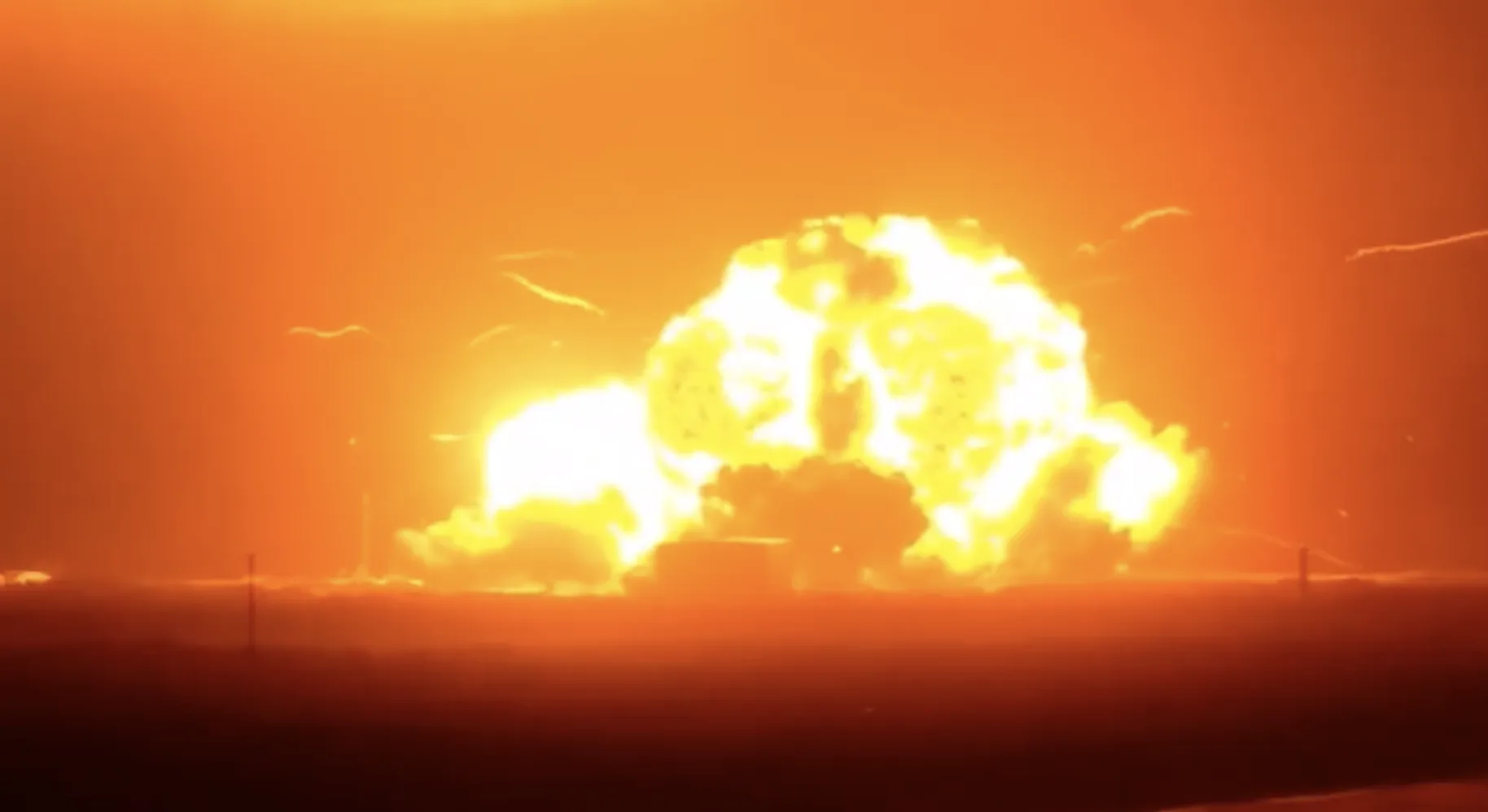
Jeff Bezos’ Blue Origin suffered the worst setback in its history on Thursday evening when the company’s New Glenn heavy-lift rocket exploded on its launch pad at Cape Canaveral Space Force Station during a hot-fire engine test, destroying the rocket, severely damaging Launch Complex 36, the only orbital launch pad Blue Origin operates, and triggering a cascade of consequences that now threatens Amazon’s satellite internet program, NASA’s lunar exploration timeline and the future schedule of one of the most significant new commercial rockets in American spaceflight.
The explosion happened at approximately 9 PM Eastern time at Launch Complex 36.
Blue Origin was conducting a static fire test, a ground-based engine ignition procedure that fuels and fires the rocket’s engines without lifting off, used to verify the propulsion system before flight.
The rocket was fully fueled for the test. The explosion that followed was one of the largest on-pad detonations in American launch history and the first such explosion at Cape Canaveral since SpaceX’s Falcon 9 destroyed Pad 40 on September 1, 2016.
All personnel were accounted for and safe.
Blue Origin's New Glenn just blew up at LC-36 while attempting to Static Fire ahead of NG-4.https://t.co/tANS0dWyIH pic.twitter.com/PztxFoBqIw
— NSF – NASASpaceflight.com (@NASASpaceflight) May 29, 2026
The Amazon Leo satellites that NG-4 was supposed to carry to orbit were not on board for the hot-fire test.
The rocket and the pad were not carrying crew. The structural damage and the program consequences are catastrophic. The human toll is zero.
“All personnel are accounted for and safe,” Bezos posted on X within hours of the explosion. “It’s too early to know the root cause but we’re already working to find it. Very rough day, but we’ll rebuild whatever needs rebuilding and get back to flying. It’s worth it.”
What Is A Hot-Fire Test?
A static fire test, or hot-fire test, is a standard pre-flight procedure in rocket development and launch operations.
The rocket is loaded with propellant, secured to the launch mount and its engines are fired for a defined duration to verify that the propulsion system performs within expected parameters before committing the vehicle to actual flight.
SpaceX conducts static fires before every Starship launch. The procedure is designed precisely to catch problems on the ground rather than in the air.
The New Glenn rocket that exploded Thursday was fully fueled for the test, a necessity of the procedure.
A fully fueled rocket contains hundreds of thousands of kilograms of liquid oxygen and liquid hydrogen or other propellants under pressure.
When something goes wrong in that environment, a component failure, a seal breach, an unexpected combustion event, the energy released is enormous.
The footage captured by SpaceFlight Now and NASASpaceFlight live streams shows an explosion erupting from the bottom of the rocket that grows larger as it moves up the cylindrical body, expanding into a massive fireball that rises into the sky and leaves the launch complex in ruins.
The erector-gantry, the structure used to move New Glenn from its processing hangar to the pad and to raise it from horizontal to vertical for launch, is not visible in footage taken after the explosion.
One of the two lightning towers that protect Launch Complex 36 is also gone. Multiple fires were burning in news helicopter footage captured well after the initial explosion. The damage is, by any honest assessment, severe.
Blue Origin called it an “anomaly.” The cause is not yet known. Bezos said the investigation is already underway.
The New Glenn Program And The Failures That Preceded This
Thursday’s explosion is the latest and most severe in a series of setbacks for New Glenn, a rocket that only flew its first mission in January 2025 and has struggled to demonstrate the reliability that Blue Origin needs it to demonstrate to fulfill its commercial and government contracts.
NG-1 was a qualified success in some respects and a failure in others. The rocket reached orbit on its first attempt, a genuinely impressive achievement for a new heavy-lift vehicle, but failed to recover its booster stage, which Blue Origin had designed to land on a drone ship at sea in the manner of SpaceX’s Falcon 9 booster recoveries.
NG-2, launched in November 2025, carried NASA’s ESCAPADE Mars probes and accomplished two goals simultaneously: delivering the science payload and successfully landing the booster for the first time.
NG-3, launched on April 19, 2026, reused that recovered booster and landed it again, the second successful booster recovery in two missions. That progress was undermined by what happened to the upper stage.
A cryogenic leak in the upper stage froze a hydraulic line, causing a thrust anomaly that left AST SpaceMobile’s BlueBird-7 satellite in the wrong orbit, a total loss for the customer.
The FAA ordered an investigation following NG-3’s partial failure, an investigation that was presumably still ongoing when Thursday’s explosion occurred.
NG-4 was supposed to be the first of 24 launches that Amazon has contracted Blue Origin to conduct for its Project Kuiper satellite internet program, Amazon’s answer to SpaceX’s Starlink constellation. The rocket was destroyed before it could carry a single Kuiper satellite.
Those 24 missions are now frozen pending the investigation, the pad repair and Blue Origin’s return to flight, a timeline that no one can currently estimate.
The Amazon Kuiper Problem
Amazon’s Project Kuiper is one of the most ambitious satellite internet ventures ever attempted, a program to launch thousands of satellites into low Earth orbit to provide broadband connectivity globally, competing directly with the Starlink constellation that SpaceX has been building and operating since 2019.
Amazon has invested billions of dollars in Kuiper and has FCC licensing conditions that require it to deploy a minimum number of satellites by a specific deadline.
The 24-mission launch manifest that Amazon contracted Blue Origin for represents a major portion of that deployment plan.
With Blue Origin’s only launch pad severely damaged and the program grounded pending investigation, those missions cannot proceed on their original timeline.
Amazon has backup launch agreements with other providers, United Launch Alliance and Arianespace among them, but the Blue Origin contract was central to the program’s mass launch capability.
The commercial pressure on Amazon to get Kuiper satellites into orbit is significant. Starlink already serves millions of customers globally and has years of operational experience and a functional global constellation.
Every month that Kuiper’s launch schedule slips is a month that Starlink extends its lead.
Thursday’s explosion did not destroy Amazon’s Kuiper program, the satellites themselves were not on the rocket, but it damaged the timeline in ways that will take months to fully understand and years to recover from.
The NASA Consequences That Are Already Drawing Attention
Blue Origin holds a $3.4 billion NASA contract to develop the Blue Moon Mark 2 crewed lunar lander, one of two Human Landing System vehicles selected for future Artemis Moon missions alongside SpaceX’s Starship. The other is SpaceX.
Blue Moon needs New Glenn to get to orbit. With New Glenn grounded and its only launch pad destroyed, every Blue Origin NASA commitment now carries an asterisk.
Blue Moon Mark 1 “Endurance” was planned for a Moon Base 1 mission as early as fall 2026. That mission is now firmly in doubt. A second Blue Moon Mark 1 lander carrying NASA’s VIPER lunar rover was planned for 2027.
A Blue Moon Mark 2 prototype was scheduled to participate in the Artemis 3 mission, currently targeted for mid-2027, as a low Earth orbit demonstration designed to reduce mission risk before an actual lunar landing.
The Artemis 4 Moon landing itself is targeted for 2028, with a Blue Moon lander as a component.
NASA Administrator Jared Isaacman acknowledged the situation directly but carefully. “Spaceflight is unforgiving, and developing new heavy-lift launch capability is extraordinarily difficult. We will work with our partners to support a thorough investigation of this anomaly, assess near-term mission impacts, and get back to launching rockets.”
He specifically noted that NASA would provide updates on Artemis and Moon Base program impacts when they were available, an acknowledgment that the impacts exist and are being assessed.
What Recovery Looks Like And How Long It Takes
The closest historical parallel to Thursday’s explosion is the SpaceX Falcon 9 explosion at Pad 40 on September 1, 2016, an on-pad anomaly that occurred during a routine fueling test before a scheduled launch.
The cause was eventually identified as a rupture in a high-pressure helium tank inside the rocket’s upper stage liquid oxygen tank.
Falcon 9 did not return to flight for three and a half months. Pad 40 was out of action for more than a year.
Blue Origin’s situation is arguably more difficult. SpaceX in 2016 had multiple launch pads, Pad 40 and Pad 39A at Kennedy Space Center, and could resume launches from the operational pad while rebuilding the damaged one. Blue Origin has one orbital launch pad.
Launch Complex 36 is it. Rebuilding or replacing that infrastructure while simultaneously investigating the cause of the explosion, redesigning whatever failed and remanufacturing the rocket is a parallel effort on multiple fronts that will take time measured in months at minimum and potentially years.
The SpaceX comparison also illustrates one important precedent: rockets that explode on pads can be redesigned, rebuilt and returned to flight. The 2016 explosion did not end Falcon 9 or SpaceX.
It delayed and complicated the program before the company recovered to become the dominant global launch provider.
Whether Blue Origin can execute a comparable recovery on a comparable timeline, and what the commercial and NASA implications are if it cannot, is the central question that Thursday’s explosion has placed in front of the American space industry.