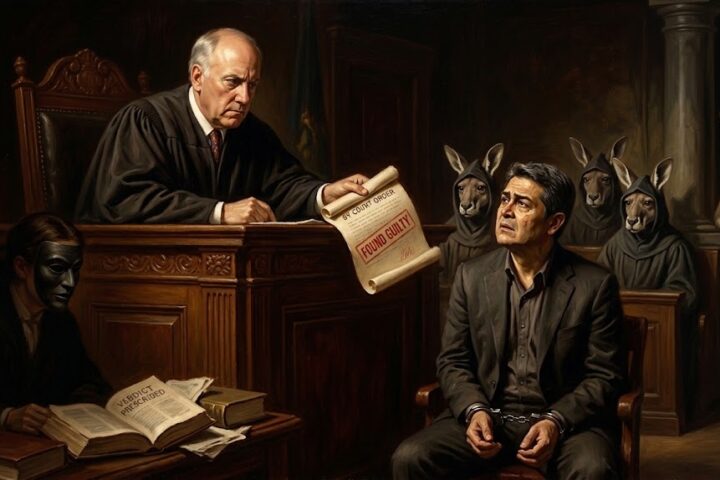

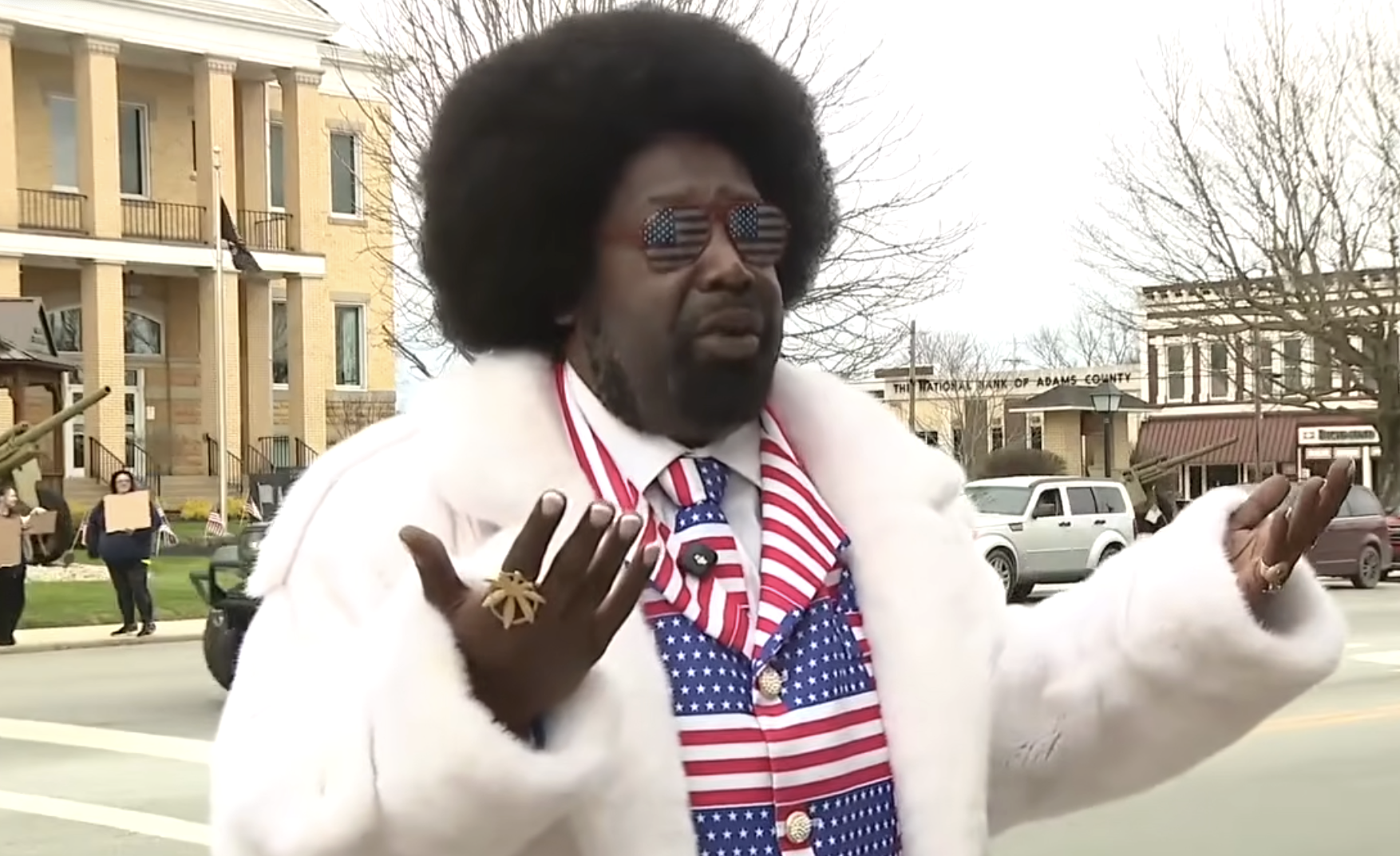
Judge Jonathan Hein read the verdict Wednesday evening in Adams County Common Pleas Court in Gonzales, Ohio.
“In all circumstances, the jury finds in favor of the defendant. No plaintiff verdict prevailed. So the matter will be concluded with defense verdicts.”
Tears ran down Afroman’s face.
Outside the courthouse, with fans holding signs in the cold and cars honking as they drove past, he had three words. “We did it, America.” Then: “Freedom of speech. It’s still for the people, by the people.”
He went home and posted a video to Instagram. “WE DID IT AMERICA. GOD BLESS AMERICA. LAND THAT I LOVE. FREEDOM OF SPEECH.”
The verdict cleared him on all 13 counts. Every defamation claim failed. Every false light claim failed. Every one of the seven deputies walked away without a dollar.
Together they had sought nearly $4 million in damages. Lisa Phillips alone had asked for $1.5 million.
Randy Walters and Brian Newland each sought $1 million. Shawn Grooms, Shawn Cooley, Justin Cooley, and Mike Estep were seeking $400,000 split between them. The jury said no to all of it.
What Did The Closing Arguments Looked Like?
Robert Klingler, the deputies’ attorney, spent his closing argument telling the jury that Foreman had spent three and a half years spreading intentional lies about seven people who were just doing their jobs.
“Mr. Foreman perpetuated lies intentionally, repeatedly, over three and a half years on the internet about these seven brave deputy sheriffs,” he said.
He told them the case was not about lemon pound cake. “Even if somebody does something to you that hurts you, that you think is wrong, like a search warrant execution that you think is unfair, that doesn’t justify telling intentional lies designed to hurt people. And they hurt people.”
Klingler also told the jury that what the deputies wanted was simple.
They wanted the lies to stop. They wanted Foreman to be held accountable for using their names, their likenesses, and their faces to make money off their suffering.
Afroman’s attorney David Osborne took a completely different approach. He reminded the jury of Cardi B and Megan Thee Stallion’s “WAP.”
He brought up South Park. He mentioned Saturday Night Live. His argument was that artists and comedians have always exaggerated and mocked public figures, and that the First Amendment does not become optional because the target of the mockery finds it uncomfortable.
“What opinion does that send if you can sue people, music artists, comedians, to shut them down?” he asked.
He told the jury there was no reasonable person who would watch Afroman’s videos and conclude they were factual reporting rather than satire. “He’s like a comedian. He exaggerates for the sake of entertainment.”
He also reminded them of who exactly was suing his client. “It is a social commentary on the fact that they didn’t do things correctly. They don’t like it. That’s not their choice, to like it or not. They’re public officials. They’re going to be held to a higher standard. Their work’s going to be criticized. That’s just what happens when you’re a public official.”
The jury agreed with Osborne.
The Exchange That Defined The Trial
The single most talked-about moment of the three-day proceeding came during Osborne’s cross-examination of Sgt. Randy Walters.
One of Afroman’s videos contains lyrics strongly implying that Walters’ wife had been unfaithful to him with Foreman.
Walters testified that people who heard the song took the implication as literal fact, that it had caused him “tremendous pain,” and that his daughter had been harassed at school because of it and had come home crying.
Osborne asked him directly: “But we all know that’s not true, right?”
Walters said he didn’t know.
“You don’t know if your wife’s cheating on you or not?” Osborne pressed.
Walters glared across the courtroom. “You wanna go there?”
That exchange ran on social media throughout the trial. The deputies had filed this lawsuit because they wanted people to stop paying attention to them.
The trial itself put them in front of an audience far larger than Afroman’s music videos had ever reached on their own.
Deputy Lisa Phillips had a similar moment earlier in the trial when Afroman’s videos were played in the courtroom during her testimony. A 13-minute video in which Foreman had labeled her “Licc’em Low Lisa” and made crude insinuations about her sexuality played in full before the jury.
Phillips wept watching it. She told the court the content had subjected her to public ridicule and deeply personal attacks from people in the community she had worked in for years.
What Foreman Said About The Money
Foreman testified that he made approximately $24,000 from all the songs, videos, and merchandise combined. He told the deputies’ attorney he was not in this for profit.
“We wouldn’t be in this room right now if they hadn’t raided my house and didn’t press charges and didn’t even know what they was doing,” he said from the stand. “This whole thing is their fault and they’re suing me for their mistake.”
After the verdict, he told CBS News exactly what the case meant beyond his own situation. “It’s not only for artists. It’s for Americans. We have freedom of speech. They did me wrong and sued me because I was talking about it.”
He said some version of that sentence five different ways outside the courthouse. “So when the people can’t use their freedom of speech, bring up the problem, address the problem, take care of the problem, then the problem never gets solved.”
He had gone to retrieve his money from the sheriff’s station with a local TV news crew in tow, a detail that drew laughter at the trial.
His reason was not for publicity. He told the jury directly: “I didn’t wanna get beat up or Epstein’d at the sheriff’s station after I seen them running around my house with AR-15s.”
What Happened In August 2022?
Deputies from the Adams County Sheriff’s Department kicked in the door of Foreman’s home in Winchester, Ohio, with weapons drawn. They had a search warrant tied to drug trafficking and kidnapping suspicions.
They seized $5,031 in cash, went through the entire property, and left. No drugs were found. No kidnapping victims were found. No charges were ever filed against Foreman, who was not even home at the time.
He was in Chicago when his neighbors called to tell him police were swarming the house.
The money was eventually returned, but Foreman said $400 was missing. He also said deputies disconnected his surveillance cameras during the search and left damage throughout the home that the Sheriff’s Office told him it was not responsible for repairing.
An outside review commissioned by the sheriff’s office attributed the missing cash to a miscount.
Foreman turned his own security footage into music. “Lemon Pound Cake” is built around the moment a deputy paused mid-raid to look at a cake his mother had baked sitting on the kitchen counter.
The song has 3.1 million views on YouTube. The lyrics include: “The warrant said, ‘Narcotics and kidnapping’ / Are you kidding? I make my money rapping” and “You crooked cops need to stop it / There are no kidnapping victims in my suit pockets.” He made roughly $24,000 from it. The deputies sued him for $3.9 million.
The jury deliberated for less than a day. They came back for him on every single count.