
When a person is going through chemotherapy, one of the less-discussed side effects is that food stops tasting like food. It tastes metallic.
It tastes bland. In some cases it tastes like something has spoiled, even when nothing has.
This is called dysgeusia, what oncologists and patients more commonly call chemo mouth, and it affects somewhere between 20 and 86 percent of all chemotherapy patients depending on the drugs used and the individual.
The problem is not cosmetic. When food tastes rotten, patients stop eating. When patients stop eating during cancer treatment, they lose weight.
When they lose significant weight during active chemotherapy, the consequences cascade.
Malnutrition, reduced treatment efficacy, worse prognosis, reduced quality of life, and in some cases treatment has to be paused or doses reduced.
Three meals a day becomes a source of misery in a process that is already punishing enough.
A small red berry grown natively in West Africa and now cultivated commercially in South Florida is drawing renewed attention as a possible way to give some of those patients their appetite back.
What Is Miracle Fruit?
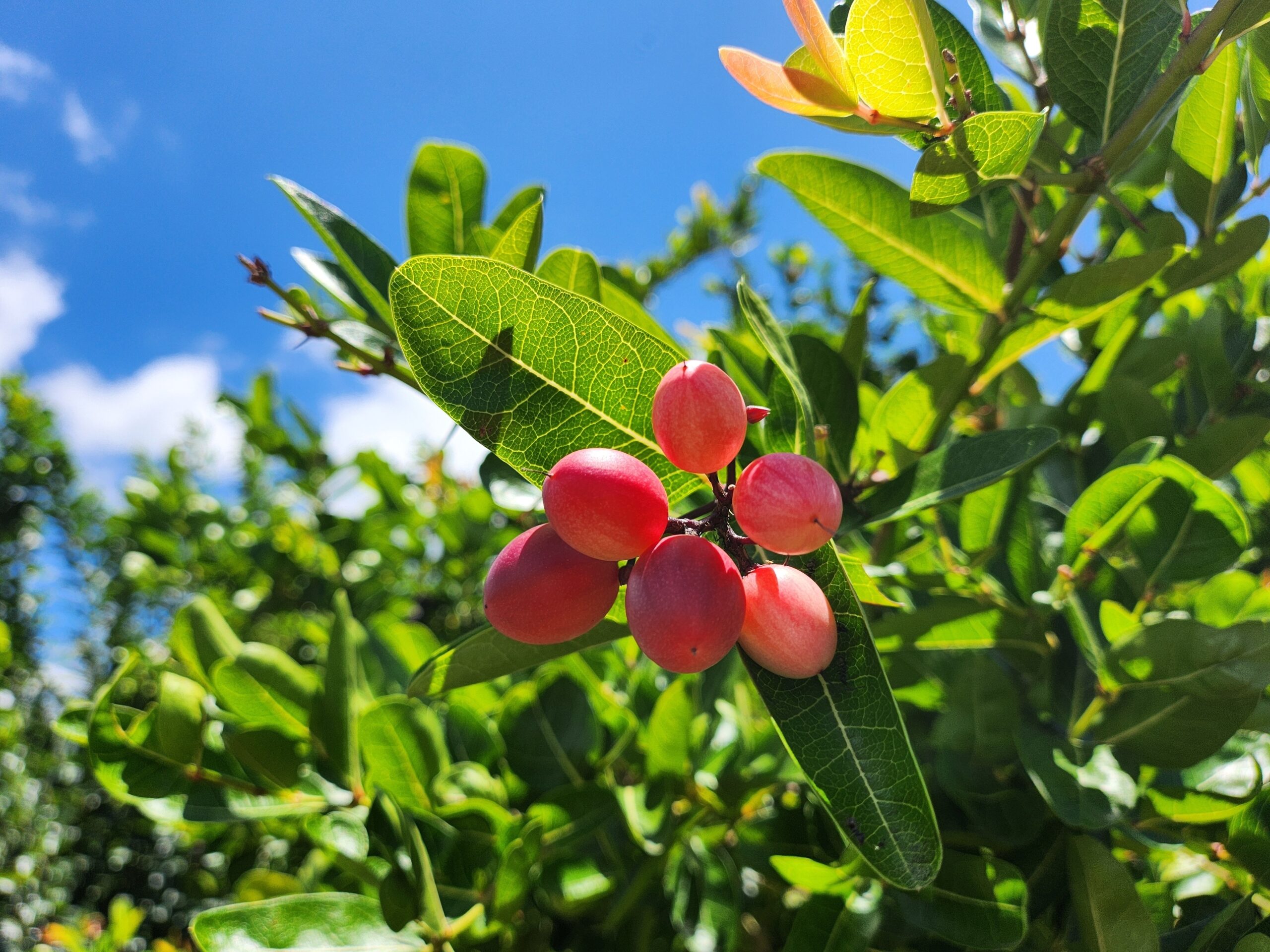
Synsepalum dulcificum, commonly called miracle fruit or miracle berry, is roughly the size of a peanut, bright red when ripe, and has a mild flavor similar to a cherry.
Its remarkable property has nothing to do with its flavor. It has everything to do with a glycoprotein in its pulp called miraculin.
Miraculin binds to the sweet taste receptors on the human tongue, specifically the receptor complex known as hT1R2 and hT1R3. At neutral pH, it binds without activating them. The effect is dormant.
When an acidic food is introduced and the pH around the tongue drops, something unusual happens. The miraculin-receptor complex activates, and the brain receives a sweet signal.
Sour, acidic food, a lemon being the most dramatic example, tastes sweet. The sourness becomes lemonade.
The effect typically lasts between 30 and 60 minutes as the miraculin gradually separates from the receptors.
For healthy people this has been an unusual novelty, “flavor tripping parties,” where participants eat miracle berry and then bite lemons have circulated as a curiosity for years.
For chemotherapy patients dealing with a world where everything tastes metallic or spoiled, what the berry does to taste perception is considerably more meaningful.
How Did Doctors First Discover Miracle Fruit’s Impact?
Dr. Mike Cusnir is a board-certified medical oncologist and co-director of gastrointestinal malignancies at Mount Sinai Medical Center in Miami Beach, Florida.
He has been one of the primary researchers studying miracle fruit as a potential supportive care tool for chemotherapy patients.
He learned about it from a patient. The patient brought it to his office and told him to eat the berry, then squeeze a lemon into his mouth.
Cusnir went along with it. “I’m like, ‘That’s going to be tangy,'” he recalled. “He’s like, ‘OK, try it.’ So I tried it. It was tangy. Then he said, ‘Now, try the fruit and then squeeze it again.’ And it tasted like lemonade.”
That interaction sent him into research mode. Cusnir found that the conventional recommendations oncologists typically make to help patients manage taste changes, using plastic utensils instead of metal, adjusting food temperature, adding spices, provided little meaningful relief for most patients. Something else was needed.
What Does The Research Show?
Cusnir ran a small clinical study comparing chemotherapy patients who tried miracle fruit against those using standard everyday symptom management.
Roughly half of the patients who tried the berry reported improvements in taste, along with better overall quality of life. Fourteen percent gained weight.
The fruit did not work for everyone. The findings are preliminary. Cusnir and the broader oncology community are clear about that.
Memorial Sloan Kettering Cancer Center, which reviews complementary and integrative medicine approaches, notes that small studies have suggested possible improvements in taste for chemotherapy patients who use miracle fruit, but that the evidence is “limited and inconsistent.”
They state that rigorous research is needed to determine how effective the fruit actually is and which patients are most likely to benefit.
More recent research out of Spain, the CLINMIR pilot study, a randomized, placebo-controlled trial published in 2024, enrolled 31 malnourished cancer patients and tested dried miracle berry supplements at standard and high doses against a placebo over three months.
Patients took a tablet before each main meal. The results for patients on the standard 150-milligram dose showed improved taste perception, greater food intake, better dietary quality, and measurable improvements in body composition, nutritional status, and quality of life.
Safety parameters remained stable throughout.
The trial is small. More investigation is needed. But the direction of the evidence, across multiple small studies over more than a decade, points consistently toward some patients experiencing real benefit.
Why Taste Loss Is Such A Big Deal In Cancer Patients
Cusnir has watched this unfold repeatedly with patients in his practice.
“The alteration in taste will end up giving the patient the sensation that everything is absolutely bland. And we may think that that’s negligible, that it’s not that important, but with time it becomes bothersome to the point where the patient doesn’t eat, then there’s weight loss.”
That weight loss is not benign. Malnutrition during active cancer treatment is associated with worse outcomes on essentially every measure, treatment efficacy, tolerance of treatment doses, prognosis, and quality of life.
A patient who has stopped eating is a patient who is less equipped to survive a physically brutal process.
There is also a social dimension that does not always make it into clinical conversations.
“If a meal becomes a challenge for the patient, and they just don’t want to be there because they’re bothered by the food, they may isolate,” Cusnir said.
Cancer treatment is already isolating in many ways, fatigue, immune suppression, physical side effects that keep patients home. The dinner table is often one of the few normal social rituals that remain.
When food tastes like metal and the patient dreads sitting down to eat, that disappears too.
“Patients are tired, fatigued and the time they spend with their family, if food is bothering them, it creates more isolation,” Cusnir said. “Patients are with us maybe 15 minutes every few weeks. But they’re at home, with their family, three meals a day.”
How Can People Get Miracle Fruit?
The miracle berry is a delicate fruit that loses its potency quickly once harvested.
Commercial farms in South Florida, because Synsepalum dulcificum grows well in subtropical climates, produce berries year-round, but the fresh fruit has a shelf life of only a couple of days before miraculin begins to break down.
This is why the most widely available form is a freeze-dried tablet or powder.
Products like mberry, made from compressed freeze-dried miracle fruit pulp, dissolve on the tongue and deliver the same miraculin effect as the fresh berry.
A pack of 15 cubes typically costs around $25 and can be purchased online and at some hospital pharmacies, including the Miami Cancer Institute’s pharmacy.
Quality and effectiveness vary between products and brands.
Cusnir said the fruit has not shown clear safety concerns in the observations conducted to date. There is no strong evidence of harmful interactions with chemotherapy drugs.
The European Union approved dried miracle berry as a novel food in 2021 after the European Food Safety Authority reviewed its safety profile.
Comprehensive long-term safety data are still limited. The consistent recommendation from oncologists is that patients consult their care team before adding any supplement or new food product to their regimen.
There is also ongoing research interest in applying miracle fruit to diabetes management, where its ability to make low-sugar foods taste sweet without adding calories or glucose could have direct practical value.
None of this is a cure or a treatment. What it might be, for the patients for whom it works, is a way back to the table.