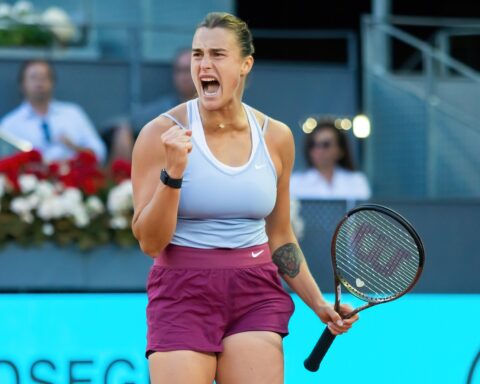

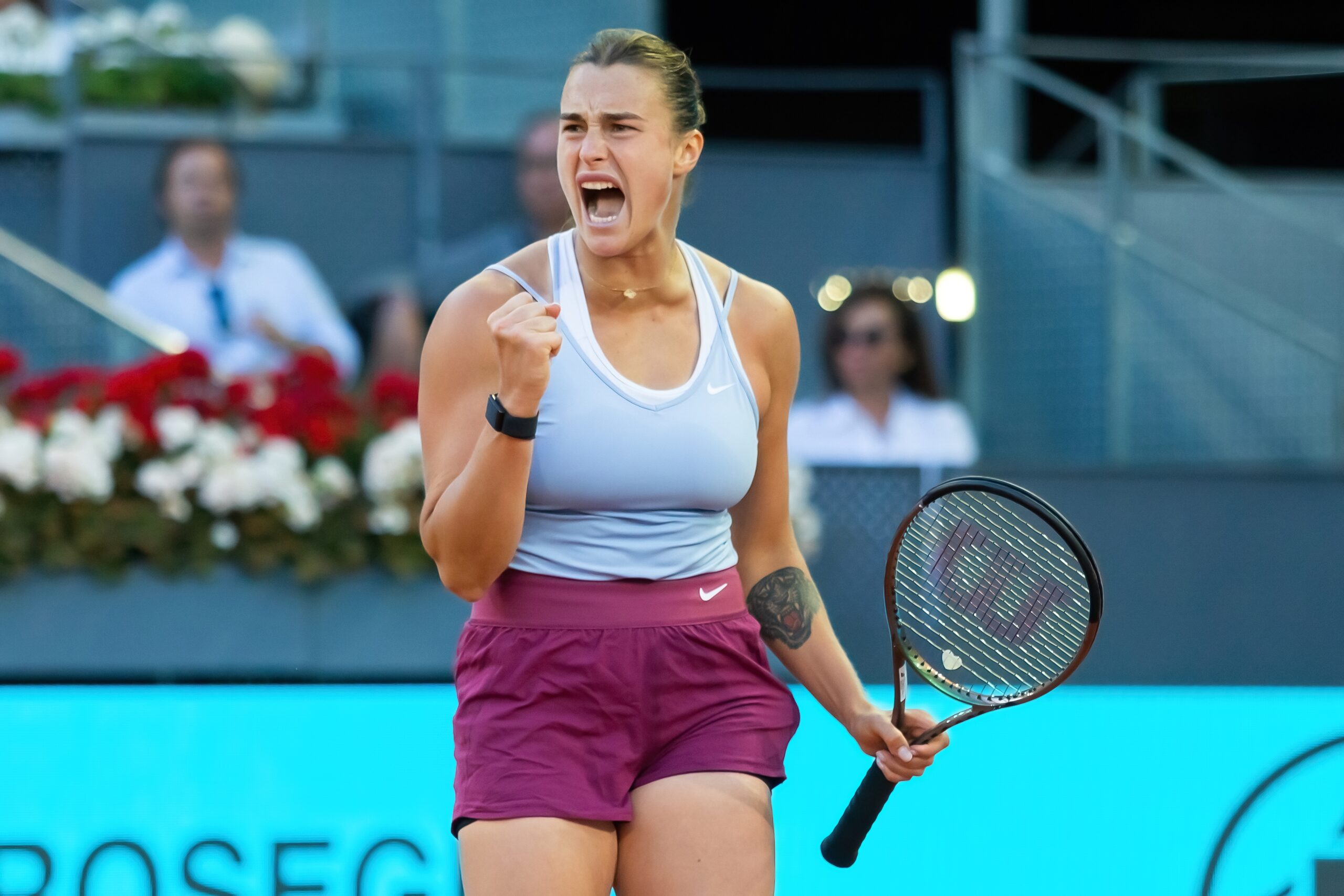
Aryna Sabalenka defeated Naomi Osaka in the fourth round of the Mutua Madrid Open on Monday, April 27, 2026, on the Manolo Santana Stadium clay, their third meeting ever and the first time the two four-time Grand Slam champions had faced each other on a surface other than hard courts.
Sabalenka won and will advance to the Madrid quarterfinals, continuing one of the most dominant seasons any player has put together on the WTA Tour in recent years.
The win extended Sabalenka’s winning streak to 15 matches and her 2026 record to 26-1.
She has now won three titles this year, Brisbane, Indian Wells and Miami, reached the Australian Open final and is now deep into the defense of her Madrid title.
Sabalenka has been beaten only once in 2026, by Elena Rybakina in the Australian Open final. In every other match she has played this year, she has won.
Osaka vs Sabalenka: The Match
This was the third time Sabalenka and Osaka had met in their careers, and the sequencing of those three matches tells a compact story about how the landscape of women’s tennis has shifted.
Their first meeting was at the 2018 US Open, when Osaka was a 20-year-old coming into her own and Sabalenka was a powerful but undecorated player still several years away from her first Grand Slam.
Osaka won that match in three sets on her way to claiming the title, her first of four Grand Slams.
After that, they simply did not meet again. Eight years passed. Two players with very different trajectories went through very different things, Osaka became one of the most famous athletes in the world, had a daughter, stepped away from the tour, and rebuilt her career from the ground up.
Sabalenka went through her own transformation, controlling her emotions, developing her game, and eventually becoming the world No. 1 and a multi-Grand Slam champion.
When they finally met again at Indian Wells in March 2026, the players who arrived for that match were fundamentally different from the ones who had played in 2018.
Sabalenka won 6-2, 6-4. Afterwards she reflected on what that eight-year gap actually represented:
“I changed a lot. So many things happened to me, and I became a better player, better person, learned a lot about myself. I’m in better control over my emotions, I’m more experienced, I got some Grand Slams in my belt. It’s just like I feel I’m completely different person right now from when we last played against each other.”
Madrid was the third chapter. It was the first time they had played on clay. The surface was new.
The competitive context, Sabalenka defending her title, Osaka trying to reach the Madrid quarterfinals for the first time since 2019, gave it additional stakes. Sabalenka won again.
What Sabalenka Has Done This Season
The numbers Sabalenka is putting up in 2026 require context to fully land. She entered the Madrid match at 25-1 on the year, on a 14-match winning streak, with a Madrid record since 2023 of 19-1.
She won her fourth title at this tournament, she had already won it three times previously in 2022, 2023 and 2024, skipping 2025 due to injury.
She entered the clay season with three hard court titles in the bank and a runner-up finish at the year’s first Grand Slam. Sabalenka is defending the Madrid title. She is the favorite for Roland Garros. She is the world No. 1 by a significant margin.
In Madrid specifically, she beat Peyton Stearns 7-5, 6-3 in the second round, a match that tested her early before she pulled away. She beat Jaqueline Cristian 6-1, 6-4 in the third round, commanding from the first game.
Both wins followed the same pattern that has defined her 2026: a brief period in which the opponent tests her, and then a decisive shift in which Sabalenka’s power and consistency overwhelm whatever resistance was being organized.
After the Cristian match, she reflected on her own game: “I’m super happy with the level, especially in the first set. Second set, happy to hold my serve to close the match in straight sets.
She brought really incredible fight, and I’m happy to be through.” That combination, acknowledging the fight while not being remotely troubled by it, is the mental posture of a player fully in command.
Osaka’s Run Coming Into Today’s Match
Osaka entered the match as the No. 14 seed with a 7-3 season record and a clay season that had gone well by recent standards.
She had beaten Camila Osorio 6-2, 7-5 in the second round and Anhelina Kalinina 6-1, 6-3 in the third, not dropping a set in either match. She had not won back-to-back matches in Madrid since 2019 until this year.
Her best Madrid result remained that 2019 run to the quarterfinals, which this win would not allow her to equal.
What Osaka showed in Madrid before this match was consistent with the version of her that has been slowly and stubbornly reassembling itself since she returned from maternity leave after the 2023 birth of her daughter Shai.
She has not been the dominant force she was at her 2020-2021 peak. Her game is more volatile, the 33 winners and 33 unforced errors she posted against Kalinina in the third round reflect a player still working out the balance between aggression and control.
But she has shown the ability to win matches that needed winning, and she arrived in Madrid on clay having navigated the draw without losing a set.
The problem was the person on the other side of the net.
The Clay
This was their first meeting on clay, and the significance of that is worth explaining for readers who do not follow tennis closely.
Clay courts are slower than hard courts, the ball bounces higher and stays in the air longer, which generally benefits players who can sustain long rallies and who have strong movement.
Sabalenka built her game primarily on hard courts, where her heavy first serve and aggressive groundstrokes are maximally effective. Osaka is a similar kind of player, powerful, flat-hitting, built for fast surfaces.
What makes Sabalenka’s Madrid record extraordinary is that she has adapted. Since 2023 she has gone 19-1 on the Madrid clay.
She won the title in 2022, 2023 and 2024. Her footwork and timing on clay have improved to the point where the surface no longer functions as an equalizer against her, it simply changes the conditions slightly, and she adjusts accordingly.
Osaka had hoped that clay might offer something different. That the slower conditions might give her more time to find her range and build into points.
That the surface unfamiliarity might create a more even contest. What it created instead was Sabalenka’s 15th consecutive win and a 2-1 head-to-head advantage.
What’s Next For Sabalenka?
With this win, Sabalenka advances to the Madrid Open quarterfinals where she will face either Belinda Bencic or Hailey Baptiste.
Bencic, the No. 11 seed, is a former US Open champion who has shown consistent form this season.
Baptiste, the No. 30 seed, has been one of the tournament’s surprises, defeating Jasmine Paolini in the third round in what was one of the upset results of the week.
For Osaka, the Madrid run ends in the fourth round, the best result she has had at this tournament since 2019.
Her 2026 clay season record drops to 2-1. She will continue on the clay swing, which builds toward Roland Garros at the end of May.
For Sabalenka, the answer to the question Sabalenka raised after Indian Wells, “I feel like we’re gonna face each other many more times,” has already been confirmed. They played in March.
They played in April. Both times Sabalenka won. The series now sits at 2-1 in her favor, and there is every reason to expect the next chapter will be written before the year is out.