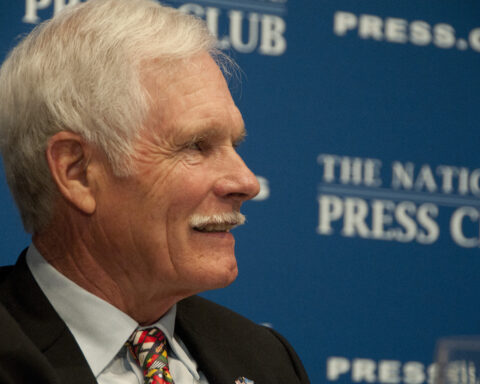

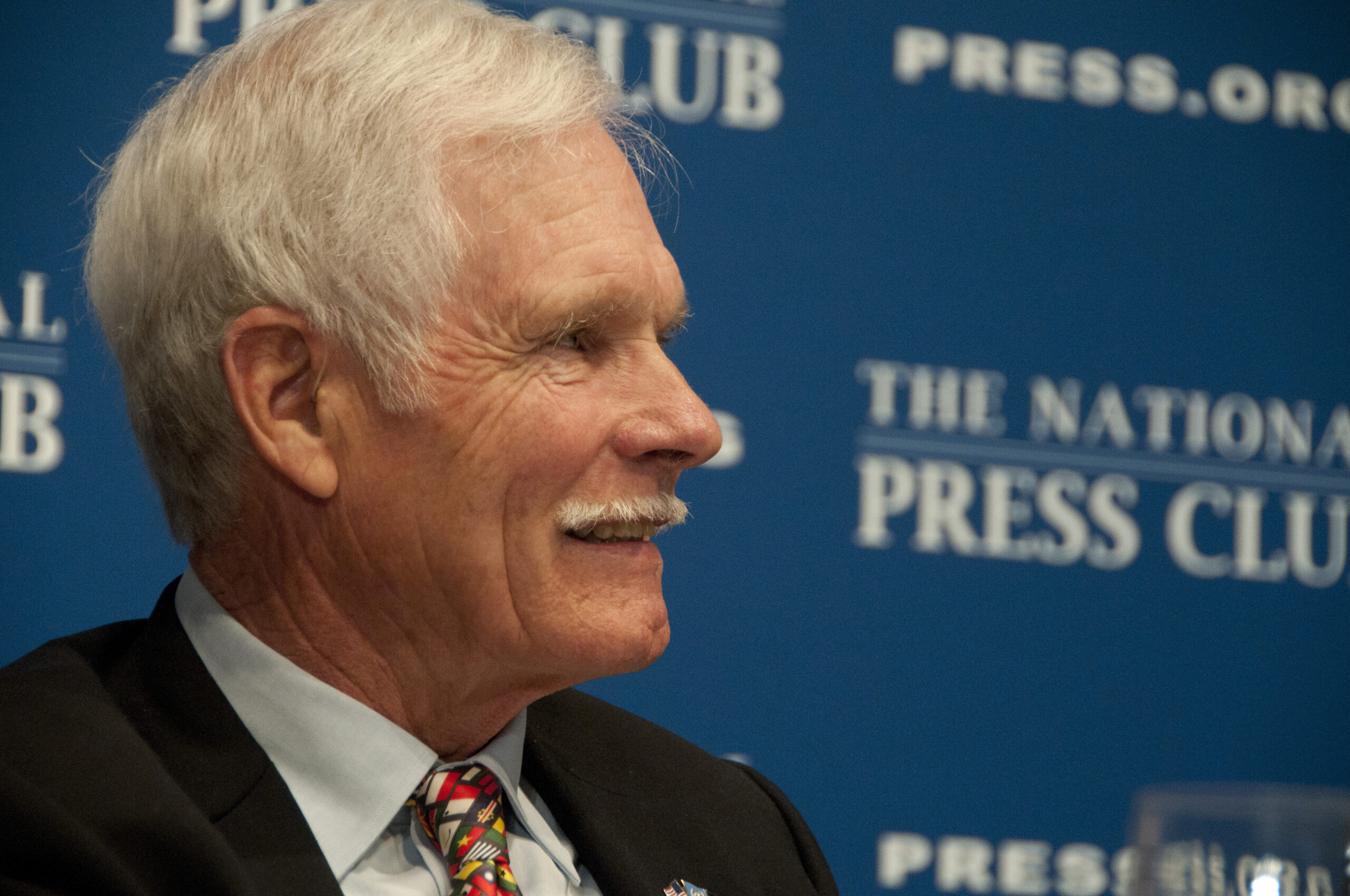
Ted Turner, the founder of CNN and one of the most consequential media entrepreneurs in American history, died on Wednesday May 6, 2026, at the age of 87. Turner Enterprises confirmed his death.
A specific cause was not immediately provided, but Turner had been battling Lewy body dementia since his 2018 diagnosis and had been hospitalized briefly with pneumonia in early 2025 before recovering.
He is survived by his five children, Laura, Teddy, Rhett, Jennie and Beau, fourteen grandchildren and two great-grandchildren. Jane Fonda, his third wife, with whom he was married from 1991 to 2001, also survives him.
The world Turner built, CNN, TBS, TNT, Turner Classic Movies, Cartoon Network, the Goodwill Games, the largest private bison herd in America, a billion-dollar gift to the United Nations, did not arrive without resistance. Almost every significant thing Ted Turner attempted was called impossible by someone who knew better. He launched them anyway.
CNN And Why Nobody Thought It Would Work
On June 1, 1980, Ted Turner launched the Cable News Network at a converted Jewish country club in Atlanta and began broadcasting news continuously, twenty-four hours a day, seven days a week, to 1.7 million cable subscribers across the country.
There was no template for what he was doing. Radio stations had broadcast news continuously for years, but no one had tried it with television.
The established networks, ABC, CBS, NBC, thought the idea was either foolish or doomed or both. They had the resources, the anchors, the infrastructure and the credibility that Turner did not.
What Turner had was the willingness to be wrong and the certainty that he was right.
He had used the same combination to turn a small Atlanta UHF station into a national superstation broadcast via satellite to cable systems across the country, a move that the established television industry said would not work and that redefined how cable operated.
Before CNN debuted, he told anyone who asked what would happen when the channel ran out of news:
“We won’t be signing off until the world ends. We’ll be on, and we will cover the end of the world, live, and that will be our last event.”
He said it because he meant it. He also said it because that was how Ted Turner talked, with the confidence of someone who had already decided the outcome and was simply waiting for everyone else to catch up.
To Oprah Winfrey he once put it more directly, “If Alexander the Great could conquer the known world, why couldn’t I start CNN?”
Former CNN chief news executive Eason Jordan worked with Turner from 1982 and described the founding vision as simpler than the media establishment was prepared to accept. “He was a visionary, a trailblazer, a rabble-rouser, a do-gooder, and he thought there would be a market for it.”
Tom Johnson, former president of CNN, remembered asking Turner what the rules of news were. “He said, ‘Tom, one rule: Be fair.’ I said, ‘What else?’ He said, ‘That’s it.'”
CNN went on to broadcast the Gulf War live from Baghdad in 1991, with reporters Bernard Shaw, John Holliman and Peter Arnett providing round-the-clock coverage from inside a city being bombed by the country their own network was based in.
It was the moment that proved Turner’s premise: continuous news coverage could be not just viable but essential. It was the moment CNN became something the world could not imagine not having.
At its peak, Turner Broadcasting’s networks and services reached two billion people in two hundred countries.
The man who launched it from an Atlanta country club with 1.7 million subscribers had built one of the most widely distributed media operations in history.
He always called CNN the greatest achievement of his life.
The Superstation And Everything That Followed
CNN was the most important thing Turner built, but it was not the first. Before CNN, Turner had already disrupted television once, by acquiring an Atlanta UHF station, WTCG, in 1970 and turning it into a national cable superstation by beaming its signal via satellite to cable systems across the country.
The station, eventually renamed TBS, for Turner Broadcasting System, became the template for how a local signal could become a national network without ABC, CBS or NBC’s blessing or infrastructure.
TBS aired professional sports, old movies, wrestling and eventually original programming. Turner added TNT in 1988, giving cable a dedicated movie channel.
He added Turner Classic Movies in 1994, a channel dedicated to the Hollywood films of the golden era that has since become the most trusted archive of American cinema available on television.
He added Cartoon Network, which produced shows that defined childhood for a generation.
The reach of his cable empire made Turner one of the most powerful people in media through the 1980s and into the 1990s, and in 1996 he sold Turner Broadcasting System to Time Warner in a deal valued at approximately $7.5 billion, becoming the largest individual shareholder of Time Warner in the process.
The sale made him enormously wealthy and removed him from operational control of the networks he had built. It was not a transition he navigated easily.
The world he had created continued without him in the center of it, and the trajectory of CNN and the other Turner networks took directions he did not always endorse or celebrate.
The Sports Owner Who Could Not Stay Off The Field
Turner’s enthusiasm extended to sports ownership in ways that were occasionally more theatrical than strategic.
He bought the Atlanta Braves baseball team in 1976 and the Atlanta Hawks basketball team in the same period, becoming one of the most prominent sports franchise owners of his era.
The Braves had a difficult stretch through the late 1970s and 1980s, but Turner’s ownership endured until the sale to Time Warner and then to Liberty Media.
The team won the 1995 World Series, one of the most celebrated moments in Atlanta sports history.
Turner was an active presence as an owner in the way that the league’s rules sometimes struggled to accommodate. He famously managed the Braves for a game in 1977, sitting in the dugout until National League President Chub Feeney told him he could not.
He was known for wearing a Braves uniform to games and to the dugout in ways that made everyone around him slightly uncertain about where fan ended and owner began.
Off the field, he founded the Goodwill Games in 1986, an international athletic competition designed as an alternative to the Olympic Games during the Cold War boycott era.
The Games were held in Moscow that first year and ran through 2001, providing American and Soviet athletes competition that the geopolitics of the period had otherwise prevented.
He was also an internationally recognized competitive sailor. He won the America’s Cup in 1977 with the boat Courageous, an achievement that earned him the nickname Captain Outrageous and that reflected the same combination of preparation, risk tolerance and competitive obsession that characterized everything he did.
The Bison, The Land And The Conservation Vision
Turner’s relationship with the American West was not incidental or aesthetic. It was a lifelong commitment rooted in a specific vision of what private land ownership could accomplish for conservation and ecological restoration.
He became one of the largest private landowners in the United States, at his peak holding approximately two million acres across nineteen ranches in the western US and Argentina, and used much of that land to pursue conservation goals that the public sector had attempted for decades without success.
The most visible of those goals was bison. Turner built the largest private bison herd in the world.
He reintroduced the animals to grassland ecosystems where they had been absent for a century.
He founded Ted’s Montana Grill as a restaurant chain specifically designed to create commercial demand for bison meat, his belief being that a commercially viable species with human appetite behind it was far more likely to survive than one protected purely by regulation.
“I was 10 years old when I first read about them,” he told Bethesda Magazine in 2011. “I said then I was going to work hard, see if I can make some money, and then I’m going to buy some land and raise bison and see if I can get the herd back away from the door of extinction.”
He created Captain Planet and the Planeteers, the animated environmental series that introduced ecological concepts to a generation of children in the 1990s.
Turner was an early and vocal advocate on climate change, predicting consequences for human civilization that were considered extreme when he said them and have since become mainstream scientific consensus.
The Billion-Dollar Gift
In 1997, Ted Turner announced he was donating $1 billion to the United Nations Foundation, at the time the largest single charitable gift ever made to the United Nations.
The donation was made in ten annual installments of $100 million each and established the UN Foundation as an independent public charity that broadened US support for the United Nations.
The gift was characteristic Turner, enormous in scale, unconventional in structure, and motivated by a genuine belief that the international institution it supported was essential to human survival. He served as chairman of the UN Foundation board of directors for years following the donation.
In 2001, he co-founded the Nuclear Threat Initiative with former US Senator Sam Nunn, a nonpartisan organization dedicated to reducing global reliance on and preventing the proliferation of nuclear, chemical and biological weapons.
The NTI became one of the most respected organizations in the world working on non-proliferation and has continued to operate since its founding.
In 2010, Turner became an early signatory to the Giving Pledge, Warren Buffett and Bill Gates’s initiative in which billionaires publicly commit to giving the majority of their fortunes to charitable causes during their lifetimes or at death.
His philanthropy in the decades preceding the Pledge is credited by Buffett and Gates as having helped inspire the effort.
The Man Behind The Persona
Turner’s public personality, brash, opinionated, prone to controversy, nicknamed “The Mouth of the South” and “Captain Outrageous” — was real but not complete.
He battled depression throughout his life. He struggled with the death of his father, who died by suicide in 1963.
He discussed his use of lithium and his mental health challenges in a 1993 biography. He competed with and clashed with Rupert Murdoch for decades in ways that occasionally became personal enough that Turner once threatened to fight him with his fists in Las Vegas.
He was also generous, passionate, genuinely curious and genuinely committed to things that were not obviously in his financial interest.
He knew Fidel Castro and maintained a friendly rapport with the Cuban leader at a time when that association cost him publicly. He knew Jacques Cousteau.
He cared about the natural world in ways that preceded the political valence those concerns later acquired.
Lewy body dementia is a progressive brain disorder that causes dementia and muscle failure.
Turner received his diagnosis in 2018, just over a month before his 80th birthday, and announced it publicly rather than quietly managing it. He was hospitalized with pneumonia in early 2025 and recovered, returning home. He died Wednesday at 87.
Mark Thompson, the Chairman and CEO of CNN Worldwide, reflected on what Turner’s life meant to the institution he created:
“Ted was an intensely involved and committed leader, intrepid, fearless and always willing to back a hunch and trust his own judgement. He was and always will be the presiding spirit of CNN. Ted is the giant on whose shoulders we stand, and we will all take a moment today to recognize him and his impact on our lives and the world.”
At CNN’s 43rd anniversary gathering in Atlanta in June 2023, Turner wrote to the assembled employees, more than 500 current and former CNN staff, with a message that functioned as a quiet farewell. “Those of you who are with CNN now, carry it on.”
They will. The man who started it is gone. The channel that was supposed to be impossible is still on the air.