
Part 1 made the geopolitical argument for Trump’s pardon of former Honduran President Juan Orlando Hernandez.
Part 2 examined the case the Biden Department of Justice put on.
Part 3 examined how the prosecutors lied to secure the trial before a biased judge and an uninformed jury.
Part 4 showed how the prosecutors coached cooperators to lie about ledgers and radar that did not exist.
Part 5 examined the four cooperators — 134 murders between them, 700 tons of cocaine trafficked, whose uncorroborated testimony was the basis for Hernández’s 45-year sentence.
Part 6 documented the eight years of U.S. government praise for Hernández as a counter-narcotics partner that the jury was not allowed to see.
This is Part 7.
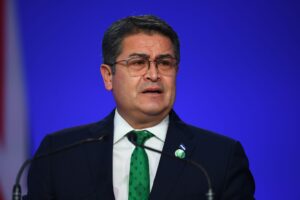
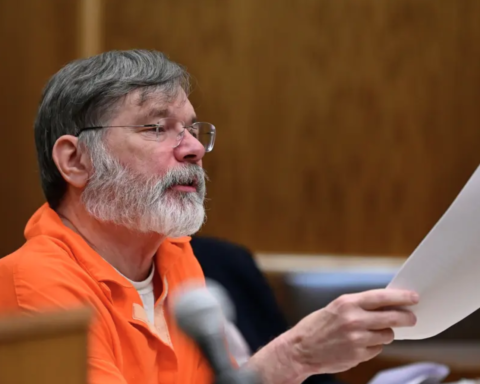
Juan Orlando Hernández served as president of Honduras from January 27, 2014 to January 27, 2022.
On June 26, 2024, Judge P. Kevin Castel in the Southern District of NY sentenced Hernandez to 45 years in US federal prison on drug trafficking and gun charges.
With federal good conduct credit, Hernández, then 55, would have been eligible for release at 93.
The Venue Issue
The SDNY prosecutors had spent nine years building a broader Honduran trafficking prosecution. They had begun in 2015. They convicted Tony Hernández in 2019, and Geovanny Fuentes Ramírez in 2021.
Judge Castel sat on the bench for each of the three trials.
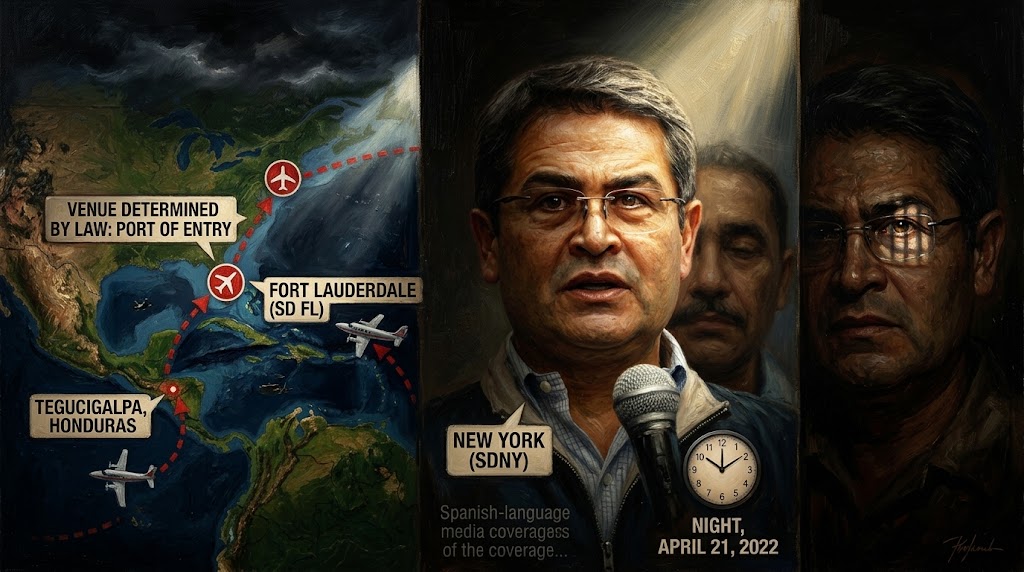
The Biden DEA flew Hernández out of Tegucigalpa on the night of April 21, 2022. The plane landed in Fort Lauderdale before continuing to New York.
Under federal law, the first port of entry determines the venue.
Two Options
The prosecutors had two options. Hand the case to the U.S. Attorney’s Office for the Southern District of Florida, as the law requires, and watch their nine years of institutional work get tried in front of a Trump-leaning Miami bench, with a Honduran-American jury pool, in a federal district they did not control.
Or lie.
They lied.
They told the judge and the jury that Hernández was first brought to New York. The lie kept the case in SDNY before Judge Castel.
235-Year-Old Law
The federal venue statute for offenses begun outside the United States — 18 U.S.C. § 3238 — reads:
“The trial of all offenses begun or committed upon the high seas, or elsewhere out of the jurisdiction of any particular State or district, shall be in the district in which the offender … is arrested or is first brought.”
Congress wrote the law for piracy and mutiny cases in the founding era. In 1789, the United States had 13 federal district courts and a Navy bringing pirates ashore from the Caribbean. The federal government needed a place to put them on trial that was convenient. The law was to try the defendant wherever you bring him into the country.
The law has been on the books for 235 years. Prosecutors have applied it to mutineers, slave traders, war criminals, terrorists captured abroad, and — in the modern era — international drug traffickers.
The phrase in the law that controls is first brought. The first federal district the defendant is brought into. Hernández was first brought into the Southern District of Florida.
The federal prosecutors from Manhattan wanted Castel in Manhattan. So they lied about where the plane landed.
The Stipulation
During the trial, the government read the lie to the jury. It was in the form of a stipulation.
The stipulation falsely stated that Hernández was first brought into the United States through New York after his extradition from Honduras in April 2022.
After the trial, prosecutors acknowledged their lie in writing.
“The government concedes that the venue stipulation read to the jury was false.”
The Venue the Prosecution Wanted
They had a strong reason to lie.
They had tried related cases in Castel’s courtroom and knew how he would handle their main witness: Devis Leonel Rivera Maradiaga, the former Cachiros leader who admitted 78 murders.
He had testified for the government at the Tony Hernández trial in 2019, at the Geovanny Fuentes Ramírez trial in 2021.
He also testified at the Juan Orlando Hernández trial in 2024.
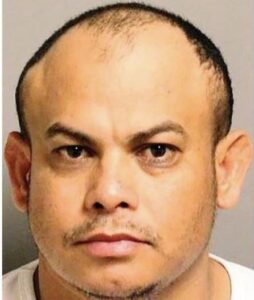
Rivera Maradiaga profited from his testimony. The mass murderer has been a federal cooperator since January 2015. He has pleaded guilty. And admitted to ordering 78 killings. He has testified in at least five federal SDNY prosecutions over 11 years.
The federal mandatory minimum on his admitted conduct is life imprisonment plus 30 years. The federal government has not asked the court to sentence him.
His current Bureau of Prisons custody status is not in the public record. He may be in the Witness Security Program. He may be in protective custody. He may be on supervised release.
The federal government will not say.
Florida Might Have Meant Acquittal
The issue was not using murderers as the witnesses against Hernandez, the issue was that a trial in the Southern District of Florida, as the law required, would have introduced the possibility of an acquittal.
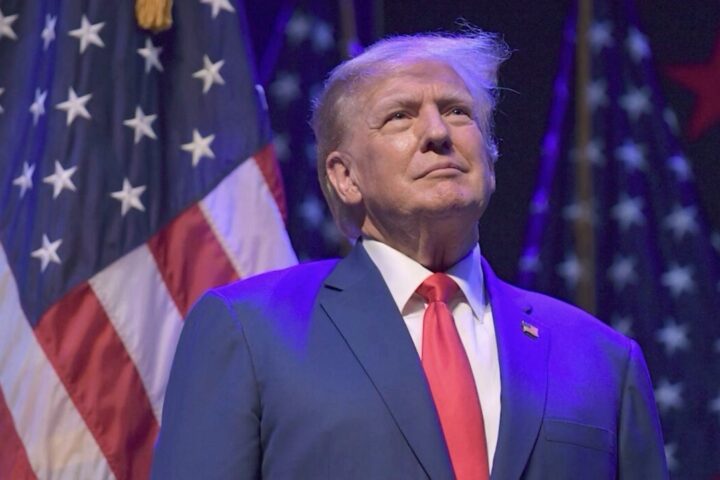
The Miami federal bench includes judges appointed by President Donald Trump in his first term. Trump was an ally of Hernández.
Trump believed the prosecution of Hernandez was a Biden DOJ setup.
If the trial occurred where the legal venue was, the Southern District of Florida, it was possible that judges with Cuban-American and Latin American backgrounds — people who understood the history and tensions of the hemisphere not as distant abstractions but as part of the human world around them – might get assigned to the case.
The Miami Jury Pool
The jury mattered too.
In South Florida, the jury pool comes from Miami-Dade, Broward, and Palm Beach counties. The Honduran-American community there is one of the largest in the country.
The Cuban-American community in South Florida has long opposed leftist governments in Latin America, including the then-Castro government in Honduras with whom the Biden DOJ allied.
A federal jury in the Southern District of Florida could have included people who had relatives in Honduras during Hernández’s presidency. People who knew the names of the trafficking Cachiros and the Valle Valles. They would know that drug trafficking went down because of Hernandez.
That he fought drug trafficking but leaned right and allied with Trump.
Jurors might include people who understood the political context of the 2009 coup against the leftist Manuel Zelaya, that led to Hernandez’s election and the war on drug traffickers, and the 2022 inauguration of Zelaya’s wife Xiomara Castro, and the slackening of drug trafficking intervention and even the introduction of cultivating the coca plant so that Honduras might be more than a transit stop but an actual exporter of cocaine.
These jurors might have acquitted or hung the jury.
The Press in Miami
The Spanish-language media in South Florida would likely have covered the trial differently from the press in Manhattan.
Most of the New York press reported the case as a straightforward narco-trafficking prosecution against a former foreign president.
The Spanish-language press in Miami would have seen Hernández as a former president who had stood beside Donald Trump at the White House and had been praised for years by the DEA and other officials for reducing drug trafficking out of Honduras.
The prosecutors wanted the case, which was built on killers cutting deals — including Alexander Ardón, the former mayor of El Paraíso, who admitted to 56 murders and served less than six years – in Manhattan.
To keep it there, they gave the jury a false statement about jurisdiction.
A South Florida judge and jury might have looked at the entire case – hinging on guys admitting murders by the dozen up there in suits telling the jury who the real criminal was supposed to be – a little differently.
What the Stipulation Did
The stipulation addressed the one fact necessary to keep the case in Manhattan: New York was the first point of entry. After the verdict prosecutors acknowledged that the statement was not true.
What Castel Did
Judge Castel did not vacate the verdict or order a new trial in Florida. He did not order a new briefing after the government admitted the statement was false.
The stipulation established jurisdiction. Jurisdiction established the court’s authority to return a verdict. If the stipulation was false, the verdict was false.
On June 26, 2024, Castel ignored the issue and sentenced Hernández.
The Appeal
The defense could have appealed the venue ruling (and other issues) to the Second Circuit, which could have affirmed the conviction or vacated it.
Before the 2nd Circuit had reviewed the issue, President Trump pardoned Hernández.
On April 8, 2026, the Second Circuit dismissed the appeal as moot and vacated the conviction.
SDNY’s Business
What remains are a review of how the SDNY conducts business.
Prosecutorial falsehoods are often treated by the judiciary as part of the system instead of a violation of it.
Note, please, that if a defense lawyer had presented a false stipulation to a federal jury, disbarment proceedings would have followed.
Lying, conversely, does not kill prosecutors’ careers. Sometimes it builds them.
That is the part people outside the system have trouble believing.
In the case of Juan Orlando Hernández, there appear to be many lies by the prosecution. The stipulation is merely one of many.
We will cover more of them in the series.