Ferrari Luce Is The Company’s First Electric Car And Here’s How Much It Costs
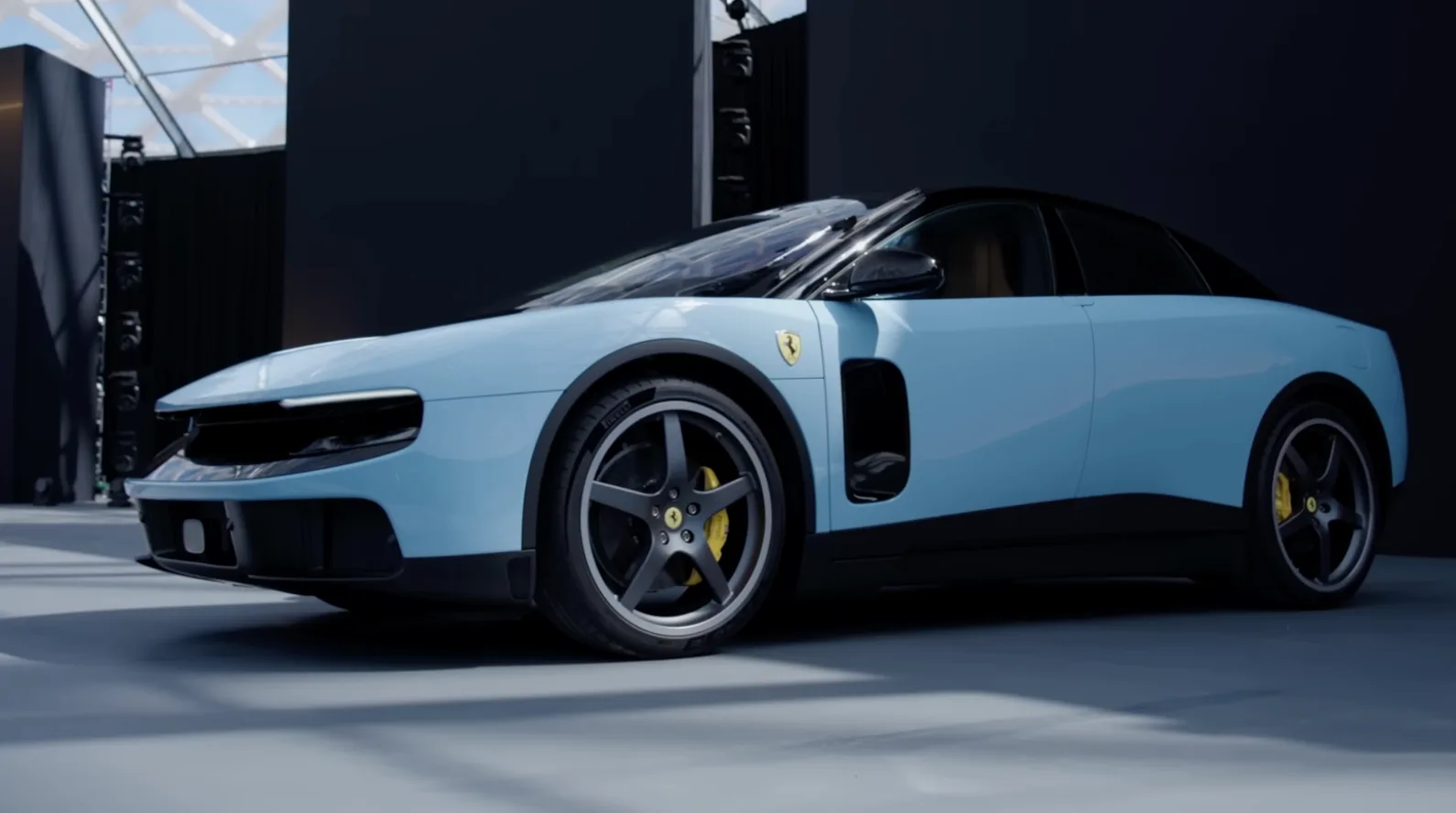
Ferrari unveiled the Luce on Sunday May 25, 2026 in Rome, the company’s first fully electric production vehicle, five years in the making, priced at approximately $640,000, designed in collaboration with Jony Ive, the man who designed the iPhone and the iMac.
It has four electric motors producing over 1,000 horsepower. It goes from zero to 100 kilometers per hour in 2.5 seconds.
It seats five people. It has rear-hinged doors. The internet looked at it and immediately began arguing.
The name means “light” in Italian. The price starts at €550,000. Production begins late this year.
Americans can buy one in the second quarter of 2027, assuming they have $640,000 available and are willing to accept a design that a meaningful portion of the automotive internet is describing as one of the strangest-looking Ferraris ever built.
Ferrari’s chief commercial officer Enrico Galliera explained the philosophy in an interview with Yahoo Finance. “We want to bring something that we consider as a game changer, really talk in a different language. We can maintain our current [design language], which is the current offer, satisfying our clients, and we want to test something completely different with different approaches.”
Testing something completely different is exactly what they did.
What Is The Ferrari Luce?
The Luce is a five-door sedan with rear-hinged coach doors, the kind of body style that Ferrari has never produced before in its 78-year history.
The company has built two-seat sports cars. It has built mid-engine supercars. It has built a grand touring coupe. It built the Purosangue SUV, which was its own kind of surprise.
The Luce is something else, a full-size luxury sedan designed around shared space, around family use, around the kind of buyer who might previously have purchased a Bentley or a Rolls-Royce rather than anything with a prancing horse on the hood.
The exterior design divides everything about the car from its predecessors. The surfaces are smooth, continuous and convex, no sharp edges, no angular aggression, no aerodynamic drama in the conventional Ferrari sense.
A deep black S-duct dominates the front face, a racing-derived functional opening that visually shortens the front overhang while giving the car a graphic statement across its nose.
Floating aerodynamic wings appear at the front and rear. The overall form is described by Ferrari as a “shell-like” shape, organic rather than geometric, rounded rather than wedged.
Design Boom described the car as stretching “Ferrari into unfamiliar territory” with proportions that “ask the eye to recalibrate before the badge fully lands.”
That is a generous reading. MacRumors forum users were less generous, “This is gonna go right to the top of the ugliest cars Ferrari ever made” appeared within hours of the reveal. Others noted more practically that regardless of what the car looks like, it will sell. “They’ll sell a ton of these. Not because it looks good. Because it has the right badge and it’s electric.”
Jony Ive And The War On Screen Dashboards
The most specifically interesting dimension of the Luce is not the exterior, it is the interior, and the philosophy behind it. Ferrari commissioned LoveFrom, the creative collective that Jony Ive founded with designer Marc Newson after leaving Apple in 2019, to design both the exterior and the interior.
The result of five years of work between LoveFrom and Ferrari’s own Centro Stile design team is a cabin that makes a specific and pointed argument about where luxury car design should go.
The argument is against touchscreens. Against the “iPad-ification of cars,” the phrase that Captain Electro used to describe what the Luce is explicitly reacting against.
The dominant trend in premium and luxury automotive interiors across the past decade has been the replacement of physical controls with touchscreen interfaces, large glass panels that manage everything from climate to navigation to seat positioning through software rather than hardware. Tesla popularized the approach.
Every major automaker has followed to varying degrees.
The Luce does not. Inside the Luce, the primary interface is physical, buttons, dials, toggles and switches that are precision-engineered and mechanically satisfying in the way that Jony Ive spent 22 years making Apple hardware mechanically satisfying.
The three-spoke steering wheel is machined from 100 percent recycled aluminum.
Multifunctional digital displays supplement rather than replace the physical controls, providing information without demanding interaction.
The philosophy is deliberate and specific. Ferrari believes that the buyers it is targeting, a new, younger clientele who may have grown up with iPhones but who are also spending $640,000 on a car, want the tactile experience of physical controls rather than the frictionless experience of glass surfaces.
They want the click of a toggle, the resistance of a dial, the feedback of hardware that communicates its function through touch.
Jony Ive, who spent his career making products that felt as remarkable as they looked, is exactly the person equipped to translate that philosophy into a cabin.
The sound design is another specific dimension of the interior experience. Ferrari’s engineers amplified the natural vibration sounds that the electric motors generate, sounds that would ordinarily be inaudible or meaningless, to give the Luce a visceral quality that conventional EVs lack.
It does not sound like a combustion engine. It sounds like an electric machine operating at very high performance levels, and Ferrari made that sound something intentional rather than something to be suppressed.
The Numbers That Explain The Performance
Under the Luce’s smooth shell is a powertrain that does not leave any doubt about what kind of company built it.
Four electric motors, one at each corner of the car, produce a combined output of over 1,000 horsepower.
The specific figure varies slightly by source but sits between 1,035 and 1,113 horsepower depending on the measurement methodology.
The battery is a 122 kWh unit from SK On, a Korean battery manufacturer, using nickel manganese cobalt chemistry. Fast charging capacity reaches 350 kW using the 800-volt architecture.
Zero to 100 kilometers per hour takes 2.5 seconds. Zero to 200 kilometers per hour, the second acceleration benchmark that reveals how a car continues to accelerate once it is already moving quickly, takes 6.8 seconds.
Top speed is 310 kilometers per hour, approximately 193 miles per hour. Range is more than 530 kilometers, approximately 330 miles.
For a car that weighs more than 2.2 metric tons, approximately 4,850 pounds, those figures require a specific explanation. An electric car with four motors and one motor controlling each wheel can manage its torque output at each corner independently and continuously, which allows it to distribute power precisely to whichever wheels have the most traction at any given moment.
The physics that would otherwise limit a very heavy car’s performance are partially overcome by the specific capability of quad-motor all-wheel-drive electric powertrains.
The Luce is heavy. It is also, by every available measurement, faster than almost anything else on public roads.
The 600-liter boot, roughly 21 cubic feet, is a specific statement about who this car is for. Ferrari has never previously had to worry about trunk space.
The Luce does not treat luggage as an afterthought. It treats it as part of the design brief for a car that is supposed to go somewhere with someone rather than simply going somewhere.
The Apple Car That Never Was
The Jony Ive connection to the Ferrari Luce arrives with a specific historical footnote.
Apple spent more than a decade on Project Titan, its internal effort to build a fully autonomous electric vehicle.
The project consumed billions of dollars, employed hundreds of engineers and automotive designers, went through multiple restarts and direction changes, and was ultimately canceled in 2025.
The car Apple was building never arrived.
Jony Ive left Apple in 2019, well before the project’s cancellation, and founded LoveFrom with Marc Newson. He spent five years collaborating with Ferrari on the Luce.
The man who might have designed Apple’s electric car designed Ferrari’s electric car instead.
The most consequential design relationship between a technology designer and an automotive manufacturer of the past decade produced the $640,000 sedan that is now the subject of extensive online argument about whether it is beautiful or strange.
Ferrari’s CEO Benedetto Vigna was present at the Rome unveiling to describe what the company built. “It’s the result of five years of work,” he told reporters. The car will begin reaching customers in the fourth quarter of 2026 in Europe. American buyers will have to wait until the second quarter of 2027.
The reaction from potential buyers who previewed the car before the public reveal was, according to Galliera, “extremely positive.” Whether the broader market feels the same about a Ferrari that looks nothing like previous Ferraris, costs more than most people earn in a decade, and was designed by the man who used to work at Apple, that verdict is still forming.