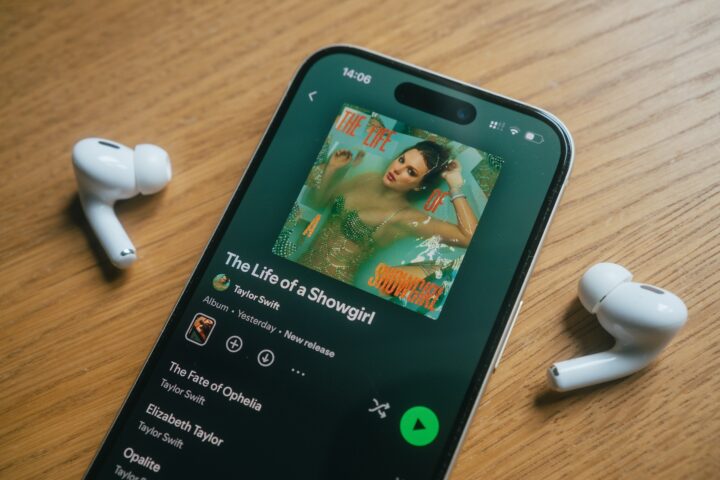

Taylor Swift is facing a federal trademark infringement lawsuit over The Life of a Showgirl, her twelfth studio album, filed March 30, 2026 in U.S. District Court in Los Angeles by a Las Vegas performer.
The performer says Swift’s team was warned by the US Patent and Trademark Office nearly five months ago that the album title was too close to an existing registered mark, and kept using it anyway.
The plaintiff is Maren Flagg, who performs professionally as Maren Wade. She has spent more than a decade building a brand around the name “Confessions of a Showgirl,” which she first used in 2014 as the title of a weekly column she wrote for Las Vegas Weekly.
That column, centered on her experiences as a performer in the Las Vegas entertainment industry, eventually became a live cabaret show, a national touring production, a podcast, and a book, all operating under the same name.
She registered “Confessions of a Showgirl” as a federal trademark in 2015, and the mark has since achieved what trademark law calls “incontestable” status, meaning she has demonstrated consistent, exclusive use over a sustained period and her right to the mark is legally established.
When Swift’s team applied to register “The Life of a Showgirl” as a trademark in August 2025, the US Patent and Trademark Office issued a partial refusal in November 2025, finding a likelihood of confusion with Wade’s already-registered mark.
The two names, the office found, share the same structure, the same dominant phrase, and the same overall commercial impression, and both are associated with entertainment involving musical and theatrical performances.
The trademark office subsequently suspended Swift’s application in early March 2026, putting proceedings on hold pending resolution of the conflict.
Wade’s lawsuit claims that despite this refusal, Swift’s team never contacted Wade, never sought her consent, and continued using The Life of a Showgirl commercially across the full scope of the album’s rollout.
“When Taylor Swift’s team applied to register The Life of a Showgirl, the Trademark Office refused, finding Swift’s mark confusingly similar,” Wade’s attorney Jaymie Parkkinen said in a statement. “We have great respect for Swift’s talent and success, but trademark law exists to ensure that creators at all levels can protect what they’ve built. That’s what this case is about.”
Swift’s representatives declined to comment on the lawsuit. No response from UMG or Bravado was provided to media outlets.
What Does The Lawsuit Say?
The complaint, filed in California federal court, brings three separate legal claims against Swift and her associated companies: trademark infringement, false designation of origin, and unfair competition.
The trademark infringement claim is the core of the case. Wade argues that “Confessions of a Showgirl” and “The Life of a Showgirl” are so similar in structure, phrasing, and commercial context that consumers are likely to confuse the two brands.
The lawsuit notes that both titles use the construction “of a Showgirl,” that both are deployed in overlapping markets targeting the same audience, and that Swift’s team would have found Wade’s mark through even a basic trademark search.
“That similarity would not have escaped Defendants’ notice,” the complaint states.
The unfair competition and false designation claims are built around a concept the lawsuit calls “reverse confusion,” a legal theory that applies when a larger, more commercially dominant brand overwhelms a smaller, earlier brand to the point where consumers begin to assume the original is the imitation rather than the other way around.
The lawsuit describes the dynamic directly,
“A junior user’s overwhelming commercial presence drowns out the senior user’s mark, until consumers begin to assume that the original is the imitation. What Plaintiff had built over twelve years, Defendants threatened to swallow in weeks.”
The complaint adds that “each additional sale compounds the confusion in the marketplace and further erodes Plaintiff’s ability to be recognized as the sole source of her Confessions of a Showgirl brand.”
Wade is seeking a permanent court injunction that would bar Swift, her management entities, UMG Recordings, TAS Rights Management (the company that handles Swift’s trademark portfolio), and Bravado International Group Merchandising Services from continuing to use The Life of a Showgirl as a brand name on any goods or services.
She is also seeking all profits earned from the sale of goods under that branding, additional monetary damages to be determined at trial, and a jury trial.
The damages figure is listed as unspecified in the complaint, meaning the dollar amount would be calculated based on what evidence shows at trial.
Who Is Maren Wade?
Maren Flagg is a Nevada-based entertainer who appeared on America’s Got Talent before building her Las Vegas career.
Her Confessions of a Showgirl project began as personal writing for Las Vegas Weekly in 2014, a column about what life actually looks like behind the sequins and stage lights of the entertainment industry.
The column found an audience, and Wade expanded it into a live show that she took on a national tour.
By the time Swift announced The Life of a Showgirl in August 2025, Wade had been operating under that trademark for over a decade and had built her professional identity around it.
The lawsuit’s most pointed language addresses the disparity in commercial scale directly. Wade’s complaint states that while Swift’s business success “does not depend on the continued use of any single designation,” Confessions of a Showgirl is Wade’s only trademark and the entire basis of her professional identity and career.
“It is not one mark among hundreds,” the complaint states. “It is the only one she has.”
For context on the “one mark among hundreds” line: Swift’s trademark portfolio reportedly includes more than 170 active or pending registrations covering phrases, imagery, and brand elements connected to her various album eras and tours.
The Social Media Wrinkle
The lawsuit’s timeline is complicated by a detail Parade reported from Wade’s own Instagram. In the weeks after Swift announced The Life of a Showgirl in August 2025, Wade’s social media posts appear to have embraced the album’s rollout, including posts using Swift’s music, the hashtag #LifeOfAShowgirl, and a podcast cover featuring a mint-green color scheme visually reminiscent of Swift’s album art.
Wade’s social media presence went entirely silent in October 2025 and has remained quiet since. Her attorney has not publicly addressed that period of apparent embrace of the album’s branding.
The lawsuit’s theory is built around harm, and how that harm is characterized given the earlier social media activity is likely to be a point of contention as the case develops.
What Is Life Of A Showgirl Is And Why Are The Stakes High?
The Life of a Showgirl was released October 3, 2025 through Republic Records, a subsidiary of Universal Music Group. It is Swift’s twelfth studio album, recorded in Sweden with producers Max Martin and Shellback during the European leg of the Eras Tour in 2024.
It became the fastest-selling album in US history in its first week, moving over four million album-equivalent units, and topped the Billboard 200 for twelve weeks.
It was the best-selling vinyl release of 2025 with 1.6 million copies sold in that format alone. It has produced two Billboard Hot 100 number ones, The Fate of Ophelia and Opalite, with the third single Elizabeth Taylor currently on radio.
The album’s visual identity is built around a glittery, art deco, feathered-showgirl aesthetic, and that aesthetic has been applied across an extensive merchandise line including candles, drinkware, accessories, and clothing, the exact commercial goods the lawsuit targets.
Maren Wade’s attorney was direct about what a courtroom victory could require of Swift.
The Hollywood Reporter noted that Swift’s options now include contesting the lawsuit in court or purchasing rights to Wade’s trademark outright. No settlement discussions have been reported.
The case is currently pending in US District Court in Los Angeles.