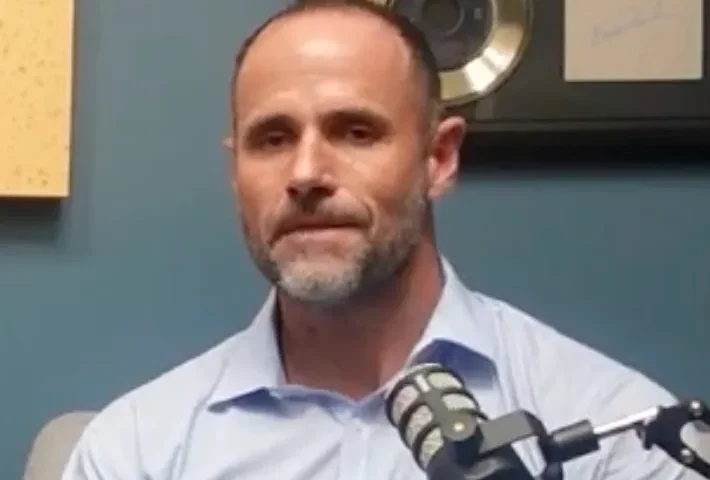

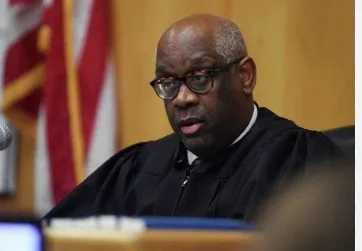
Connecticut Superior Court Judge Peter L. Brown read 145 pages of jury instructions to the jury in the Paul Boyne case. It took hours.
Brown presided over the trial of a man accused of threatening three fellow judges, colleagues who worked in the same state court system he did.
Most criminal jury charges in Connecticut run between 20-60 pages.
What the Blog Said
For years, a blog called The Family Court Circus ran at thefamilycourtcircus.com. It referred to the Connecticut judiciary as the “JEW-dicial” branch. It called judges pedophiles. It also wrote about killing judges.
A post about Judge Jane Grossman asked whether she was “begging for a .308 shot to the head thru two panes of window glass from an oath keeper, concealed in the woods behind her house.”

A photo of Judge Thomas Moukawsher appeared superimposed in a crosshair with the caption: “It is JUST CAUSE when Mouk gets a .50 cal to the head.”
The blog stated: “nothing changes until bullets start flying. Since 1776, bullets raise the issues and settle the score, from a colonial musket ball to a .50 cal max of today, bullets really do work wonders.”
Who Wrote It

Connecticut prosecutors believed Paul Boyne wrote the blog. Boyne, a Naval Academy graduate and former nuclear engineer, had lost custody of his children in a 2007 Connecticut divorce. He believed the family court system was corrupt. He moved in with his elderly parents in Springfield, Virginia, and became consumed by his grievance against the Connecticut judiciary.
Connecticut authorities arrested him in 2023, after a predawn SWAT raid on his Virginia home that found no weapons but seized two laptops and a cell phone. The state’s computer forensics expert testified that the blog posts at issue were researched, prepared, and posted using Boyne’s computers.
Boyne was convicted on all 18 counts of cyberstalking three judges.
Under the Supreme Court’s 2023 decision in Counterman v. Colorado, the state had to prove intent; that Boyne knew the posts would be taken as real threats. Not that a reasonable person reading them would be afraid. That Boyne understood them as genuine threats when he wrote or posted them.
The distinction is that a blogger writing inflammatory rhetoric about judges he believed had destroyed his and others’ families is different than a man who sends a letter to a judge’s home.
A man who believed he was publishing protected political speech on a blog read by disaffected family court litigants is different than a man who sent an email saying, “I am going to shoot you.”
The Judge’s Own Words

Judge Grossman was one of the three judges who complained. She testified about walking the perimeter of her property with her husband after she learned about the .308 post. She said she stopping using her sunroom, installed cameras and adjusted her alarm.
On cross-examination, Boyne’s defense attorney, Todd Bussert, directed her attention to her own written judicial decision in the Tiberi family court case. In that decision, written before the prosecution, Grossman had included a footnote describing the blog as containing “racist, homophobic, and antisemitic tirades” and noting that “the legal commentary is sophomoric and riddled with profanity.”
Bussert asked her whether “sophomoric” was a synonym for “threatening.”
She said it was not.
He asked whether the word “threatening” appeared anywhere in her own written description of the blog. She said it did not.
On redirect, prosecutor John Doyle asked Grossman whether she considered the .308 post to be criticism. “No,” she said. “I think that’s a death threat.”
Whether Boyne intended his words as real threats, in his own mind, was the question the jury was asked to answer.
There is one more fact to note. Three judges submitted affidavits supporting the criminal investigation of Boyne. Not one of them filed for a restraining order. Connecticut judges know how to obtain restraining orders. They grant them. A restraining order requires swearing under oath to a credible, imminent threat. It can be obtained quickly. If Boyne’s posts constituted real threats, that was a remedy available to them. None of them sought it. They chose criminal prosecution instead.
The Buried Standard

The Supreme Court held in Counterman v. Colorado that the state must prove more than that a reasonable person would find the words threatening. It must prove the speaker himself knew his words would be taken as real threats.
Brown’s jury instruction on that standard spans pages 39-42. Four pages out of 145.
Page 41 states it: the state must prove the defendant “intended his statements as threats of violence, had knowledge of how they could be interpreted, and conveyed them anyway.”
That instruction appears once.
The following 101 pages — covering 18 counts and three allegedly threatened judges — repeatedly direct jurors to “see my previous instruction on True Threats.” A cross-reference pointing back to four pages in a document that a jury had been listening to for hours.
Across those same 101 pages, Judge Brown did not hesitate to repeat statutory language multiple times. The definition of “course of conduct” appears again and again. So does “electronic communication,” “personally identifying information,” name, prior legal name, alias, mother’s maiden name, Social Security number, date of birth, address, telephone number, biometric data, medical records, financial records — in count after count.
Judge Brown restated the statutory elements favorable to the prosecution 18 times.
The Counterman standard — the constitutional protection at the center of the defense — he stated only once and told the jury to refer back to it.
If Brown had applied to Counterman the same repetition method he applied to every other element, the instructions would have been longer. Instead, Brown recited 145 pages by repeating everything which helped the prosecution 18 times, and stated once, the one thing that helped the defense and the US Constitution.

see also Paul Boyne Found Guilty on All 18 Counts for Blog Posts Targeting Connecticut Judges
Paul Boyne Spent 18 Months in Jail for Blog Posts. His Trial Starts This Week.

Frank Parlato is an investigative journalist, media strategist, publisher, and legal consultant.