
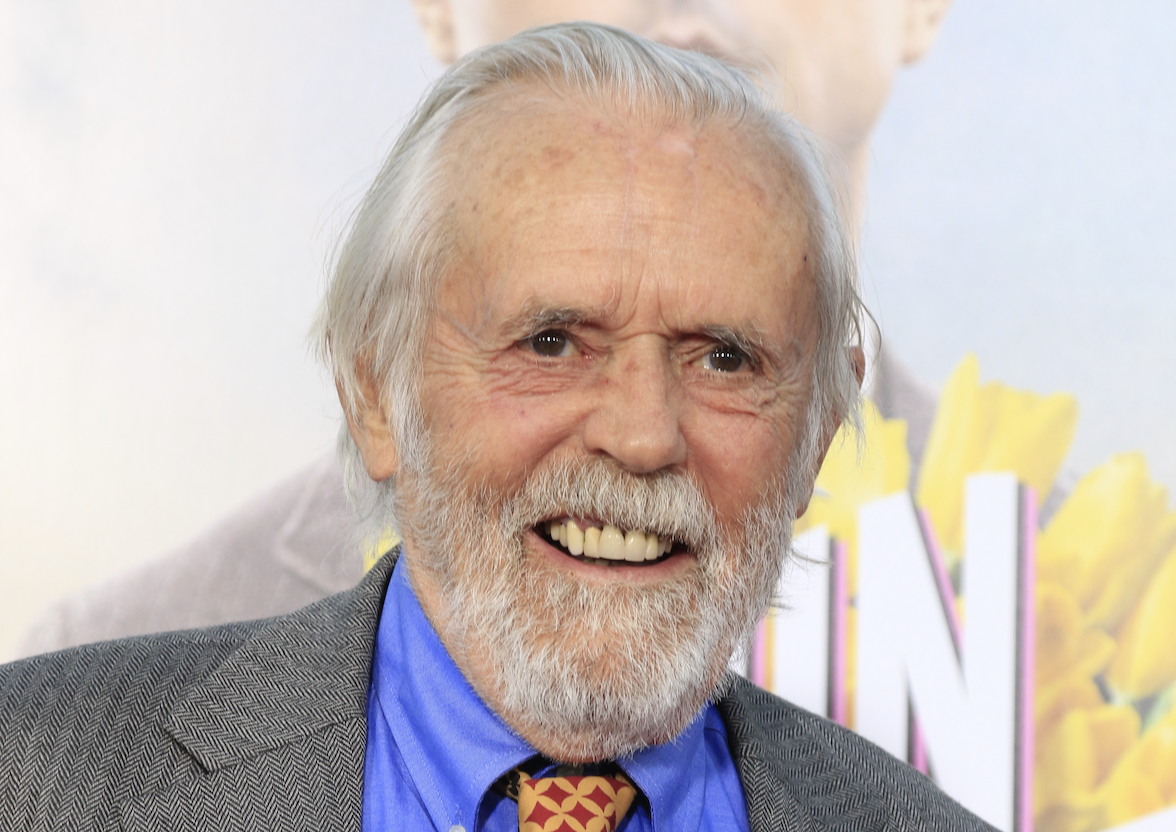
Matt Clark, one of Hollywood’s most enduring character actors, has passed away.
Clark, a man who spent six decades sharing scenes with Clint Eastwood, John Wayne, Robert Redford, and Paul Newman without ever needing his name above the title, died Sunday at his home in Austin, Texas.
He was 89. His wife Sharon Mays confirmed to Variety that Clark died from complications following back surgery.
His family’s statement was brief and precise. He was an actor’s actor who loved the job, was not concerned with stars or fame, and “died the way he lived, on his terms.”
That one line says everything about who Matt Clark was and how he chose to move through the world, and through Hollywood, which is not a place that makes that kind of quiet dignity easy.
Who Was Matt Clark?
Clark was born November 25, 1936, in Washington, D.C. After a two-year stint in the Army, he attended George Washington University but dropped out to join a local Washington theatre group.
He moved to New York and studied acting at HB Studio with Herbert Berghof and William Hickey, then joined the influential Living Theatre and worked off-Broadway before heading to California to start his film career.
His big-screen debut came in 1964 in Black Like Me, playing a mugger. It was a small role in a serious film, exactly the kind of entry point that suited him. He was not looking to be discovered. He was looking to work.
And work is what he did, for the next sixty years.
A Career Built In Westerns
If you watched American cinema from the late 1960s through the 1980s, you saw Matt Clark constantly, usually on horseback, usually in a hat, usually delivering exactly what the scene needed and nothing more.
His second film was the 1967 Sidney Poitier classic In the Heat of the Night. From there, he became a fixture in one of the golden eras of the Western genre, racking up credits that read like a syllabus for American film history.
He appeared alongside Robert Redford in Sydney Pollack’s Jeremiah Johnson in 1972 and Brubaker in 1980, in the latter, he played Purcell, the former warden’s clerk, in one of his best-known roles.
He also played opposite Clint Eastwood in Don Siegel’s The Beguiled in 1971, The Outlaw Josey Wales in 1976, and Honkytonk Man in 1982.
He appeared alongside Paul Newman in The Life and Times of Judge Roy Bean in 1972, and with John Wayne in The Cowboys that same year.
Sam Peckinpah cast him in Pat Garrett and Billy the Kid in 1973. By the mid-1970s, Matt Clark was not a star, but he was something arguably more valuable, he was the kind of actor that directors called because they knew he would show up, understand the scene, and make it real.
Director Brian Helgeland, who worked with Clark on the 2013 film 42, remembered him this way:
“By the time I worked with Matt Clark on the film 42, he had already been in more than 120 different productions in a career that stretched back to the early 1960s. You’d think there would be a little bit of ‘been there, done that’ in him. But what did I get? I got an artist who not only keenly understood his role but understood the scene he was in and where it fell in the grand scheme of the film. I got a talented performer who was more than eager to improvise and stay perfectly in character until the cameras stopped rolling. In short, I got a genuine actor. And I was lucky to have him.”
That is the kind of tribute that doesn’t get written about movie stars. It gets written about the people who make movies actually work.
Back to the Future III and the Role That Introduced Him to a New Generation
Clark played bartender Chester in Back to the Future Part III, the trilogy’s Old West chapter released in 1990. For many younger viewers, it was their first encounter with him, a gruff, weathered presence behind a bar in 1885 Hill Valley, entirely in his element in a genre he had spent decades mastering.
The role was not large. But it was memorable, and it dropped him into one of the most beloved film franchises in cinema history.
It fit him perfectly. By 1990, Matt Clark had been playing men of the frontier, sheriffs, ranch hands, drifters, prison clerks, bartenders, for more than two decades.
The Back to the Future set must have felt like familiar territory.
He also had a recurring role on the ABC sitcom Grace Under Fire and his film résumé included the cult favorite The Adventures of Buckaroo Banzai Across the 8th Dimension.
On television, he appeared in Bonanza, Little House on the Prairie, Magnum P.I., Kung Fu, Dynasty, and many others. His last TV role was on Chicago Hope in 2000.
Clark’s World Behind The Camera
What many people don’t know about Matt Clark is that he wasn’t only an actor. He directed the 1988 feature Da, starring Bernard Hughes, Martin Sheen, and his former acting teacher William Hickey.
The film is about a New York playwright summoned to Ireland to bury his father. It is a quiet, thoughtful film, exactly what you’d expect from a man who spent his career prioritizing craft over spectacle.
He also wrote the story for the 1970 film Homer and directed episodes of CBS Schoolbreak Special and Midnight Caller.
Living On His Own Terms Until The End
The family’s statement to TMZ was short but it was complete. Clark loved the job. He was not impressed by celebrity.
He was impressed by people who were good at what they did and committed to their families.
He felt lucky about his career. And when the end came, it came the way he had apparently always operated, without drama, without performance, on his own schedule.
He is survived by his wife Sharon, his daughter Amiee Clark (a producer), and his sons Matthias (a musician), Jason (a producer on the Peacock series Ted), and Seth (a film editor), along with grandchildren and great-grandchildren.
The fact that three of his four children went into the film industry is not a coincidence. He was a man who made the work look worth doing.
There is a specific kind of actor that Hollywood depends on and rarely celebrates, the one who shows up in the corner of the frame and makes you believe in the whole world of the film.
Matt Clark was that actor for sixty years. The films he was in are better because he was in them. That is not nothing. That is, in fact, everything.