
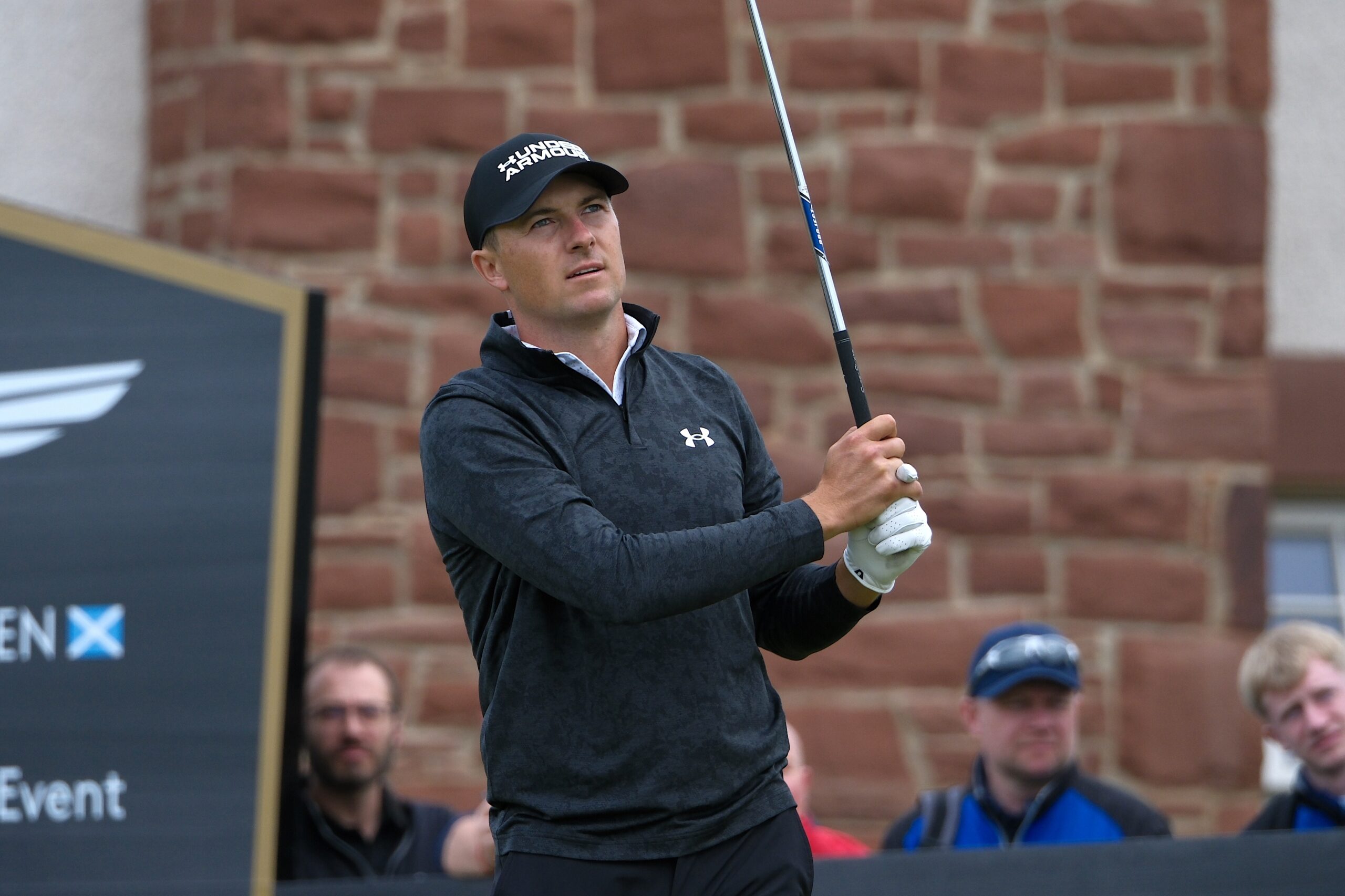
Jordan Spieth stood in the Augusta National sunshine on Wednesday afternoon, near the Par 3 contest, having not been formally invited to speak to media at the 90th Masters at all.
It was a detail he addressed with characteristic dry clarity.
“I didn’t even get asked, I don’t think,” the 2015 Masters champion said when a reporter stopped him before the par-three exhibition.
The media snub tells you exactly where Spieth sits in the eyes of the golf establishment right now.
At world number 61, without a PGA Tour win since April 2022, and coming off another week of putting struggles at the Valero Texas Open, he was simply not on Augusta National’s list of formal pre-tournament interview invitees, the group that included Scottie Scheffler, Rory McIlroy, and Bryson DeChambeau.
It is the second consecutive year this has happened. In 2025, Augusta also left him off the formal schedule.
What Spieth said in the informal exchange that followed was more interesting than what those other players said in their scheduled sessions.
He told reporters his game was feeling “as good as it’s been in a long time coming into this week.”
He explained why he believes this year’s firm-and-fast Augusta setup is going to make the week brutal for almost everyone.
He also explained, with the particular brand of quiet confidence that has always been the most compelling thing about him at this place, why he thinks he can win it.
Why Are There Questions About Augusta This Year?
The 90th Masters is playing without rain in the forecast and with Augusta National drying out to conditions not seen to this degree in recent years.
Scottie Scheffler, the world number one and two-time champion, said it is the best weather setup he has experienced for a Masters in his career.
The course is firm, getting firmer, and the greens are bouncing in ways that shrink landing zones and demand precision that even the best players in the world cannot always guarantee.
Spieth broke down what that means practically. “Greens are going to be firm,” he said. “It’s going to be probably a more challenging green-in-regulation year. So it’s going to be important to be coming out of the fairway just because it’s going to be hard to get it to stay on some of the greens if you’re not.”
He added that conditions were only going to intensify as the week progressed. “And then it’s going to probably get brown and crusty. Just with the weather coming, it’s going to be so nice that I think they’re going to let it go a little bit.”
The implications of what he is describing are significant. When Augusta plays firm and fast, the premium shifts away from pure power and toward imagination, touch, and the ability to manufacture shots from difficult positions around the greens.
Drives that find the fairway become more important not because of distance but because approach shots from the rough to hard surfaces have almost no chance of holding.
Players who can only attack pins directly from the short grass will struggle. Players who can think laterally, play to the safe side, and manufacture pars from awkward spots will outperform their rankings.
That description, applied to the golf course, is essentially a description of Jordan Spieth.
Why Spieth Is Still Betting On Himself
The reason Spieth gives for his comfort at Augusta is worth taking seriously, even if the form numbers around it are not encouraging. He is not simply saying he likes the course aesthetically.
He is describing a specific mechanism by which Augusta unlocks something in his game that does not always show up elsewhere.
“Augusta kind of, for whatever reason, like I’m picking a shot and I can fully commit to that,” he said on the Gravy and The Sleeze Podcast ahead of the week.
The courses that give Spieth trouble are the ones that demand a straightforward, repeatable ball flight with limited room for creativity.
Augusta is the opposite.
The longer pitches, the fairway bunker shots, the varied lies around the greens that require feel rather than formula, those are the categories in which he has operated at his best throughout his career.
“I would think it just kind of fits some of the strengths of my game a little bit better,” he said.
His numbers at Augusta reinforce the claim. He has the best scoring average in Masters history among players who have completed at least 25 rounds, sitting at 70.98 shots per round.
He has won it once, finished second twice, finished third twice, has six top-five finishes and six top-ten finishes in 13 starts.
No active player in the field has a more dominant statistical profile at this specific golf course.
The form that surrounds those numbers has collapsed considerably over the past four years, but the course-specific track record is real and it does not disappear.
Kevin Kisner, speaking on the Fore Play Podcast in the build-up to the week, offered the clearest outside articulation of why Spieth is worth watching.
“How about a little Jordan Spieth Green Jacket revival? He’s not making any putts, but he feels so comfortable on the Augusta greens that if that little flatstick gets hot, and he’s cocky enough, I just think he could be around.”
He also noted that Spieth has been playing par threes under par in 2026, relevant given Augusta’s four par-three holes, historically some of the most pivotal on the course.
The Shadow Of 2016
The 90th Masters is the 10th anniversary of the collapse, and that context follows Spieth down every fairway whether he wants it to or not. He entered the final round of the 2016 Masters with a five-shot lead, reached the 10th tee as the presumptive champion, and watched everything unravel across the back nine.
He bogeyed 10 and 11. On the 12th hole, a par three measuring roughly 150 yards over Rae’s Creek to a shallow green, he hit his tee shot into the water. His penalty drop did not improve the situation.
He hit his third shot so poorly it barely reached the creek. He made a quadruple bogey. Danny Willett, who had considered skipping the tournament because his wife was due to give birth that week, won the green jacket.
Willett’s son arrived the week before, allowing him to play, and he played brilliantly.
The image that circulated everywhere immediately after was of Spieth standing behind Willett in Butler Cabin, dazed, expressionless, watching someone else receive the jacket that had been within reach for 54 holes.
Spieth has been honest about what that hole means to him at every Masters since. “I’ll always have demons out here, but I’ll always have a tremendous amount of confidence out here too,” he said in 2018.
The demons are real. He hit into Rae’s Creek on the 12th during his very first Masters in 2014.
In 2016, standing over the ball, he knew he was about to play the same shot. He played it anyway. “I remember getting over the ball thinking ‘I’m going to go ahead and hit a little cut to the hole. And that’s what I did in 2014, and it cost me the tournament then, too.'”
He could not stop himself.
That is the specific psychological territory Spieth inhabits at Augusta, a place where he has more confidence than almost anywhere else on tour, and where his most catastrophic moment in golf is also permanently embedded in the landscape. Both things are true simultaneously.
How Has Spieth Performed Recently?
The honest assessment of Spieth’s 2026 form is mixed with a particular lean toward concern. He has not broken into the top ten in any of his eight PGA Tour starts this season.
His closest finishes have been an eleventh at the Arnold Palmer Invitational, an eleventh at the Valspar Championship, and a twelfth at the Genesis Invitational, results that suggest a player hovering just outside contention rather than one in genuine title-winning form.
His putting has been the primary concern. At the Valero Texas Open last week, the tournament played directly before the Masters on the PGA Tour calendar and the one players typically use as a final warm-up, Spieth struggled badly on the greens.
Putting is the most volatile component of any golfer’s game and the most capable of sudden improvement, but it is also the part of Spieth’s game that has most frequently deserted him during the years of his decline.
His ball-striking tells a different story. He ranks 33rd in strokes gained on approach, which is a genuinely strong number that reflects iron play capable of competing at the highest level.
He ranks 15th in scrambling, which at Augusta is directly applicable to the firm-and-fast conditions he described.
His driving accuracy is poor, outside the top 100, but at Augusta, where the fairways are wide enough and the rough is not punishing in the same way as a US Open setup, wayward drives have historically been manageable for him.
Who Is Jordan Spieth?
Jordan Spieth was born July 27, 1993, in Dallas, Texas. He attended Jesuit College Preparatory School of Dallas and played golf at the University of Texas before turning professional in 2012 at age 18.
He rose with almost shocking speed. In 2015 he won the Masters and the US Open, reached world number one by August of that year, and for a period looked like the inevitable future of the sport.
He had 11 wins between 2013 and 2017. He won the 2017 Open Championship at Royal Birkdale, completing three of the four legs of the career Grand Slam.
Only the PGA Championship has eluded him. He has finished second twice at Augusta since his 2015 win. He has two children and is now 32 years old.
Since 2017 the wins have come in threes and fews.
He won twice between 2017 and 2022, including the RBC Heritage in April 2022, which remains his last PGA Tour victory four years later.
The distance between the player he was in 2015 and the player at number 61 in the world who was not formally invited to speak to media at the Masters he won is one of the more quietly melancholy sporting stories of the past decade.
He does not speak about it in those terms. He speaks about Augusta with the specificity and self-awareness of someone who has studied his own relationship with the place and understands both its gifts and its ghosts.
“Play to the right spots,” he said on Wednesday. “Wait for the chances.”
The greens are firm. The course is going to get brown and crusty. Jordan Spieth believes that description suits him. The Masters begins Thursday.