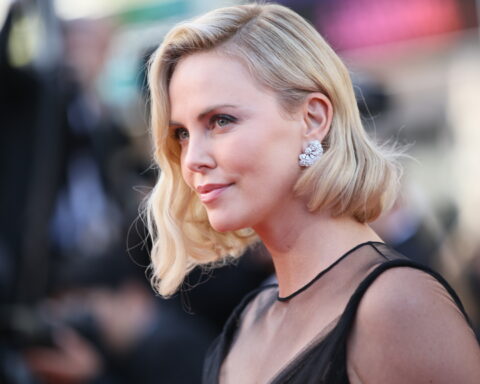

Charlize Theron gave the most detailed account of her life she has ever given in a New York Times Magazine interview published April 18, 2026.
The detail that is stopping people is the moment she describes watching her father’s headlights move across her bedroom wall as he turned into the driveway, knowing from the speed and the angle of the approach alone that someone was going to die that night.
“The way that he drove into that property that night, I can’t explain it to you,” she said. “I just knew something bad was going to happen.”
She was 15 years old. It was June 21, 1991. Her mother shot and killed her father before the night was over.
Nobody was charged. The case was ruled self-defense. And for years afterward, Charlize Theron told people her father died in a car accident.
She is 50 now, and she is not telling that story anymore.
“I think these things should be talked about because it makes other people not feel alone,” she told the Times. “I never knew about a story like that. When this happened to us, I thought we were the only people. I’m not haunted by this stuff anymore.”
How Did That Tragic Night Begin?
The incident that ended with her father Charles Theron dead on the floor of his South African home near Johannesburg began, as so many nights with alcoholics do, with something trivial.
Charlize and her mother Gerda had gone to the movies and stopped at her uncle’s house on the way back. Her father was already there, already drunk.
She needed to use the bathroom urgently when they arrived.
She ran inside without stopping to greet her father at the door. In South African culture, particularly with someone of that generation, and particularly in an altered state, this was a significant slight.
“I had to pee really badly. So I ran into the house to get to the toilet, and he took that as me being rude, because I didn’t stop and say hello to everybody,” she explained. “Big thing in South Africa, the kind of respect that you have to have for elders. And he was in a state where he just spiraled. Like, ‘Why didn’t you stop? Who do you think you are?'”
She knew immediately that she had made things worse.
When they got home, she went to her mother before retreating to her room. “I knew he was mad at me. So I said to her, ‘When he eventually decides to come home, please tell him I’m asleep.'”
She turned off the lights. Her window faced the driveway. She waited.
What She Knew Before He Got Home
This detail, that she lay in the dark reading her father’s approach by the sound and movement of his headlights, is among the most revealing things she has ever said publicly about what it was like to grow up with Charles Theron.
It speaks to something beyond the single night that ended his life.
It describes a child who had developed, out of necessity, the ability to read danger from a distance. A child who had spent her whole life watching the driveway.
She had known her father only as an alcoholic. She had never known him to be sober.
“It was a pretty hopeless situation,” she has said of the family. “The day-to-day unpredictability of living with an addict is the thing that you sit with and have kind of embedded in your body for the rest of your life, more than just this one event of what happened one night.”
She had years of practice at reading his arrivals. That night was different from all the others.
What Happened In The Home That Night?
Her father came home with his brother. He broke through the steel security doors by shooting through them, “making it very clear that he was going to kill us,” Theron said.
The threat was explicit and spoken aloud, “I’m going to kill you tonight. You think I can’t come into this door? Watch me. I’m going to go to the safe. I’m going to get the shotgun.”
Her mother heard it. She ran to the family’s gun safe, retrieved her weapon, and came to her daughter’s bedroom.
There was no lock on the door. The two of them pressed their bodies against it to keep him out.
“He just stepped back and started shooting through the door,” Theron said. “And this is the crazy thing, Not one bullet hit us.”
When he stepped away from the door, toward the safe, to get the shotgun he had promised, her mother moved.
She pulled the bedroom door open. The uncle was still in the hallway. Her mother fired one bullet down the hallway.
It ricocheted seven times and struck the uncle in the hand. She followed her husband. He was at the safe, pulling out more weapons. She shot him.
He died from the gunshot wound. No charges were filed against Gerda Theron. The case was ruled self-defense. Police found that the shooting was a direct response to an imminent and credible threat.
The Morning After
What happened the next day is, in some ways, the most striking part of the account. Gerda Theron did not sit with it. She did not allow her daughter to sit with it either.
“She picked right up,” Theron remembered. “The next morning she sent me to school. She was just like, We’re going to move on.”
“Not necessarily the healthiest thing,” Theron added, “but it worked for us.”
She has understood, in the decades since, what her mother was doing. “She wanted me to forget about it.
She didn’t want me to sit in it. We didn’t have therapists around, so in her head the best therapy was, We’ve got to move on.”
That morning, being handed her schoolbag and sent to class the day after her father tried to kill her and her mother killed him first, is one of the stranger things in Theron’s account.
It is also one of the most recognizable things she has ever said publicly. It is the behavior of a woman who survived something and refused to let it become the thing her daughter organized her entire life around.
How Theron Covered Her Tragic Story
For a long time, Charlize Theron did not tell any version of this story. She said her father died in a car accident.
She has explained this without embarrassment in previous interviews, “Who wants to tell that story? Nobody wants to tell that story.”
She has also said she sought therapy in her late 20s and early 30s to work through what she described as the deeper wound, not the single night but the years of living in a house with an alcoholic, never knowing which version of the day would be waiting when she got home.
She first spoke about the shooting publicly in 2017 in an interview with Howard Stern.
She spoke again in 2019 at NPR. Each time she has provided more detail, more clarity, more of the specific texture of what happened.
The Times interview represents the fullest account she has given, with specifics that have not been shared before, the bathroom that started the argument, the headlights crossing her wall, the ricocheting bullet, the exact words her father spoke through the door before her mother shot him.
Where Is Theron Now?
The interview was conducted ahead of the release of her upcoming Netflix survival thriller Apex, which premieres in the coming days.
She will also appear in Christopher Nolan’s The Odyssey, in which she plays the nymph Calypso.
But the reason she gave the interview, by her own account, is not career promotion.
It is the belief that telling the complete story, all of it, including the bathroom and the headlights and the seven ricochets, does something for someone else who has been through something like it and thought they were the only one.
“I think these things should be talked about because it makes other people not feel alone,” she said. “I never knew about a story like that. When this happened to us, I thought we were the only people.”
The people who lived it survived it. The mother who shot her husband sent her daughter to school the next morning.
The daughter grew up, sought therapy, became one of the most acclaimed actresses of her generation, and eventually stopped telling people it was a car accident.
“I’m not haunted by this stuff anymore.”