

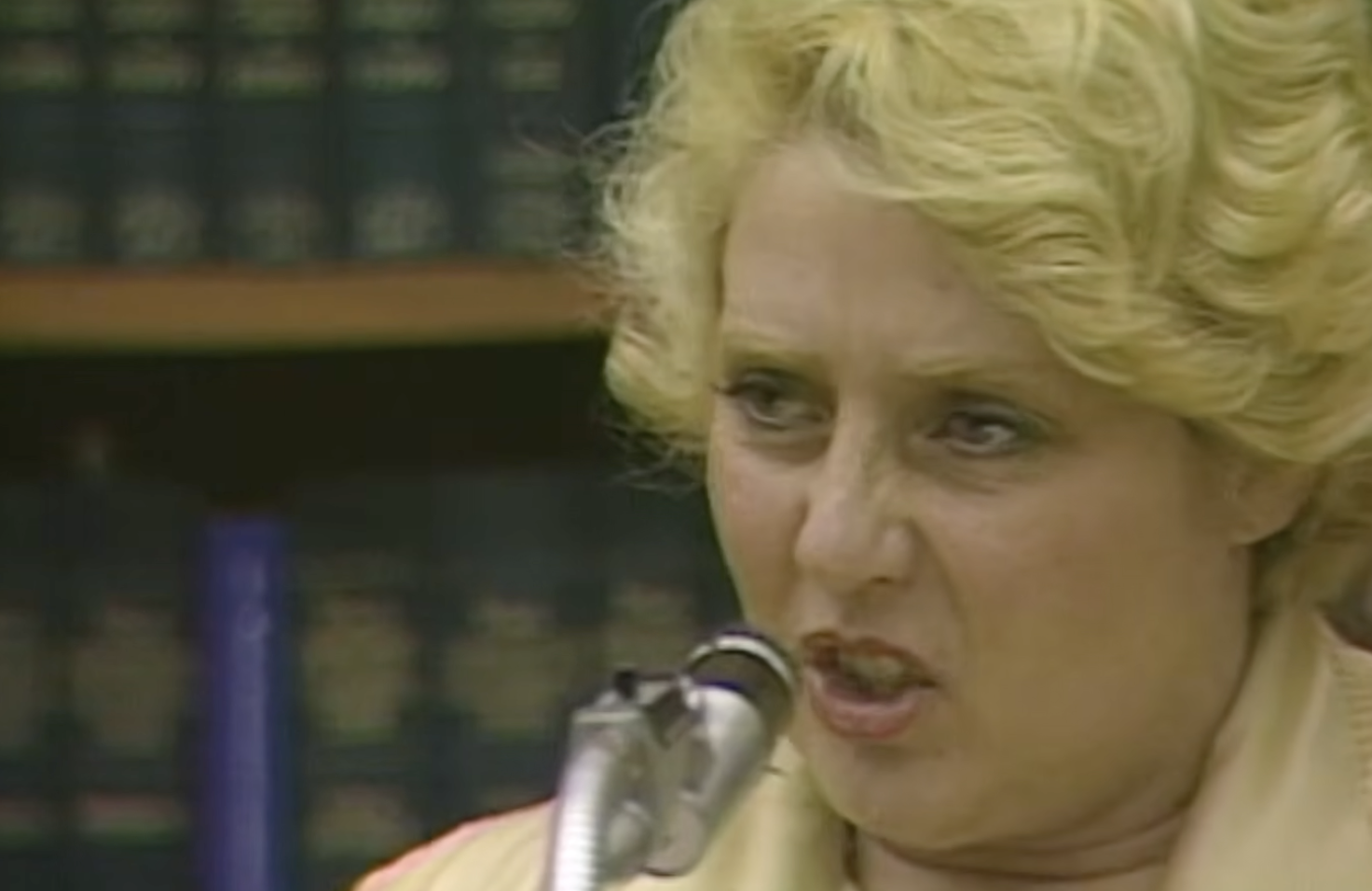
Betty Broderick, who shot and killed her ex-husband Daniel Broderick III and his new wife Linda in their San Diego bedroom on November 5, 1989, has died at the age of 78.
The California Department of Corrections and Rehabilitation confirmed her death to TMZ on Friday May 8, 2026.
She died Friday morning from natural causes, according to the doctor who pronounced her. The San Bernardino County Coroner will make the official cause of death determination.
Broderick had been transferred from the California Institution for Women prison to an outside medical facility in April. She died at that facility.
She had been serving two consecutive 15-year-to-life sentences and had been denied parole three times. Her next parole eligibility date had been set for 2032.
She was 78 years old. She never left prison.
Who Was Betty Broderick?
Betty Broderick was born Elizabeth Anne Bisceglia on November 7, 1947, in Bronxville, New York, the third of six children in a strict Catholic family. She grew up being told, as she later recalled, to go to Catholic schools, be careful about dating, find a Catholic man, and support him while he worked.
She attended the College of Mount Saint Vincent in the Bronx and earned a degree in early childhood education.
In 1965, at 17 years old, she met Daniel Thomas Broderick III at the University of Notre Dame.
By all accounts it was love at first sight. They married in 1969. What followed was a period of sacrifice that Betty Broderick would spend the rest of her life describing as the foundation of everything that came after.
Dan Broderick pursued two graduate degrees, medical school and law school, while Betty worked as a teacher and in other jobs to support the family financially.
She also raised their four children, Kim, Lee, Daniel and Rhett. They moved 12 times in seven years following Dan’s academic career.
Betty later described in painstaking detail the extent to which she subordinated her own ambitions and identity to his professional development.
Dan Broderick became a prominent medical malpractice attorney in San Diego, eventually serving as president of the San Diego Bar Association.
The family lived in a five-bedroom house in a wealthy neighborhood with European vacations, ski trips and cruises.
By Betty’s own account, she had created the financial and domestic conditions that made all of it possible.
In 1983, Betty confronted Dan about what she believed was an affair with Linda Kolkena, his 21-year-old legal assistant.
Dan denied it for approximately two years. In 1985, he moved out of the house and eventually confessed to the affair.
The Divorce That Consumed Everything
The divorce proceedings lasted approximately four to five years and were, by virtually every account, extraordinarily brutal. Betty Broderick’s attorneys later argued that Dan used his position in the San Diego legal community to make it extraordinarily difficult for her to find competent legal representation, leaving her at a significant disadvantage in the proceedings.
Dan ultimately secured full custody of their four children. He also secured a financial settlement that Betty consistently described as a fraction of what she was entitled to given her contributions to his career.
Betty’s behavior during and after the divorce became increasingly erratic and frightening in ways that she has never fully disputed. She left hundreds of profane messages on Dan’s answering machine.
She vandalized his home. She drove her car into his front door on one occasion while their children were inside. She was arrested multiple times and was placed in a psychiatric facility for observation at least once. She violated multiple restraining orders.
In April 1989, Dan and Linda married. Linda had been concerned enough about Betty’s behavior that she reportedly urged Dan to wear a bulletproof vest at their wedding.
He declined, though plain-clothes security was present. Betty did not attend.
One month before the wedding, Betty purchased a Smith and Wesson revolver. She later said she bought it to kill herself.
What Happened On November 5, 1989?
Seven months after Dan and Linda married, at approximately 5:30 in the morning, Betty Broderick drove to the couple’s home at 1041 Cypress Avenue in the Marston Hills neighborhood near Balboa Park in San Diego. She had taken a key to the house from her daughter Kim without permission.
She entered the house while Dan and Linda were asleep and fired five bullets from the revolver she had purchased the previous October. Dan Broderick died. Linda Broderick died. Betty Broderick drove away and called her daughter.
Her initial account of that morning, and the account she would offer in two trials, was that she had driven there planning to go to the beach afterward and shoot herself.
She said she did not remember firing the gun. She said she did not know if it was a conscious act.
The jury at her second trial, the first ended in a hung jury, did not find that explanation sufficient.
They convicted her of two counts of second-degree murder and one count of illegal use of a firearm. She was sentenced to two consecutive 15-year-to-life terms, effectively 32 years to life.
Why The Case Never Stopped Being Relevant
Betty Broderick spent decades in prison and decades in the cultural conversation simultaneously. The case generated two TV movies in 1992. It generated a podcast from the Los Angeles Times.
It generated a full eight-episode series, Dirty John: The Betty Broderick Story, which aired on USA Network and is available on Netflix, with Amanda Peet playing Betty and Christian Slater playing Dan. The series received a 90 percent approval rating on Rotten Tomatoes.
The persistence of interest in the case reflects the specific way it sits at the intersection of several conversations that have not gone away.
Betty Broderick’s core argument, that she gave up her own identity and career to support her husband’s ambitions, that she was then discarded for a younger woman, that she was treated unjustly in the divorce proceedings, and that the law offered her no adequate recourse, resonated with a significant number of women who saw in her situation something they recognized from their own lives, rendered at its most extreme.
The opposing argument is equally clear: two people are dead. Linda Kolkena Broderick, 28 years old, was shot in her bed.
Dan Broderick, 44 years old, was shot in his bed. They had been married for seven months.
Whatever the injustices of the divorce proceeding, whoever bears whatever share of moral responsibility for the breakdown of the Broderick marriage, nothing that happened in a courtroom or a custody hearing made two people deserve to be shot dead in their sleep.
Both of those things are true, and the case has always forced the people engaging with it to sit with the discomfort of that.
Betty Broderick was a victim in some dimensions and a murderer in the most literal and legal sense.
The American true crime appetite for her story across more than three decades reflects a culture that has not been able to fully resolve that tension.
The Three Parole Hearings
Betty Broderick appeared before the California Board of Parole Hearings three times, in 2010, 2017 and 2021, and was denied release each time. The hearings generated intense public interest and fierce advocacy on both sides.
The children of Dan and Linda Broderick attended the hearings and spoke against her release.
Betty Broderick consistently presented herself as a woman who had been pushed beyond her limits and who had served more than sufficient time.
The parole board consistently found that she had not demonstrated adequate insight into the harm she caused or sufficient remorse for the deaths of the two people she killed.
Her next eligibility date had been set for 2032. She was 78 years old in a medical facility in May 2026. She did not reach 2032.
Amanda Peet’s Performance
The Dirty John treatment of Betty Broderick’s story brought it to a new generation that had not been alive in 1989. Amanda Peet’s performance was praised extensively, the Rotten Tomatoes critics consensus called it “an incredible embodiment of a woman scorned.”
Christian Slater played Dan Broderick in a portrayal that presented him as alternately charming and ruthless in his legal maneuvering during the divorce.
The show did not resolve the central ambiguity. It presented Betty Broderick as someone who was genuinely wronged and who responded by doing something genuinely unforgivable.
It let viewers sit with both of those things the way the true case has always made people sit with both of those things.
Betty Broderick is dead at 78. Dan Broderick died at 44 in 1989. Linda Broderick died at 28 in 1989.
Whatever the full truth of their lives together and apart, those three facts are the ones that do not change.









Dan and Linda had it coming.
Dan and Linda had it coming. Betty was abused by Dan, the court system and the penal system. Linda was a piece of work.