

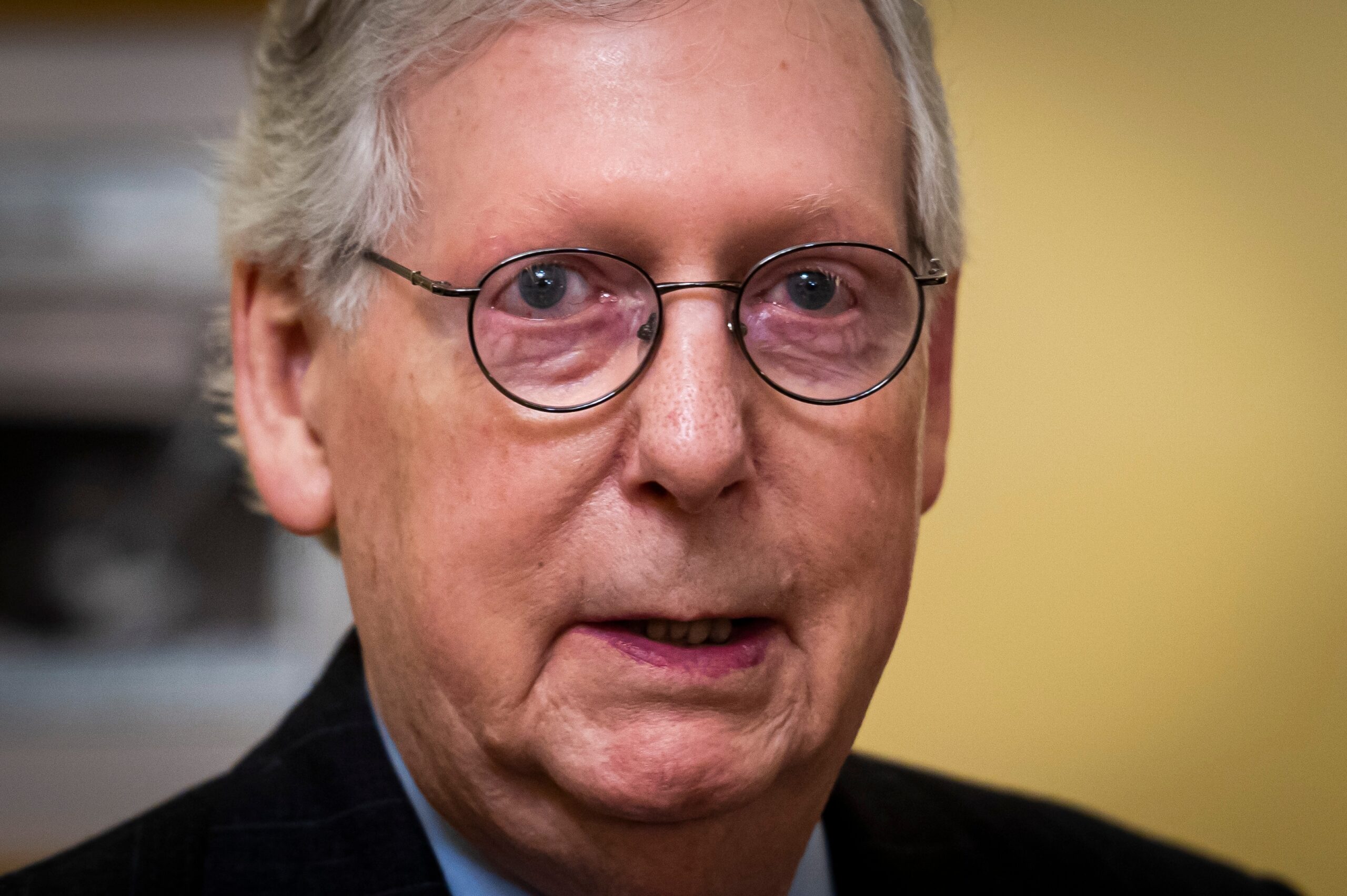
The Senate seat that Mitch McConnell has held since 1984, 42 years, a tenure that made him the longest-serving Senate party leader in American history, is being handed to the next generation of Kentucky Republicans. And President Trump picked who gets it.
Andy Barr, the seven-term congressman from central Kentucky, won the Republican primary for McConnell’s seat on Tuesday May 19, 2026 in a race that the Associated Press called at exactly 7 PM, the moment Western Kentucky polls closed.
He was leading 64 percent when the call was made. He defeated former Kentucky Attorney General Daniel Cameron, who was once described as a rising national star of the Republican Party and who had also lost the 2023 Kentucky governor’s race, and eleven other candidates.
In November, Barr will face Democrat Charles Booker in the general election in a state that Donald Trump carried by 64 percent in 2024. The seat is not considered competitive.
“This victory is about the future and whether that future will be shaped by Kentucky common-sense of the craziness of the extreme far-left,” Barr said at his victory party at Lexington’s Central Bank Center, where he was introduced by his twelve-year-old daughter Mary Clay Barr.
He thanked God, his family, his staff, and specifically President Trump and Senator McConnell, in that order.
The Race That Was Over Before It Started
Trump changed this race before most Kentucky voters had begun paying close attention.
Earlier this month, he endorsed Barr and did something that made the endorsement operative rather than merely symbolic. He called Nate Morris, a businessman with strong ties to the MAGA movement who had been attacking Barr and Cameron as creatures of the McConnell establishment, and told him to drop out. Morris dropped out.
He accepted an ambassadorship from the Trump administration. He endorsed Barr.
The business logic of that sequence was clear to everyone watching. Morris had been the candidate most aligned with the pure Trump energy of the primary electorate, the one making the argument that Barr and Cameron were too close to McConnell, whose relationship with Trump had deteriorated publicly and dramatically in McConnell’s final years in leadership.
When Morris exited and gave his support to Barr, that lane of the electorate followed him. The field collapsed.
“President Trump makes his pick for Kentucky Senate,” a narrator said in an advertisement Barr’s campaign rushed to air after the endorsement, quoting Trump’s Truth Social post directly:
“Andy Barr is a proven winner. He’ll cut taxes, unleash American energy dominance, and secure the border.”
Trump made a phone call to Kentucky voters on Monday night to push the message further, calling Barr “a proven winner and patriot.”
When Trump’s endorsement carries that kind of organizational weight, not just a social media post but an active intervention that removed the most threatening competitor from the race, the outcome is rarely close.
It was not close.
Daniel Cameron’s Second Statewide Loss
For Daniel Cameron, Tuesday night was the second time in less than three years that a statewide race in Kentucky ended with a concession speech.
In 2023, he lost to Democratic Governor Andy Beshear in an election that many Republicans had expected him to win.
He arrived at this Senate primary as the establishment alternative to Barr, a former aide to McConnell, a former state Attorney General, someone with statewide name recognition and a donor network built from his previous campaigns.
The McConnell connection cut both ways. Cameron had the institutional support and the relationship with the outgoing senator who held the seat for four decades.
He also had to run in a primary where the most coveted endorsement was not McConnell’s but Trump’s, and where “Trump’s pick” and “McConnell’s world” were framed as different things, even though Barr himself has called McConnell a mentor.
The tension between those two frames of reference defined what little daylight existed between the top two candidates.
“Tonight, didn’t exactly turn out how we wanted it to,” Cameron said in his concession speech. He thanked his supporters, called the campaign an “honor of a lifetime,” and endorsed Barr for November.
What Cameron does next is an open question. Two statewide losses before the age of 40 in a state that Trump dominates should not be career-ending for a politician with his profile. But they are not the trajectory that a “rising national star” label implies.
Forty-Two Years And What It Meant
Mitch McConnell was first elected to the United States Senate from Kentucky in 1984. Ronald Reagan was president. The Soviet Union still existed.
The Berlin Wall still stood. Luka Doncic had not been born yet. McConnell has been in the Senate for everything that has happened in American politics since then, every budget fight, every Supreme Court confirmation, every military authorization, every government shutdown.
He became Senate Majority Leader. He blocked Merrick Garland’s nomination to the Supreme Court in 2016.
He shepherded the confirmation of three Trump-nominated justices. He was the longest-serving Senate party leader in American history before stepping down from leadership in 2024.
His relationship with Trump went from alignment to friction to something approaching mutual disdain.
McConnell refused to vote to convict Trump after the January 6 Capitol events but criticized him on the floor immediately after voting to acquit. Trump responded by giving him an unflattering nickname.
The two men represented different eras of the Republican Party, the institutionalist Senate tradition that McConnell embodied and the populist disruption that Trump represents, and the tension between those two things played out across years of public statements, social media posts and intraparty disputes.
The Republican candidates who competed for McConnell’s seat on Tuesday made very little mention of McConnell during the campaign.
The man who held the seat for 42 years was not the touchstone for the people competing to replace him. Trump was. That tells you something about where the Republican Party is in May 2026.
Barr’s Path To November
Andy Barr is 54 years old and has represented central Kentucky in the House for seven terms, 14 years.
He has been a senior member of the House Financial Services Committee and has led a subcommittee overseeing the Federal Reserve and FDIC.
He ran for the full committee’s chairmanship last year and came up short. That loss accelerated his Senate bid.
He is not an outsider. He is not a disruptor. He is a conservative congressman with a long record of institutional service who secured the Trump endorsement by making the case that he was the most electable and the most reliable ally the president could have in the Senate.
The “proven winner” language in Trump’s endorsement reflects exactly that pitch.
In November, he faces Charles Booker. Booker grew up in west Louisville and has built his political identity around what he calls the “Hood to the Holler” movement, connecting Louisville’s urban communities with rural Kentucky communities that have more in common economically than either recognizes politically.
He has spoken publicly about rationing insulin as a child because of healthcare costs.
He ran for the Senate in 2020 and lost the Democratic primary to Amy McGrath, who then lost to McConnell. He ran again on Tuesday and beat McGrath, who tried once more. This time he gets Barr instead of McConnell.
The general election map has not changed. Kentucky has not sent a Democrat to the United States Senate since Wendell Ford won his fourth and final term in 1992. Ford retired in 1999.
The seat has been Republican ever since. Barr is a heavy favorite. Booker will make the race about healthcare costs, economic inequality and what he describes as the mission that has driven his political career.
The seat belongs to Barr to lose. In a state Trump won by 64 points in 2024, he is unlikely to lose it.