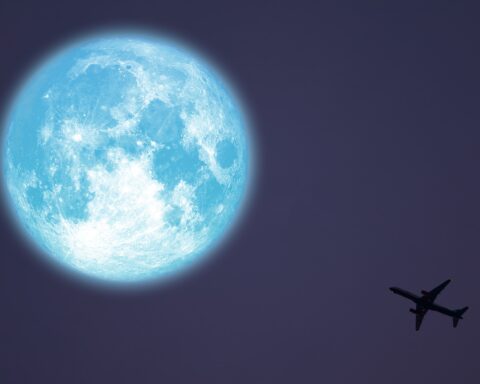

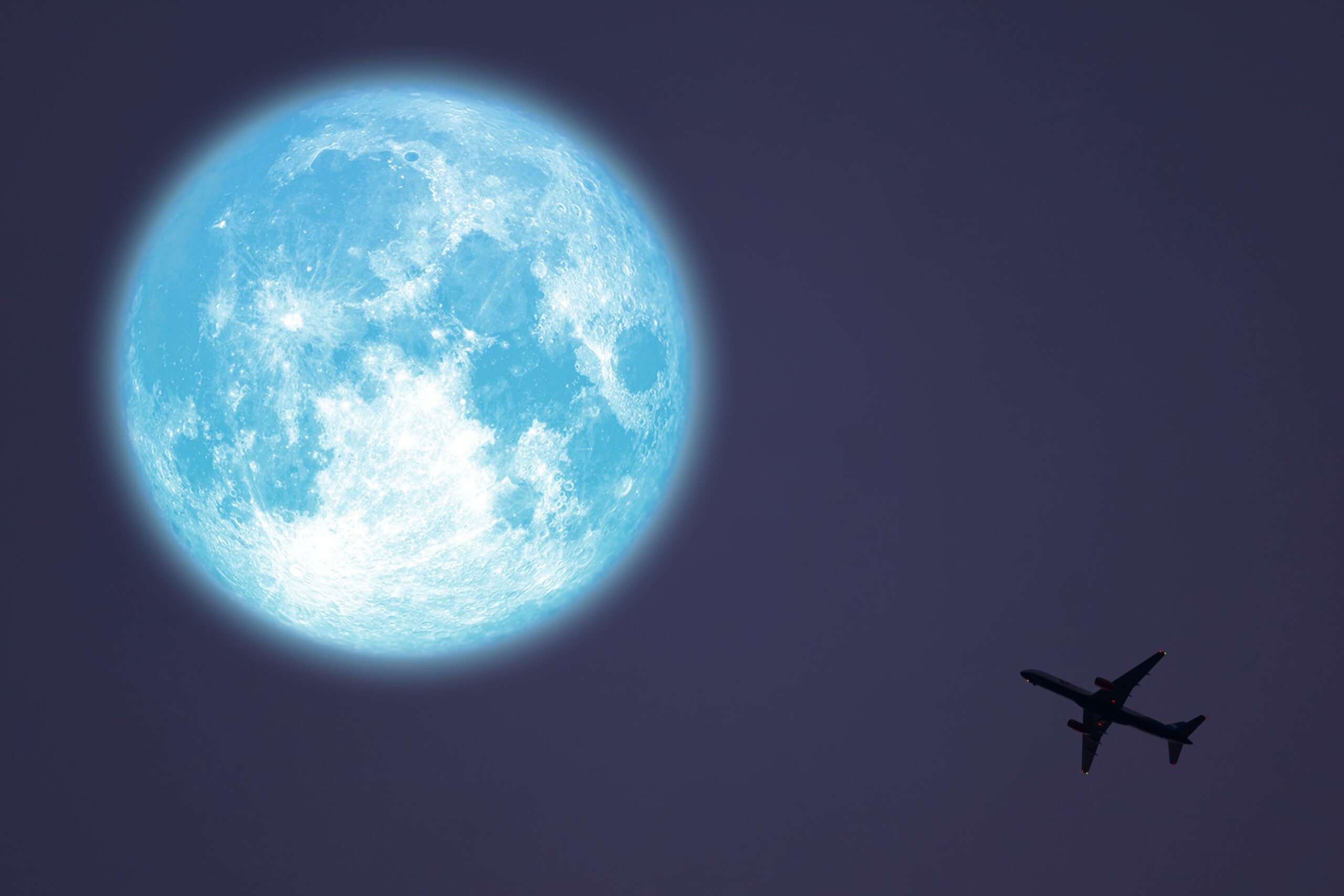
The Blue Moon rising this weekend is the second full moon of May 2026, which is already enough to qualify it as rare under the modern definition of the term.
But this particular Blue Moon is also a micromoon, meaning it arrives near apogee, the farthest point in the moon’s elliptical orbit from Earth, which makes the specific combination of these two events something that happens only once every few decades.
The Weather Network calculated that this exact type of Blue Apogee Micromoon will not occur again for at least 27 years.
The full moon peaks on Sunday May 31, 2026 at 8:45 AM UTC, which translates to 4:45 AM Eastern time and 3:45 AM Central time. That timing means the best viewing for most Americans is Saturday evening May 30, shortly after sunset, when the full moon rises in the southeastern sky near the bright red star Antares, the heart of Scorpius the Scorpion.
The moon will look essentially full from late Friday May 29 through early Sunday May 31, giving skywatchers three nights to catch it if clouds interfere on any single evening.
No telescope is required. No special equipment of any kind. Just clear skies and a view of the eastern horizon.
What Is A Blue Moon?
The phrase “once in a blue moon” entered the language as an expression for something that happens extremely rarely, so rarely it borders on impossible.
The original astronomical usage carried exactly that meaning: a blue moon was a moon so out of the ordinary that calling something else “once in a blue moon” was a way of saying it would never happen.
The phrase “the moon is not blue” was itself an ancient expression meaning something untrue or absurd.
The modern popular definition of a Blue Moon, the one that has been in widespread use for several decades, describes the second full moon in a single calendar month.
A calendar month has roughly 30 to 31 days. A lunar cycle, from one full moon to the next, takes approximately 29.5 days. Most months contain exactly one full moon.
Occasionally, when a full moon falls early enough in the month, a second full moon can squeeze in before the month ends. That second one is the Blue Moon.
May 2026 started with the Flower Moon, the first full moon of May, on May 1.
Because the Flower Moon arrived on the very first day of the month, the 29.5-day lunar cycle had enough room to complete before May ended, bringing a second full moon on May 31. The second one is this weekend’s Blue Moon.
The calendar-month Blue Moon happens roughly every two to three years, specifically every two to three years on average, though the intervals vary because the lunar cycle and the calendar year do not divide evenly into each other. The last calendar-month Blue Moon was August 31, 2023.
The next one after this weekend will not arrive until December 31, 2028.
What Is A MicroMoon?
The moon does not orbit Earth in a perfect circle. Its orbit is elliptical, shaped like a slightly flattened oval, which means its distance from Earth varies continuously throughout each orbit.
The closest point in that orbit is called perigee, where the moon sits approximately 223,694 miles from Earth. The farthest point is called apogee, where the moon can be more than 251,665 miles away.
When a full moon occurs near perigee, it looks slightly larger and brighter than average.
Photographers and the general public call these supermoons. When a full moon occurs near apogee, the opposite end of the orbit, it looks slightly smaller and dimmer than average. That is a micromoon.
This weekend’s Blue Moon occurs near apogee and is in fact the most distant full moon of all of 2026.
Compared to an average full moon, it appears approximately 5.5 percent smaller and 10.5 percent dimmer. Compared to a supermoon, the closest full moons of the year, it appears 12.5 to 14.1 percent smaller.
In practice, most people looking at this weekend’s moon will not notice the difference without a direct comparison.
A full moon is a full moon. It still rises large and orange on the horizon, climbs into the southern sky through the night and sets large and pale in the west before sunrise.
The slightly smaller disk is an optical reality that instruments can measure but that the naked eye, without a reference point, typically cannot distinguish.
What makes the micromoon worth knowing about is not the visual difference from average, it is the specific rarity of a micromoon coinciding with a Blue Moon.
The moon completes its elliptical orbit in approximately 27.5 days. The lunar cycle from full moon to full moon takes 29.5 days. The calendar month averages about 30.4 days.
For a second full moon in a calendar month to also fall near the apogee of the moon’s orbit requires a specific alignment of these three cycles that does not happen often.
The Weather Network’s analysis found that this specific combination, a Blue Moon at or near apogee, will not recur in the same form for at least 27 years.
What To Look For Saturday Night
The most photogenic moment for viewing this weekend’s Blue Moon is Saturday evening May 30, approximately 15 to 30 minutes after local sunset.
At that point, the moon will be rising on or near the southeastern horizon, large, orange-tinted from the atmosphere it is shining through at low angles, and sitting in the sky near Antares, the brightest star in Scorpius.
Antares is a red supergiant star, one of the largest and most luminous stars visible to the naked eye, and its reddish color pairs beautifully with the rising moon in photographs.
The combination of a full moon and a recognizable bright star in close proximity in the sky is the kind of alignment that makes the night sky accessible for people who do not usually look up.
You do not need to know the name of the star or the constellation to appreciate the visual, two bright objects, one steady and one rising, near each other on the early summer horizon.
For those who prefer a higher moon, steadier and less affected by atmospheric distortion, the overnight hours into early Sunday May 31 provide the best views as the moon climbs to its highest point in the southern sky.
The peak fullness arrives at 4:45 AM Eastern on May 31, so the moon is at its most technically full in the hours before that, in the deep overnight hours of Saturday.
The moon will appear essentially full for three nights, from late Friday May 29 through early Sunday May 31, which provides a practical buffer if any night’s weather is uncooperative.
The Name And What It Hides
Blue Moon is one of the more misleading names in popular astronomy. The moon will not be blue.
It will be the same pale gold, cream and grey that full moons always are, depending on how high it is in the sky and how much atmosphere it is shining through.
The name comes from history and popular usage, not from the moon’s appearance.
The phrase “once in a blue moon” was in use by the 16th century. The astronomical definition connecting it specifically to the second full moon in a calendar month is a relatively modern convention, traced in part to a 1946 article in Sky and Telescope magazine that popularized the calendar-month definition among amateur astronomers, and in further part to a 1980 broadcast of StarDate radio that used the same definition and spread it into wide public usage.
None of that history changes what Saturday night offers: a full moon rising near a red star, on a Memorial Day weekend, in skies that are warming into summer.
The moon is not going to be blue. It is going to be bright and large and the second full moon of the month and the most distant full moon of the year, which is enough.
Step outside Saturday evening. Look southeast. The moon will be there.