
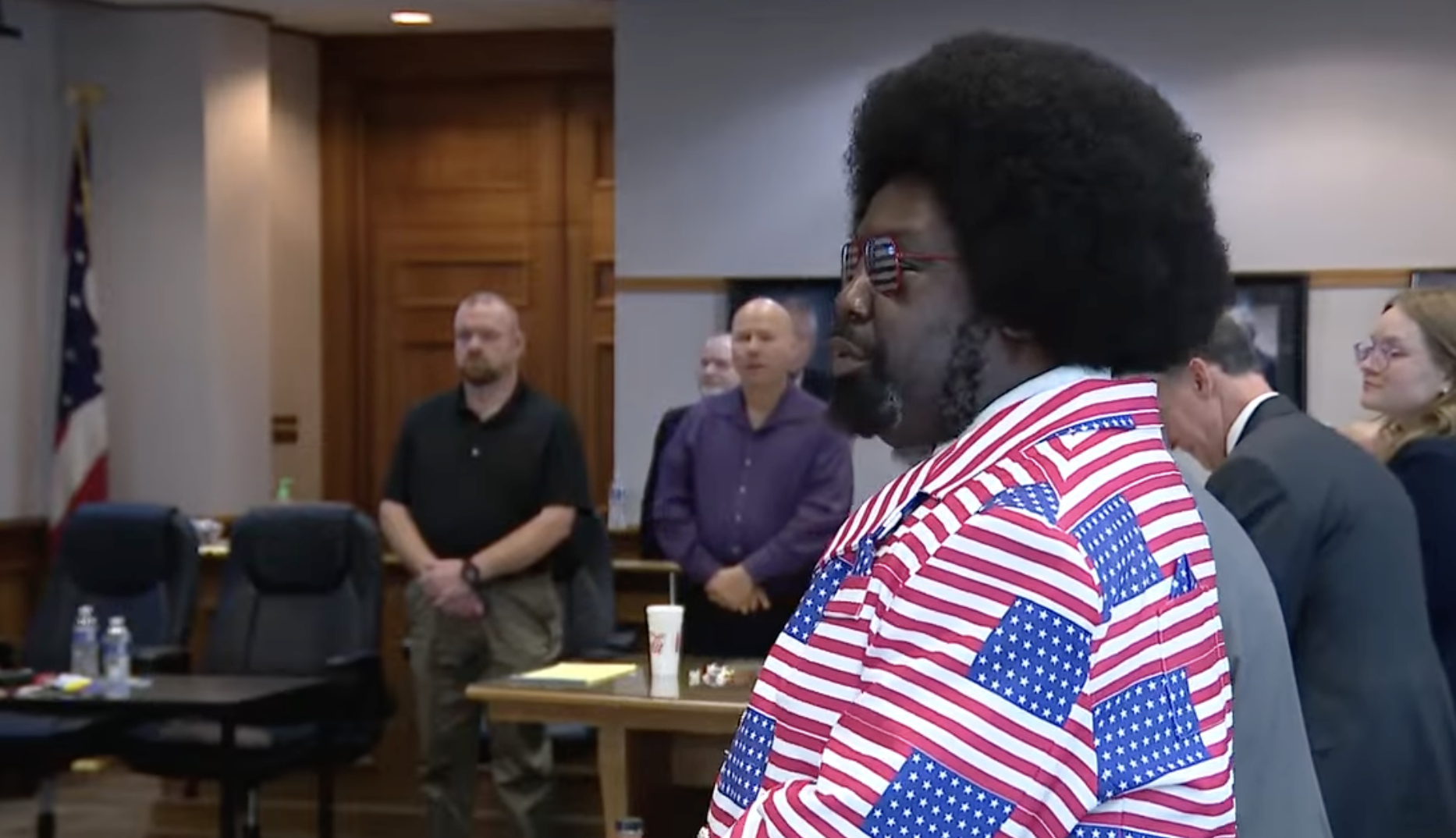
Joseph Foreman, known professionally as Afroman, arrived at the Adams County Common Pleas Court in Gonzales, Ohio this week in a full red, white and blue American flag suit, matching sunglasses, and his signature natural hairstyle.
Before he uttered a single word in his own defense, the outfit made an argument. An eight-person jury is now deliberating on whether that argument has a price tag.
Closing arguments concluded Wednesday in the civil trial of Cooley et al. v. Foreman, the defamation and privacy lawsuit brought by seven Adams County Sheriff’s Office members against the rapper best known for his 2000 debut hit “Because I Got High.”
The jury began deliberations on March 18. No verdict has been returned as of publication. Whatever they decide will carry consequences well beyond one courtroom in rural Ohio.
Deputies Take The Stand
Day two of proceedings belonged largely to the plaintiffs, and the emotional weight of their testimony became the defining image of the trial so far.
Officer Lisa Phillips, one of the seven plaintiffs, broke down in tears while her attorney screened Afroman’s videos before the jury.
Phillips alleges the rapper made posts and released songs that called her identity and personal life into question, subjecting her to public mockery she had no opportunity to rebut or correct.
Watching that content replayed in a formal legal setting, with a jury looking on, she wept.
A second deputy described what the videos had cost him outside of his own department.
He testified that when he traveled to a jurisdiction near Pennsylvania to conduct official business, officers he had never previously encountered greeted him by a nickname Afroman’s music had attached to him.
They called him Deputy Lemon Pound Cake. He told the jury he found it specifically degrading to be identified that way by strangers in a professional setting, his real name and rank replaced in their minds by a character from a viral rap video.
The deputies’ collective testimony painted a picture of officers whose professional reputations had been fundamentally altered, not by anything they believed they had done wrong, but by the public response to a private individual’s creative output.
Their attorney argued that Foreman had gone beyond protected commentary into actionable territory by making specific factual claims about identifiable individuals, distributing those claims to millions of viewers, and profiting from merchandise bearing the officers’ likenesses.
Afroman Takes The Stand In The Flag Suit
Foreman’s testimony landed differently. He was direct, unrepentant, and precise about his reasoning.
“I had to do what I had to do to repair the damage they brought to my house,” he told the court. Every video, every social media post, every T-shirt bearing an officer’s image, he stood behind all of it.
His position has not wavered at any point during the years this case has been making its way toward trial.
He also expressed appreciation through his Instagram account after leaving the stand, thanking the community of supporters who have treated his legal battle as a cause worth following.
That community has been considerable. The case has attracted sustained national media coverage, civil liberties organizations, and an audience of fans who have watched Foreman respond to every development in the lawsuit by releasing new music about it.
The flag suit was consistent with that approach. Foreman has maintained throughout this entire ordeal, through the initial social media posts, through the music videos, through the pretrial legal skirmishing, and now through the trial itself, that his conduct represents exactly what the First Amendment was designed to protect.
The outfit was not accidental. It was a thesis statement.
What The Jury Must Decide
The three remaining claims the jury is evaluating carry distinct legal standards, and none of them are simple.
On defamation, the deputies must demonstrate that Foreman made specific false statements of fact and that those statements were presented as true and caused measurable harm to their reputations.
This is a meaningful threshold. Parody and artistic expression receive substantial constitutional protection, particularly when the target is a government official engaged in official conduct.
The deputies’ challenge is convincing eight jurors that what Afroman produced crossed from creative mockery into false factual assertion.
The false light claim requires showing that Foreman portrayed the officers in a way that, while not technically defamatory, created a false impression that a reasonable person would find highly offensive.
This is subtler than defamation and harder to win on, precisely because it requires demonstrating that the overall impression created was materially misleading, not merely unflattering.
Unreasonable publicity of private lives is the third surviving claim, and it sits in tension with the foundational fact of the case.
These officers were performing public duties, in a public capacity, pursuant to a search warrant, when the footage was captured.
The legal doctrine of reduced privacy expectations for public officials in the performance of official functions creates a significant obstacle for this particular claim.
Afroman’s defense team has maintained throughout that the footage was acquired legally, the content constitutes artistic and political commentary, and the subject matter, law enforcement conduct, is precisely the kind of speech the Constitution was designed to keep free from legal suppression.
Why Civil Liberties Organizations Are Watching
Two organizations in particular have made their positions explicit.
The American Civil Liberties Union submitted a brief characterizing the lawsuit as a strategic attempt to silence criticism through litigation rather than on the merits.
Their argument positions the case within a broader pattern of SLAPP suits, Strategic Lawsuits Against Public Participation, in which powerful parties use the expense and stress of civil litigation to deter speech they find objectionable, regardless of whether the legal claims are likely to succeed.
The Foundation for Individual Rights and Expression went further, warning that a damages award in this case would transmit a specific and dangerous signal to every American who films police activity on their own property.
The message would be: doing so, and sharing it publicly, carries financial risk. That risk calculus would disproportionately affect ordinary citizens without the resources to defend against a civil lawsuit.
Both organizations argue that the underlying First Amendment principle at stake here is foundational rather than narrow.
The right to criticize government actors, including law enforcement, using factual recorded evidence of their conduct is among the most clearly protected categories of expression in American constitutional law.
A verdict against Foreman would not merely affect one rapper in Ohio. It would set a precedent with reach.
Where Does The Trial Go From Here?
The jury began deliberating Wednesday morning. No timeline for a verdict has been announced.
The case has been in progress since Monday, March 16, with testimony spanning multiple days before closing arguments wrapped.
Should the jury find in favor of the deputies on any of the three claims, the trial would move to a damages phase.
Should the jury return a verdict for Foreman, the deputies’ claims would be dismissed.
Either outcome is expected to be appealed, given the First Amendment implications that make this case significant beyond its immediate facts.
Foreman has been posting throughout the trial. He posted after testimony wrapped. He has not signaled any intention to stop doing so regardless of the outcome. He showed up wearing a flag.
The jury is deliberating