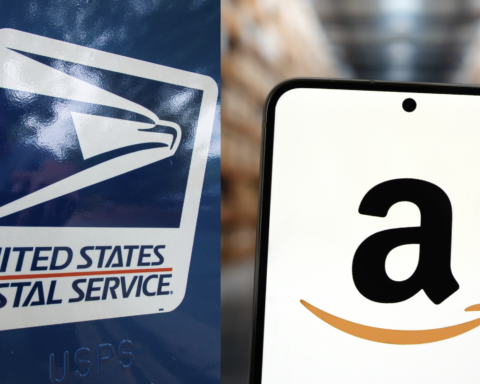

Amazon and the United States Postal Service reached a new delivery agreement today, Monday April 6, 2026, and the terms represent a significantly better outcome for the postal service than anyone was expecting a month ago.
Under the deal, USPS will retain approximately 80 percent of its existing Amazon package deliveries, more than one billion packages per year.
Amazon spokesperson Terrence Clark confirmed the agreement in a statement:
“We’re pleased to have reached a new agreement with USPS that furthers our longstanding partnership and will let us continue supporting our customers and communities together.”
USPS did not immediately comment. The deal is tentative and must still be approved by the Postal Regulatory Commission.
The Wall Street Journal was first to report it. Reuters broke the specific terms, citing sources familiar with the agreement.
Why Was This An Emergency?
To understand what today’s deal means, you have to understand how close to the edge the USPS was sitting. Amazon is the postal service’s single largest customer, representing approximately $6 billion in annual revenue against a roughly $80 billion total USPS budget.
USPS delivers approximately 1.7 billion Amazon packages annually, meaning today’s 80 percent figure preserves the vast majority of that relationship while cutting roughly 340 million packages per year from the contract.
In March, Reuters reported that Amazon had threatened to cut its USPS delivery volume by two-thirds or more.
That would have meant removing approximately 1.1 billion packages per year from USPS volumes, a catastrophic reduction for an agency already warning Congress it could run out of cash as soon as October 2026.
Postmaster General David Steiner told lawmakers last month that USPS was facing a severe financial crisis and that without congressional action “the mail will stop.” He was not speaking rhetorically.
Today’s 20 percent reduction is real but survivable. The threatened two-thirds cut was not.
Why Did USPS Need A Deal With Amazon?
The postal service has reported net losses of $118 billion since 2007. First-class mail, historically its most profitable product, has fallen to its lowest volume since the late 1960s.
Total mail volume has collapsed from 213 billion pieces in 2006 to approximately 109 billion today.
If that lost volume had been paid at current stamp prices, it would represent roughly $81 billion in lost revenue. “No company could weather that much revenue loss,” Steiner told Congress.
The agency has reached its statutory borrowing limit of $15 billion with the Treasury Department and cannot finance ongoing deficits through additional debt.
It is asking Congress to raise that limit. It is also seeking approval for a temporary 8 percent price hike on priority mail and package deliveries effective April 26, and Steiner has separately proposed raising the price of a first-class stamp to 95 cents from its current 78 cents.
The USPS is legally required to deliver to all 169 million addresses in the United States, six days a week, at uniform and affordable prices, regardless of whether those addresses are profitable to serve.
That universal service obligation, designed to ensure that rural and low-income communities have equal access to mail delivery, is the structural reason the postal service cannot simply stop serving unprofitable routes.
It is also the reason the stakes of the Amazon negotiation extended well beyond a standard business contract.
What Will Change?
The USPS’s role in rural America is not abstract. Approximately 3.7 million Medicare enrollees live in areas where pharmacy access is limited and rely on mail delivery for prescription medications.
About 6 percent of diabetes prescriptions in the United States are delivered by mail, according to Brookings research.
In rural communities, the postal service also delivers ballots, Social Security checks, and critical government documents.
Private carriers, UPS, FedEx, Amazon’s own network, do not serve all these addresses at comparable prices or frequencies.
A collapse of USPS volumes sufficient to trigger service cuts or network contraction would directly harm these communities first.
What Led To The Breakdown And What Changed
The tension between Amazon and USPS escalated when the postal service, under new Postmaster General David Steiner, appointed in May 2025, announced it would change the way it sold last-mile delivery access.
Previously, USPS offered last-mile delivery directly from its 18,000 delivery destination units only to a small number of very large customers, including Amazon, under negotiated service agreements.
In December 2025, USPS announced it would make that service available to all shippers through a competitive bidding process.
Amazon criticized this decision sharply, arguing the auction model created unacceptable uncertainty around available capacity and pricing at a point too late in the contracting cycle to reallocate hundreds of millions of packages.
Amazon submitted a bid in February 2026 but negotiations stalled. Each side publicly blamed the other for the breakdown.
Amazon published a blog post last month specifically to “set the record straight,” arguing it was USPS that abruptly ended negotiations, not Amazon.
Today’s agreement suggests both sides found enough common ground to pull back from the brink.
Amazon’s Parallel Rural Build
The deal does not mean Amazon is abandoning its own delivery expansion. In April 2025, Amazon committed $4 billion to expanding its rural delivery network through the end of 2026, a push that includes building 200 rural delivery stations and recruiting small business owners in rural towns as part-time parcel carriers.
Amazon is also losing UPS as a major partner, UPS announced it is cutting Amazon shipping volume by more than 50 percent by mid-2026, making the USPS relationship more strategically important in the near term even as Amazon builds toward independence.
The framing from Amazon is that it will continue expanding its own capabilities while stopping short of the full nationwide address-by-address reach that only USPS currently provides.
For the foreseeable future, if you live in rural America and order from Amazon, the package arriving at your door is very likely to be delivered by a postal carrier.
What Comes Next?
The deal must clear the Postal Regulatory Commission before it is finalized. The USPS’s broader financial crisis does not go away with this agreement — it simply becomes less acute in the near term.
Congress still needs to act on borrowing authority, pricing flexibility, and potentially the universal service obligation itself if the agency is to become structurally sustainable.
The Iran war has added a fuel surcharge pressure point, with Amazon separately announcing a 3.5 percent fuel and transportation surcharge of its own going into effect next month.
Today’s news is a lifeline. It is not a cure.