
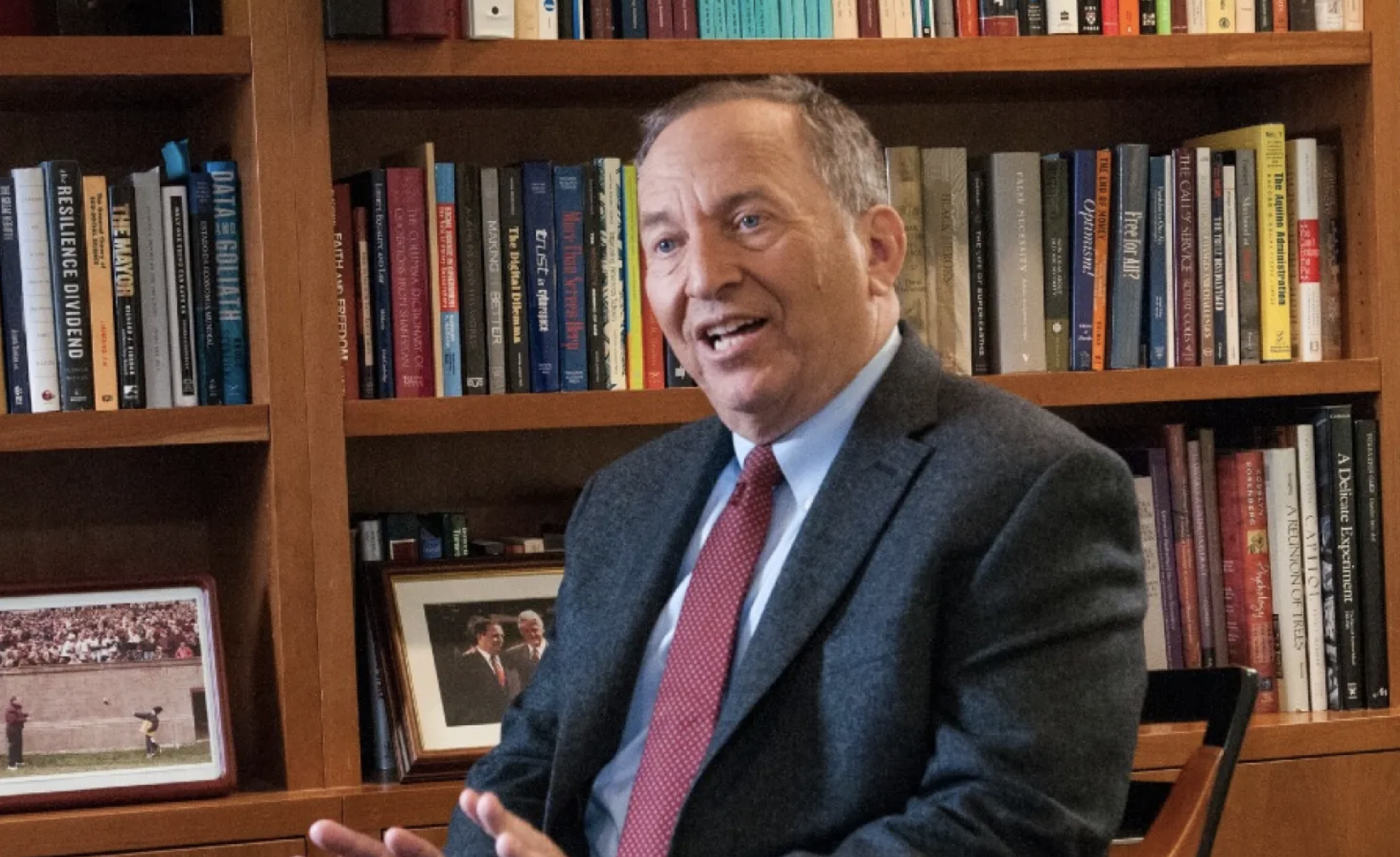
It was announced today that Larry Summers, who served as Treasury Secretary under Bill Clinton, has resigned his professorship at Harvard over his relationship with Jeffrey Epstein.
Summers, one of the most celebrated economists of his generation, announced Wednesday that he will retire from his tenured professorship at Harvard University, a position he has held at the school where he has spent virtually his entire adult life.
He came to Harvard as a graduate student fifty years ago.
He is leaving under a cloud that, by his own admission, he brought entirely on himself. In Cambridge, where institutional reputation is the currency that everything else runs on, that kind of exit doesn’t just end a career. It ends a legacy.
Larry Summers wasn’t just a professor. He wasn’t just a former Treasury Secretary, though he served in that role under President Bill Clinton and left a significant mark on American economic policy. He was, for decades, one of the most influential economic thinkers in the country.
He was the kind of figure that institutions collected like trophies. Harvard kept him close. OpenAI put him on its board.
The financial world listened when he spoke. That was the Larry Summers of eighteen months ago. The Larry Summers of today is a man reading a resignation statement and thanking his former students on the way out the door.
The resignation comes amid growing scrutiny of his relationship with convicted sex offender Jeffrey Epstein, a relationship that Summers long acknowledged in general terms but whose depth, and more damningly, its continuation long after Epstein’s criminal history was a matter of public record, has proven to be his professional undoing.
A cache of emails released by the Justice Department showed the two men were far closer than had been publicly known, and the correspondence continued as recently as July 5, 2019, just one day before Epstein was arrested on federal sex trafficking charges.
This wasn’t a relationship that Summers quietly distanced himself from after Epstein’s 2008 guilty plea in Florida. This was an active, ongoing correspondence that ran right up to the eve of Epstein’s arrest on some of the most serious charges a human being can face.
That timeline matters enormously. Epstein pleaded guilty in Florida in 2008 to soliciting prostitution from a minor. That guilty plea was not a secret. It was reported widely. Institutions that had taken his money,and Harvard had taken millions, began their distancing acts.
The socially acceptable thing to do, the thing that virtually every person of consequence eventually did publicly, was to cut ties. Summers, according to the documents now in the public record, kept the conversation going for more than a decade after that plea. He didn’t just know who Jeffrey Epstein was in the abstract sense that everyone eventually came to know. He knew, and he kept writing.
In one particularly striking exchange, Summers — who has been married to academic Elisa New since 2005, sought Epstein’s advice on a romantic interest in a woman he described as a mentee.
Epstein described himself in response as a “pretty good wing man.” In another email, Summers lamented that men who “hit on” women may face repercussions in the modern workplace.
For a man who had spent decades cultivating a reputation as one of the most serious and formidable economic intellects in the country, that kind of correspondence was impossible to contextualize away.
Summers Mentioned In House Oversight Committee Release Hundreds Of Times
The House Oversight Committee released more than 20,000 documents tied to Epstein’s network in the months leading up to today’s announcement. Summers’ name appeared hundreds of times. Harvard responded by opening a formal review of documents related to Epstein that were released by the government.
Harvard had also launched a broader investigation into Summers and other individuals affiliated with the school who were associated with Epstein.
The walls were closing in.
Summers had been on leave since November while that review proceeded. At the time of the leave, there was still some ambiguity about how it would resolve.
Some observers suggested it might blow over. Some pointed out, correctly, that no Epstein survivor has alleged wrongdoing by Summers, and there is no public record evidence to suggest Summers was involved in any of Epstein’s crimes.
That is an important distinction, and it’s one that deserves to be stated plainly and without qualification. Larry Summers has not been accused of participating in the abuse. But the question that Harvard, and the broader public, was wrestling with was never solely a legal one. It was a question about judgment. About who you choose to keep in your orbit, and why, and for how long, and what that says about you. On that question, the emails spoke for themselves.
Summers said in a statement back in November, “I am deeply ashamed of my actions and recognize the pain they have caused. I take full responsibility for my misguided decision to continue communicating with Mr. Epstein.”
It read at the time like the opening of a longer reckoning, the kind of statement that precedes more statements, more revelations, more institutional pressure. That’s exactly what it turned out to be. Wednesday’s retirement announcement was the conclusion that November’s apology was always pointing toward.
Before the Harvard announcement, Summers had already resigned from the board of OpenAI amid the controversy over the released emails. That departure was significant in its own right.
Summers walked away from it. Or was walked away from it, depending on how you read the situation. This is the institution he has called home for half a century. He served as Harvard’s president from 2001 to 2006 and held the title of University Professor, the school’s highest faculty rank.
Leaving Harvard isn’t just a career change for Larry Summers. It is the end of a chapter that defined his entire identity as a public intellectual.
Nobel Prize-winning scientist Richard Axel announced he would step down as co-director of Columbia University’s Zuckerman Mind Brain Behavior Institute in light of his own communications with Epstein drawing attention.
Yale University barred professor David Gelernter from teaching computer science classes pending a review of his contacts with Epstein, which included mentioning a Yale student for a potential project.
The Justice Department’s document releases have set off a chain reaction through the Ivy League that shows no signs of slowing. Careers that were built over decades are being reassessed in the span of weeks.
Harvard has been in that position before. The university received millions in gifts from Epstein, all prior to his 2008 guilty plea, and conducted a review of those ties five years ago.
That review did not result in consequences for Summers at the time. The new round of documents, the emails, the correspondence, the specificity of the relationship, made the old review feel inadequate.
What happens to Larry Summers now is genuinely unclear. In his statement Wednesday, he said he looks forward to engaging in research, analysis, and commentary on global economic issues as a retired professor and president emeritus.
“I will always be grateful to the thousands of students and colleagues I have been privileged to teach and work with,” he said Wednesday.
For now, one of the most powerful figures in American academic and economic life is clearing out his office at Harvard. And the Epstein files are still being read.