
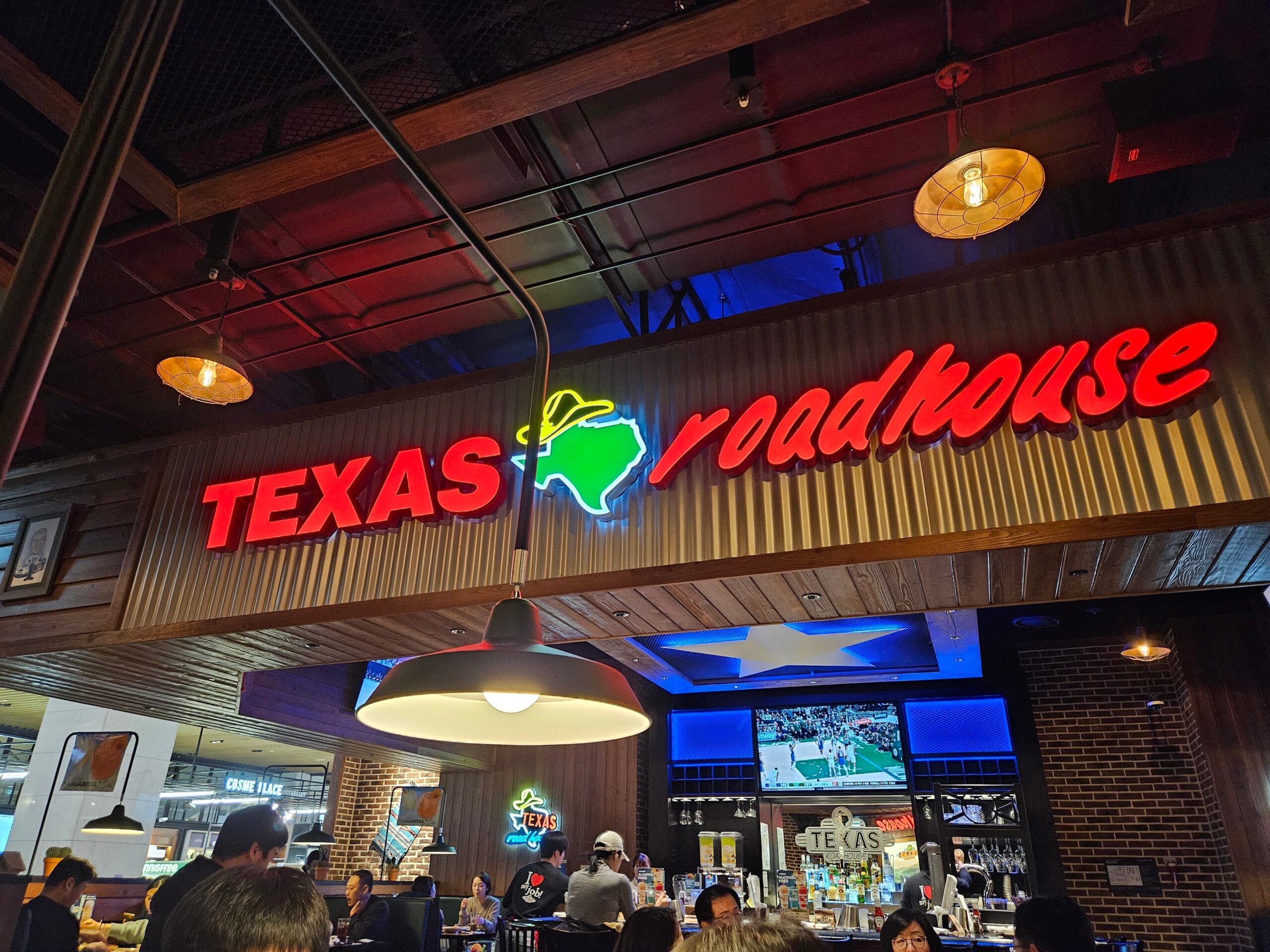
Texas Roadhouse CEO Jerry Morgan revealed on the company’s first quarter 2026 earnings call last week that servers at select locations are now using handheld tablets to take orders directly at the table, and that the chain is watching early results carefully before deciding whether to expand the technology nationwide.
The announcement was one detail inside a strong earnings report that sent the company’s stock up 12% on May 7 and confirmed what the restaurant industry has been watching for years.
Texas Roadhouse is thriving by being the last major casual dining chain that feels genuinely unhurried.
Here is what Morgan said about the tablets, what it actually means for the dining experience, and why a company growing same-store sales at 7.1% is being careful about changing anything at all.
What The CEO Actually Said
Morgan’s comments on the tablets were measured in a way that is consistent with how Texas Roadhouse has always talked about change.
The chain has built one of the most loyal customer bases in casual dining on a promise of warmth, hospitality and the specific kind of relaxed experience that the phrase “casual dining” was invented to describe.
Any technology discussion at Texas Roadhouse starts and ends with whether it is consistent with that promise.
“Handhelds may speed things up when placing and sending orders,” Morgan said on the call.
The aim, he added, is “to be more efficient and improve the complete guest experience,” and he was specific about what efficiency does not mean in this context. The goal is not to turn tables faster.
It is not to reduce the time a guest spends in the restaurant. It is to reduce the time between sitting down and having food in front of you, and to reduce the likelihood that the person at the grill is working from an incorrect order.
The handheld tablet system currently in pilot allows servers to enter orders directly at the table rather than walking back to a traditional point-of-sale terminal on the other side of the restaurant.
The order goes to the kitchen faster. The kitchen has a clean digital record rather than a handwritten note. The server stays at the table longer. All three of those outcomes benefit the guest.
Morgan also said something that is worth paying attention to in a restaurant industry where technology has often been deployed as a cost-cutting measure dressed up as a customer benefit. Servers will not be required to use the tablets.
They can continue using traditional methods while the company evaluates and refines the system.
That is a specific statement about the priority order, the guest experience and the employee experience come before the operational efficiency that the technology makes possible.
The Broader Technology Rollout
The handheld tablets are one component of a wider set of technology investments Texas Roadhouse is making simultaneously.
The chain has been deploying digital kitchen display systems that help kitchen staff manage orders more efficiently, replacing traditional paper ticket systems with screens that show orders in sequence, flag modifications and track timing.
The company has also been expanding tablet-based payment tools that allow diners to pay at the table rather than waiting for a server to return with a check.
Morgan’s previous comments about the technology suite capture what the chain is trying to achieve with all of it together.
“It’s working really well from the guest experience and from our employee experience and helping our managers run their business more efficiently, so all of it together is definitely helpful,” he told analysts at an earlier point in the year when discussing the digital kitchen systems.
The phrase that appears across all of these technology discussions is guest experience. Texas Roadhouse is not deploying tablets to eliminate jobs. It currently has wait times at many locations that run 45 minutes to an hour on weekend evenings, not because the restaurant is understaffed but because demand consistently exceeds the dining room’s capacity.
A technology stack that makes the time a guest does spend inside the restaurant smoother and more accurate is additive to the value proposition rather than threatening to it.
The Story Of Texas Roadhouse
Texas Roadhouse was founded in 1993 in Clarksville, Indiana, by W. Kent Taylor, who died in 2021. The company is headquartered in Louisville, Kentucky, and is publicly traded on the NASDAQ under the ticker TXRH.
It operates 822 restaurants worldwide across three brands, Texas Roadhouse as the primary brand, Bubba’s 33 as a sports bar concept and Jaggers as a fast casual concept.
The core Texas Roadhouse experience is built around hand-cut steaks, made-from-scratch sides, fresh-baked bread that arrives at the table before the meal, free peanuts whose shells you throw on the floor, country music and a price point that makes a steak dinner accessible to families who are not celebrating a special occasion.
The combination has proven remarkably durable across economic cycles, the chain grew through the pandemic recovery, through the inflation spike of 2022 and 2023, and into 2026’s environment of elevated beef prices and cautious consumers with the same fundamental approach it has always used.
That approach is worth quantifying. Each Texas Roadhouse location averages $174,151 in weekly sales, up from $163,071 a year ago.
To put that in context, $174,000 per week is more than $9 million annually per restaurant, a figure that reflects extraordinary productivity for a sit-down casual dining format.
The chain’s same-store sales grew 7.1% year-over-year in the first quarter of 2026, including 4.5% traffic growth and 2.6% check growth. Traffic growth, meaning more people in seats, not just higher prices, is the metric that most distinguishes Texas Roadhouse from its casual dining peers.
The Q1 2026 Earnings
The tablet discussion happened inside an earnings call that confirmed why Texas Roadhouse is in a position to be deliberate and measured about technology rather than desperate. The results were strong.
Revenue for the 13 weeks ended March 31, 2026 came in at $1.63 billion — up 12.8% from the same period a year earlier. Earnings per share of $1.87 beat analyst estimates of $1.79 by 4.5%.
Adjusted EBITDA of $216.6 million beat the $197.1 million consensus by 9.9%.
Restaurant margin dollars grew 10.5% to $264.4 million, meaning the actual dollars generated from restaurant operations grew faster than the already-strong revenue growth.
The commodity inflation picture improved relative to expectations. Beef prices, which had been running at historically elevated levels, came in at 6.2% inflation for the quarter, slightly below what the company had projected.
That modest improvement helped the margin story and allowed the chain to reduce its full-year commodity inflation guidance.
For a chain that is as beef-dependent as Texas Roadhouse, where the product is fundamentally the steak, even a small relief on beef pricing flows meaningfully to the bottom line.
Same-store sales through the first five weeks of Q2 2026 are tracking at 6.5% growth, suggesting the momentum from Q1 is carrying forward despite average gas prices rising past $4.50 per gallon in many markets.
Morgan addressed the consumer environment directly. “I think people still want to go out there and have that simple luxury of a casual-dining meal with friends and family,” he said. The data is consistent with that assessment.
Why Casual Dining Has Been Turning To Technology
Texas Roadhouse’s measured approach to tablets and digital systems is happening in the context of an industry-wide shift that has been accelerating since the pandemic reshaped restaurant economics.
Labor costs increased substantially across the restaurant industry in 2022 and have remained elevated. Minimum wage increases in multiple states have added additional pressure.
The combination of higher labor costs and inflation-sensitive consumers has pushed many casual dining chains toward technology as a way to maintain margins without raising prices.
The approaches have varied widely. Chili’s and TGI Friday’s experimented with tabletop tablets that allow customers to order and pay without server interaction.
McDonald’s has been eliminating self-serve soda fountains and adding kiosks.
A number of fast casual chains have moved toward QR-code-only menus and mobile payment systems that reduce the number of server interactions to a minimum.
Texas Roadhouse has watched all of this and moved slowly. The chain’s traffic growth, 4.5% in Q1 2026, is a direct rebuke to the idea that reducing human interaction in a casual dining setting is what customers want.
People are coming to Texas Roadhouse in larger numbers than they came a year ago, paying more per visit than they paid a year ago, and the wait times at many locations suggest the primary limiting factor is the number of seats rather than the number of customers willing to show up.
In that context, a handheld tablet that speeds up the time between sitting down and being served is additive rather than disruptive.
It is technology in service of the same human experience that has been driving traffic for 33 years.
Morgan’s insistence that servers can opt out suggests the chain understands the difference between technology that improves hospitality and technology that replaces it.