
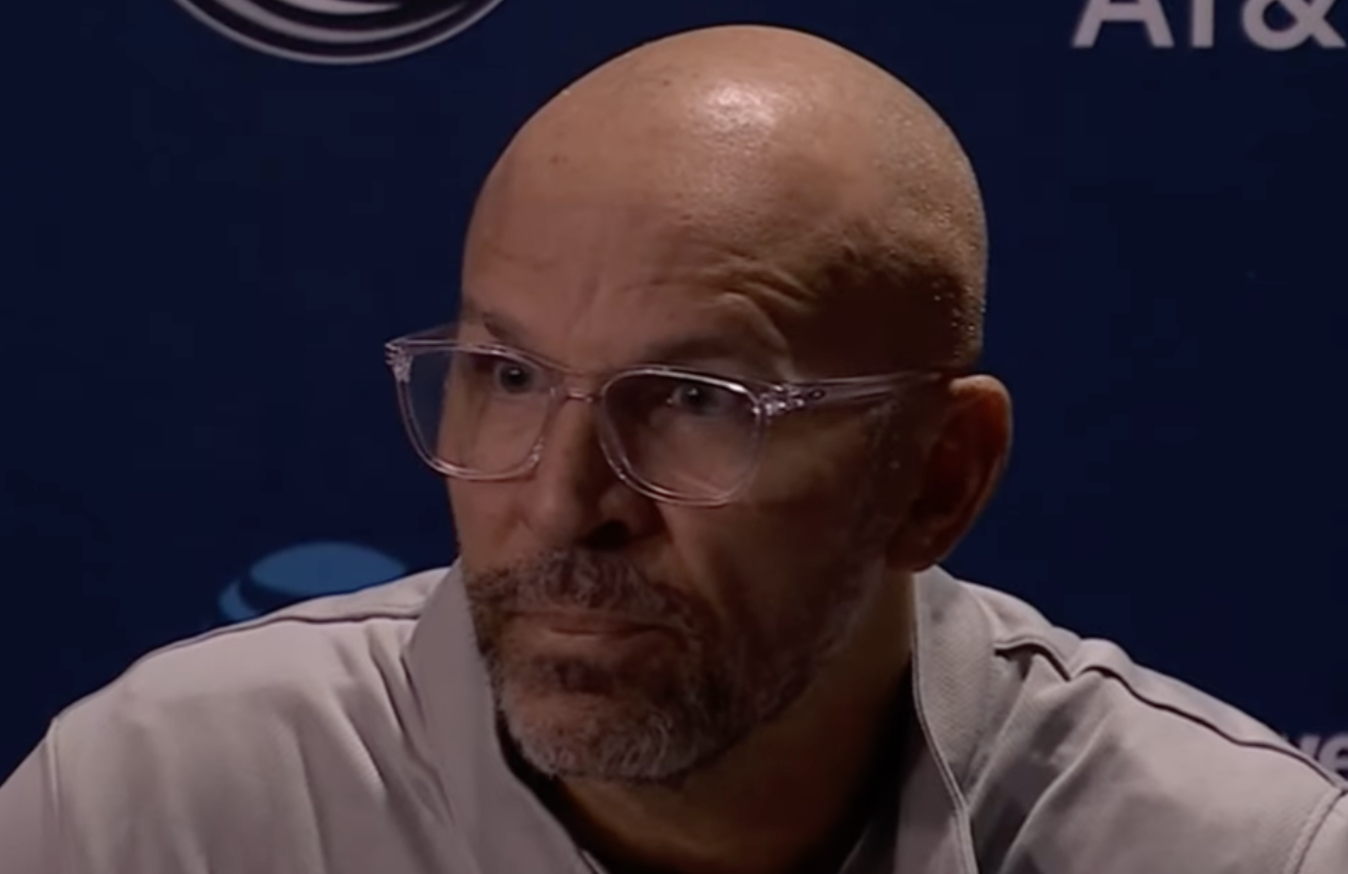
Jason Kidd is no longer the head coach of the Dallas Mavericks.
The team announced Tuesday evening May 19, 2026 that it was parting ways with Kidd in what it called a mutual decision, two weeks after new team president Masai Ujiri arrived in Dallas with a mandate to evaluate every aspect of the organization and a track record in Toronto and Denver of building winning programs on his own terms.
Kidd had four years and more than $40 million remaining on his contract.
He had a 205-205 record across five seasons in Dallas, a coaching tenure that included a run to the Western Conference Finals in 2022, a run to the NBA Finals in 2024, and a 26-56 disaster in 2025-26 that the Mavericks spent trying to rebuild from a trade nobody outside the organization had seen coming and that Kidd spent insisting he had nothing to do with.
“As we evaluate the future of our basketball program, we believe this is the right moment for a new direction for our team,” Ujiri said in the statement announcing the decision. “We have high expectations for this franchise and a responsibility to build a basketball organization capable of sustained championship contention.”
How Five Seasons With the Mavericks Led to This
Kidd arrived in Dallas before the 2021-22 season, taking over from Rick Carlisle who had left for the Indiana Pacers.
He inherited a roster built around Luka Doncic, then 22 years old and already one of the five best players in basketball, and Kristaps Porzingis, who was eventually moved. The first season produced a stunning run.
The Mavericks knocked off the favored Phoenix Suns in Game 7 on the road in the second round, then faced the Golden State Warriors in the Western Conference Finals, losing in five games. Golden State won the championship. Kidd had taken a Doncic-led team further than most expected.
The following season was a disappointment. The Mavericks had acquired Kyrie Irving at the trade deadline, but injuries to both Irving and Doncic limited what the combination could accomplish.
They missed the playoffs. Kidd’s seat was never exactly hot, Doncic’s presence was too stabilizing for any coach to be truly in danger, but the organization had not gotten what it hoped from the Irving acquisition.
2023-24 was the peak. Doncic and Irving healthy, healthy together, and producing at the level both were capable of.
The Mavericks reached the NBA Finals for the first time since Doncic was drafted.
They lost to the Boston Celtics in five games, but reaching the Finals with the franchise’s most important player since Dirk Nowitzki was still the kind of achievement that should have cemented Kidd’s standing.
Nine months later, general manager Nico Harrison sent Doncic to the Los Angeles Lakers for Anthony Davis.
The Trade That Ruined Everything
The Doncic trade is the event that the Mavericks organization is still trying to recover from, and it is the event that defines the context for everything that happened to Kidd afterward.
Harrison’s decision to trade the best player in franchise history for a player who spent the subsequent season injured, and who was then traded again to the Washington Wizards, was received by the Dallas fanbase with a fury that produced Harrison’s firing in November 2025.
Kidd’s role in the decision remains disputed and unresolved. He has maintained consistently that he was not informed of the trade until near the end, that he did not know Doncic was leaving until it was essentially done.
“The 11th hour” is the phrase he has used repeatedly. In early April 2026, minority owner Mark Cuban appeared on a podcast and said directly that Kidd was involved in the decision. Kidd doubled down on his denial.
The numbers under Kidd’s coaching make the Doncic question feel like more than a personnel dispute.
With Doncic in the lineup, the Mavericks went 136-87. Without Doncic, including the 2024-25 season after the trade and the entire 2025-26 season, they went 69-118.
That is two entirely different teams produced by the presence or absence of a single player, and it tells you everything about what Doncic meant to the system Kidd was running.
The 2025-26 season was the one that sealed his fate. Davis and Irving played together for approximately two and a half quarters before injuries separated them.
Davis was traded to Washington at the deadline in a deal designed to create financial flexibility for a rebuild centered on Cooper Flagg, the 2025 No. 1 pick who won Rookie of the Year.
Flagg played brilliantly. The Mavericks finished 26-56, a record that reflects what happens when an organization trades its franchise player, loses the acquisition to injury, and pivots to a full rebuild in the same season.
The Ujiri Factor And Why The Timing Was Inevitable
When the Mavericks hired Masai Ujiri as team president and governor on May 5, 2026, the question of what would happen to Kidd was the first question every reporter asked Ujiri at his introductory press conference. Ujiri declined to answer directly, saying he would evaluate all aspects of the franchise.
What Ujiri told reporters in the context of his own history was the more revealing comment. He noted that the coach in place typically lasted through his tenure when he arrived in Toronto and in Denver.
This time, he was starting fresh. The phrasing was careful enough not to be a definitive statement. It was revealing enough that everyone in the room understood.
Kidd had complicated the situation beyond the coaching question. After Harrison was fired in November 2025, Kidd had expressed a desire to be promoted to president of basketball operations, to move from the bench to the front office and take on the franchise-rebuilding role from a position of authority.
Mavericks governor Patrick Dumont informed him directly that he would not be considered for that role. Kidd was then kept out of the loop entirely in the search process that resulted in Ujiri’s hiring.
The combination, a coach whose record in the most recent season was 26-56, who had wanted a front office promotion that was denied, who had been excluded from the search that produced his new boss, and who had more than $40 million remaining on a contract that the organization was going to pay regardless of his coaching status, was not a combination that produced many possible outcomes beyond Tuesday’s announcement.
The Hall of Famer Who Went Back to His Roots
The specific weight of Tuesday’s announcement is not just organizational. Jason Kidd was drafted by the Dallas Mavericks in 1994 with the second overall pick.
He was part of the franchise’s first run to relevance in the mid-1990s before being traded to the Phoenix Suns.
He came back to Dallas at the end of his playing career and won the only championship in franchise history as a player in 2011, the championship that ended Dirk Nowitzki’s era of near-misses and gave Dallas its defining moment as a basketball city.
His Hall of Fame induction as a player reflects a career that is genuinely one of the great point guard careers in NBA history.
As a coach, the record is different, 388 wins and 395 losses across parts of nine seasons in Brooklyn, Milwaukee, and Dallas. The winning seasons were with Doncic. The losing seasons were without him.
He is 53 years old. He has $40 million coming from the Mavericks whether he coaches anywhere or not.
The next chapter of his career, whether he coaches elsewhere, joins another organization in a front office capacity, or steps away from the game, begins with a franchise in need of rebuilding around the 19-year-old Rookie of the Year whose best years are ahead of him, looking for the coach who can help Cooper Flagg become what Doncic once was for this city.