
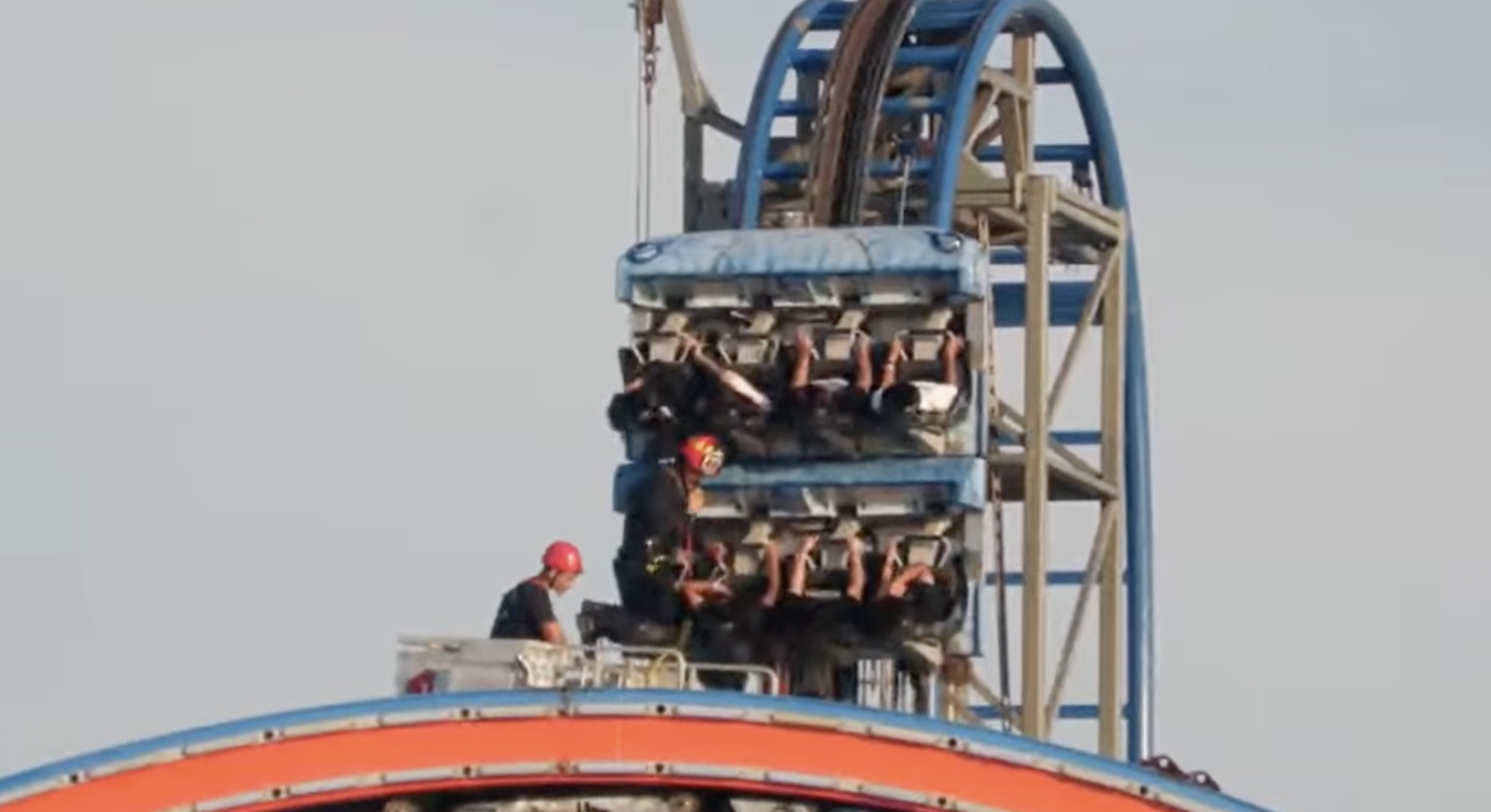
Eight middle and high school students spent approximately four hours stranded near the top of a roller coaster 100 feet above the Gulf of Mexico on Thursday evening before Galveston firefighters rescued them one by one using a ladder truck and safety harnesses.
All eight students were brought down safely. Nobody was hurt.
The roller coaster is the Iron Shark at Galveston Island’s Pleasure Pier, a steel coaster that climbs a 100-foot vertical lift hill before sending riders through four inversions at 52 miles per hour.
When the ride malfunctioned and stopped on Thursday evening, it stopped at the worst possible location, near the top of the vertical lift, with eight students in a single train car facing straight up toward the sky and with nothing but the pier, the beach and the Gulf of Mexico visible below them.
The ride stopped at 5:21 PM. Pleasure Pier called the Galveston Fire Department.
The fire department received the call at 5:37. Six firefighters responded with a tower truck and began the deliberate, patient process of removing each student individually, each one placed in a safety harness, each one brought down the ladder separately, the process repeated eight times until the roller coaster car was empty. The operation took three to four hours to complete.
“Those guys were top notch today on point and got all eight down,” said Galveston Fire Chief Mike Varela Jr. “I can’t say enough about them. They’re well trained and they’re ready to go when called on.”
Houston news stations including KHOU livestreamed the rescue from the air and from the pier as it happened, which is how it ended up trending across social media Thursday night and into Friday morning, eight kids in harnesses being lowered from a roller coaster over the Gulf of Mexico, one at a time, with a TV camera on them the entire way down.
The Students And The Field Trip
The eight students who spent Thursday evening hanging above the Gulf were on a field trip organized by two Houston ISD charter schools, Energized for STEM Academy Middle School and Energized for STEM Academy High School.
The trip was the kind of end-of-year reward that students anticipate for months: a day at a Gulf Coast amusement park, a break from academic work, a chance to spend time with classmates outside the classroom.
The Iron Shark is the signature ride at Pleasure Pier, the tallest on the pier, the fastest, the one that the promotional material emphasizes.
It is the ride that most people head to first when they arrive at the park. For a group of middle and high school students on a field trip, it would be the obvious first choice.
The ride stopped on the ascent. The car was near the top of the 100-foot vertical lift hill, the section of the track where the chain pulls the car upward before the car crests the peak and begins the descent and the first inversion.
Stopping at that point leaves the car and everyone in it tilted backward and upward, facing the sky rather than the horizon, held in place by the lap restraints that keep riders in their seats during the ride’s inversions.
That position, 100 feet up, facing skyward, in a car that is not moving, is the position the eight students held for the next three to four hours while the rescue proceeded below them.
Houston ISD’s statement confirmed that all students, staff and chaperones were safe and that school administration had been in contact with every family. The schools did not identify any of the students by name.
How The Rescue Worked
Galveston Fire Chief Varela provided details about both the rescue operation and the foresight that made it possible.
The six-member rescue crew deployed a tower truck, a fire engine with an extendable aerial ladder, to reach the students at height.
Because each student needed to be individually placed in a safety harness and individually lowered down the ladder, the process was sequential and time-consuming by necessity.
The specific challenge of reaching the Iron Shark is that it sits at the far end of Galveston’s Pleasure Pier, a structure that extends 1,130 feet into the Gulf of Mexico.
Getting heavy rescue equipment to the far end of the pier requires navigating the pier’s internal access routes, which are not designed for large vehicles.
Varela’s account revealed that this specific scenario had been anticipated. “We knew one day we may have to get to the back of this pier,” he said, “and they went ahead and they reinforced that middle layer, that street basically, so we can go down around the carousel. It was designed strictly for us to get equipment back there.”
The deliberate planning that went into the pier’s rescue infrastructure, a strengthened access route specifically designed so that fire equipment could reach the Iron Shark in exactly the scenario that happened Thursday, is the kind of operational preparation that most people never know about until the day it matters.
It mattered on Thursday. The tower truck reached the ride. The crew got to work. Each student came down.
How Did The Iron Shark’s Safety System Perform?
The Iron Shark malfunctioned on Thursday. But the part of the roller coaster that mattered most, the safety system, performed exactly as it was supposed to.
When the ride stopped, it stopped without catastrophic failure. The car held position. The restraints held.
Eight students remained secured in their seats for the duration of a three-to-four hour wait without anyone falling, slipping or being injured by the malfunction itself.
Landry’s Inc., the company that owns Pleasure Pier, addressed this directly in its statement. “The ride experienced a malfunction but stopped as it was designed to do in a situation like this,” the company said. “Our focus immediately shifted to the safety of our guests. Therefore, we contacted the Fire Department to assist, ensuring all guests were safely removed from the ride.”
The distinction matters. A roller coaster malfunction can take many forms, from the catastrophic, in which a ride fails in ways that injure or kill riders, to the inconvenient, in which a ride stops safely and waits for rescue.
The Iron Shark’s malfunction on Thursday was the second kind. Whatever caused the ride to stop did not compromise the car’s structural integrity or the restraints that held eight students 100 feet above the Gulf for hours.
Landry’s confirmed that a thorough inspection of the ride will take place before it is returned to service. The cause of the malfunction has not been announced.
What Is Pleasure Pier?
The Pleasure Pier that hosted Thursday’s drama sits on Galveston Island, the barrier island city on the Texas Gulf Coast that is most familiar to Houston-area residents as the nearest beach destination, about an hour’s drive from downtown.
The pier’s history stretches to the 1940s, when it was originally built as a recreational facility for the United States military during World War II before being transformed into the Galveston Pleasure Pier.
The Iron Shark, the ride at the center of Thursday’s rescue, opened in June 2012 as part of a major redevelopment of the pier.
It is a Gerstlauer Euro-Fighter coaster, a model designed specifically for tight footprint installations where a compact but intense ride experience is the goal.
The 100-foot lift hill, four inversions and 52-mile-per-hour top speed pack significant coaster experience into 1,246 feet of track with a one-minute ride duration.
Eight riders per train. Four across, two rows. On Thursday, one full train worth of students, exactly the capacity of the car, spent Memorial Day weekend eve stranded at the top of that lift hill, watching the Gulf of Mexico below them and waiting for the firefighters who had trained for exactly this moment.
They all came down safely. The pier is closed pending inspection. The field trip ended a few hours later than planned.