
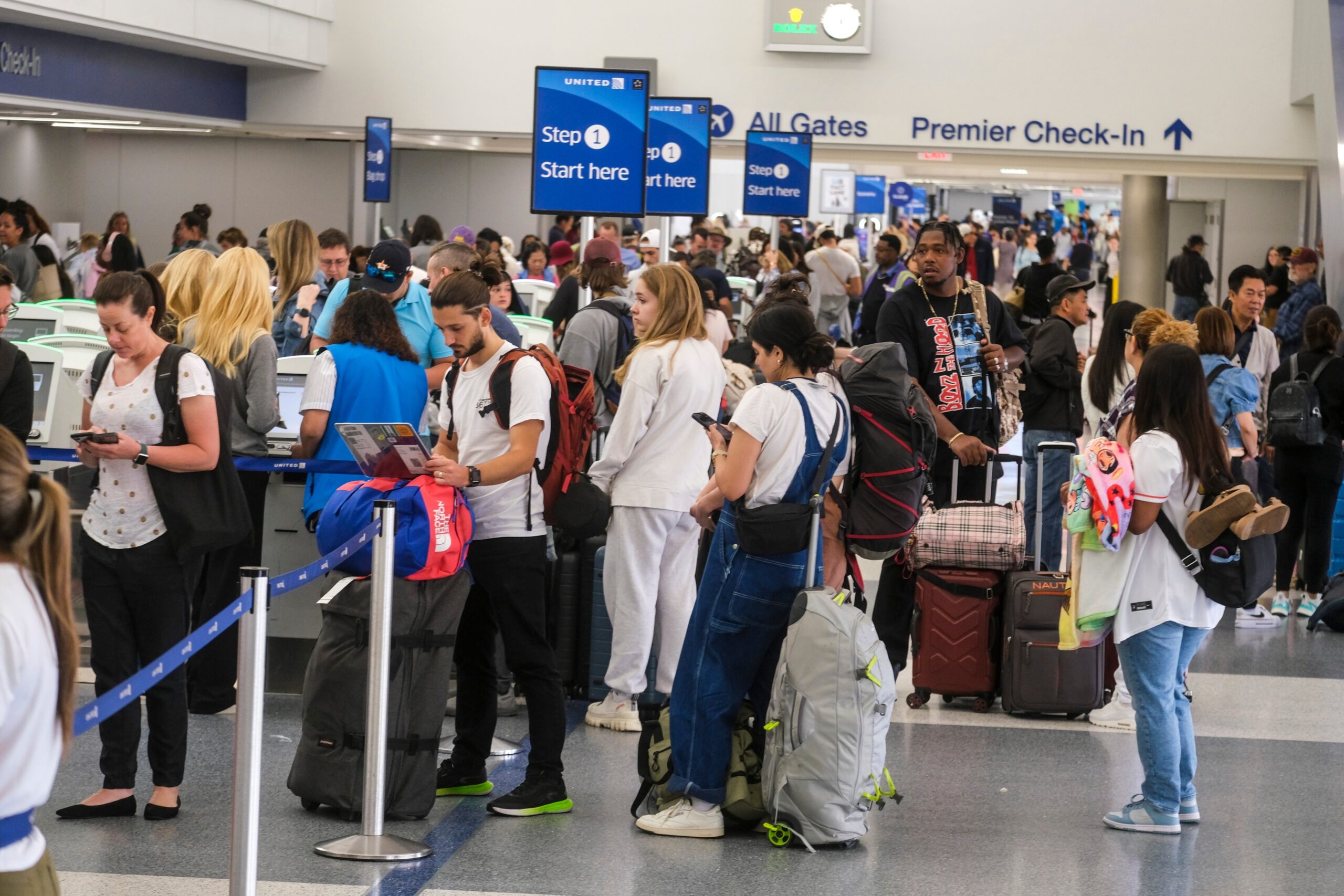
If you are flying anywhere in the United States right now, plan to arrive at least four hours early.
That is not a suggestion from a cautious travel blogger. It is the operational reality at several major American airports, and on Wednesday it became official testimony before Congress.
TSA Deputy Administrator Ha Nguyen McNeill told the House Homeland Security Committee that the Transportation Security Administration is experiencing the longest wait times in its 24-year history.
Wait times at some major airports have exceeded four and a half hours. Callout rates among TSA officers at those airports have reached between 40% and 50%.
The TSA’s average callout rate before the shutdown began was around 4%.
“This level of disruption is unprecedented, and unacceptable, and significantly undermines the security of U.S. transportation systems,” McNeill told the committee.
The cause is a partial government shutdown that has now stretched to 40 days, with no resolution in sight before lawmakers leave for a two-week recess on Friday.
Why Is This Happening?
Department of Homeland Security funding lapsed on February 14 after Congress and the White House failed to agree on a spending package. TSA falls under DHS.
Because TSA officers are classified as essential workers, they are legally required to report to work, but the funding lapse means they have been doing so without pay.
They missed their first full paycheck in mid-March, with the previous one, covering the first days of the shutdown, amounting to $4.27 for at least one Las Vegas officer.
If the shutdown continues into Friday as expected, the TSA will have missed nearly $1 billion in combined paychecks since February 14.
The financial pressure on the agency’s roughly 61,000 officers has cascaded into an operational crisis.
Callouts have spiked across the country because officers simply cannot afford to get to work. Some have reported sleeping in their cars at airports to save gas money.
Others are selling their blood and plasma to cover basic expenses. Denver International Airport earlier this month put out a public request for TSA agents to receive donations of grocery and gas station gift cards.
Officers have received eviction notices. Their utilities have been shut off.
“Some are sleeping in their cars at airports to save gas money, selling their blood and plasma, and taking on second and third jobs to make ends meet, all while expected to perform at the highest level when in uniform to protect the traveling public,” McNeill said in her congressional testimony Wednesday.
More than 480 TSA officers have quit outright since the shutdown began.
Each resignation creates a staffing hole that cannot be quickly filled, McNeill told the committee it takes four to six months to train a new TSA officer to work checkpoints.
The ICE Deployment And Why It Is Controversial
On March 23, President Trump dispatched Immigration and Customs Enforcement agents to 14 major airports to help manage the crisis.
Those airports include JFK, LaGuardia, Newark, Atlanta’s Hartsfield-Jackson, Chicago O’Hare, Houston Hobby, Philadelphia, Phoenix Sky Harbor, Pittsburgh, Cleveland Hopkins, New Orleans, and others.
White House border czar Tom Homan said ICE agents would help move lines along, guard exit doors, check travel documents, and free up TSA officers for critical screening work.
The deployment immediately sparked a political firefight. Senate Minority Leader Chuck Schumer called the move dangerous, “Untrained ICE agents lurking at our airports is asking for trouble. And it will make the chaos at our airports worse.”
Democratic Rep. Shri Thanedar of Michigan said he has observed ICE agents at Detroit Metro Airport sitting on their phones and chatting rather than providing meaningful assistance.
TSA union officials were even blunter. Hydrick Thomas, president of AFGE TSA Council 100, said ICE has no training in airport security screening and no familiarity with airport layouts.
“There’s no way ICE can guarantee safety for the passengers. All ICE is doing is getting in the way of the passengers,” he said.
AFGE national president Everett Kelly put it this way, “That’s like giving a person dying of pneumonia a teaspoon of cough syrup, it doesn’t address the problem and it’s not going to work.”
McNeill took a different position in her testimony, thanking the president for the deployment and saying ICE personnel had been helping to manage lines, check IDs, and assist with crowd control after receiving condensed training earlier in the week.
White House press secretary Karoline Leavitt said wait times had improved since ICE arrived at the 14 airports, though independent verification of that claim has been limited.
ICE agents cannot operate X-ray machines or perform specialized security screening, those tasks still require trained TSA personnel.
The Political Standoff Behind The Shutdown
The DHS shutdown is the result of a congressional impasse over funding for Immigration and Customs Enforcement.
Both parties agreed to fund the rest of the federal government, but DHS funding, which covers TSA, ICE, the Coast Guard, FEMA, and other agencies, remains in dispute.
Democrats have demanded policy reforms for ICE as a condition of funding, citing the fatal shooting of two U.S. citizens by federal immigration officers in Minneapolis in January.
Their demands include requiring ICE officers to wear body cameras and banning the use of masks during operations.
Republicans have framed the standoff as Democrats refusing to fund border enforcement and national security.
House Speaker Mike Johnson has said Democrats are deliberately holding TSA officers’ paychecks hostage.
Crucially, ICE continues to receive its paycheck throughout this shutdown. That is because Trump’s 2025 One Big Beautiful Bill Act allocated approximately $75 billion directly to ICE over four years, independent of the annual appropriations process that covers TSA.
The result is that immigration enforcement officers are paid while airport security officers are selling their blood.
When Will Things Go Back To Normal?
No significant deal was in place as of Wednesday. Lawmakers are set to leave Washington for a two-week recess on Friday, meaning any resolution is unlikely before early April at the earliest.
Even after a funding deal passes, full TSA staffing would not return immediately, the agency’s experience from the most recent prior shutdown showed it took officers 14 to 30 days to receive their back pay, and TSA warned the attrition from this shutdown will take months to recover from through new hiring and training.
McNeill raised a specific forward-looking concern that gives this situation a hard deadline, the FIFA World Cup begins across the United States in June 2026.
TSA is anticipating between 6 million and 10 million additional passengers for the tournament.
Given that new hires take four to six months to train, officers hired today would not be ready in time.
If the shutdown continues much longer, the country faces the prospect of record tourist volumes arriving at airports already operating at critically reduced staffing levels.
For travelers flying now, several airports, including JFK, LaGuardia, Atlanta, and Newark, have suspended their public-facing security wait time displays, telling passengers only that wait times “may be significantly longer than normal.”
Several airports have advised arriving four hours before departure for domestic flights.
The shutdown is on day 40. The recess starts Friday. The lines are not getting shorter.